The UK Ministry of Defence (MoD) has contracted MBDA UK to deliver two DragonFire laser-based directed energy weapon (DEW) fits for the UK Royal Navy (RN). In a significant milestone in the UK’s development of this capability, the contract follows successful completion of the latest system testing.
Award of the GBP316 million contract follows the UK Strategic Defence Review (SDR), published in June 2025, directing the UK to pursue DEW systems “such as … DragonFire, which have the potential to reduce collateral damage and reliance on expensive ammunition”. DEW capabilities create low-cost and sustainable alternatives to missiles, SDR added.
Announcing the contract on 20 November, Luke Pollard – Minister for Defence Readiness and Industry – said “This high-power laser will see the RN at the leading edge of innovation in NATO, delivering a cutting-edge capability to help defend the UK and our allies in this new era of threat.”
Speaking at MBDA UK’s Stevenage site, Minister Pollard said DragonFire’s development “is an opportunity to have a mix of capabilities to protect our warships in more dangerous times.” “DragonFire doesn’t replace missiles: it’s complementary to missiles; it provides a low-cost ability to defeat threats to those ships,” the minister added.
The threat posed to ships at sea is not just a lesson emerging from Black Sea activities in the Russo-Ukraine war. From late 2023 and well into 2024, an international collection of naval ships deployed to the Red Sea to deter and defend against ballistic and cruise missile, and uncrewed aerial vehicle (UAV) and uncrewed surface vessel, attacks against commercial and naval ships sailing in the southern Red Sea/Bab-al-Mandeb/Gulf of Aden corridor. Several RN surface ships, including the Type 45 destroyer HMS Diamond, contributed extensively to the campaign, often using missiles to defend themselves and other shipping.
“It’s this type of capability [DEW] that will provide low-cost options to the RN … to change the balance of threats when we’re currently using missiles that may cost millions of pounds to defeat drones which may cost a few thousand,” Pollard explained.
Talking to media, the minister said “The threat we’re going after is the changing nature of warfare.” Threats to warships include not just anti-ship missiles, but low-cost drones that can be deployed in numbers, including in swarms, and potentially deplete a ship’s defensive missile inventory. “Then the risk is that the ships won’t be able to defend themselves against higher-end threats, or even more low-end threats,” Pollard added.
While the RN has invested in high-end anti-air and anti-ship missiles, the Red Sea experience underlined the cost-effectiveness challenge of tackling UAVs with such systems. “Effectively, the economics of that engagement fall from favouring us, in terms of having the best technology that defeats poorer technology, to adversaries being able to afford more threats against us than we can afford to defend,” said Pollard.
Adding DEW capability like DragonFire provides another layer in a ship’s air-defence mix between high-end missiles and close-in weapons systems that gives the commanding officer more choice in what capability to use against what threat, the minister explained, adding that this particular layer of capability has specific relevance against the drone threat.
Lessons and trials
The drone threat has emerged in and from war in Ukraine. “There are many lessons you can take from Ukraine, but the ones we’re particularly looking at are how do we make sure – in an environment that has such a fast pace of change, with drones needing to be iterated every two to three weeks to remain relevant – that the systems we are fielding have the ability to be spiral developed, and don’t take years to procure and when they come online are outpaced by our adversaries,” said Pollard. “That’s why, in addition to what we are buying, how we are buying it [is] as important.”
Accelerating DragonFire procurement, with the first Type 45 fit set for 2027, will deliver the capability five years ahead of the programme’s original planning timeline. “It is precisely that type of pace we need to have, as we’re facing a new era of threat,” the minister said.
The programme got underway in 2017. With the technology focused initially on tracking the target, identifying the aimpoint, and holding the laser precisely on that point, the first trial took place in 2021 and tackled the tracking element using a low-power laser. A high-power laser was tested in 2022, including in below-the-horizon firings. Above-the-horizon firing was tested in 2023.
Trials at Porton Down earlier in 2025 encompassed detecting and tracking large numbers of smaller UAV targets, including drones conducting high-speed manoeuvring.
The most recent trials, which took place in October 2025 on the UK’s Hebrides testing range, involved successful use of DragonFire against larger UAV targets, including some able to travel at 650 km/h. These tests comprised (for the first time) tracking, targeting, and shooting down such drones in above-the-horizon tactical contexts.
Ship fit
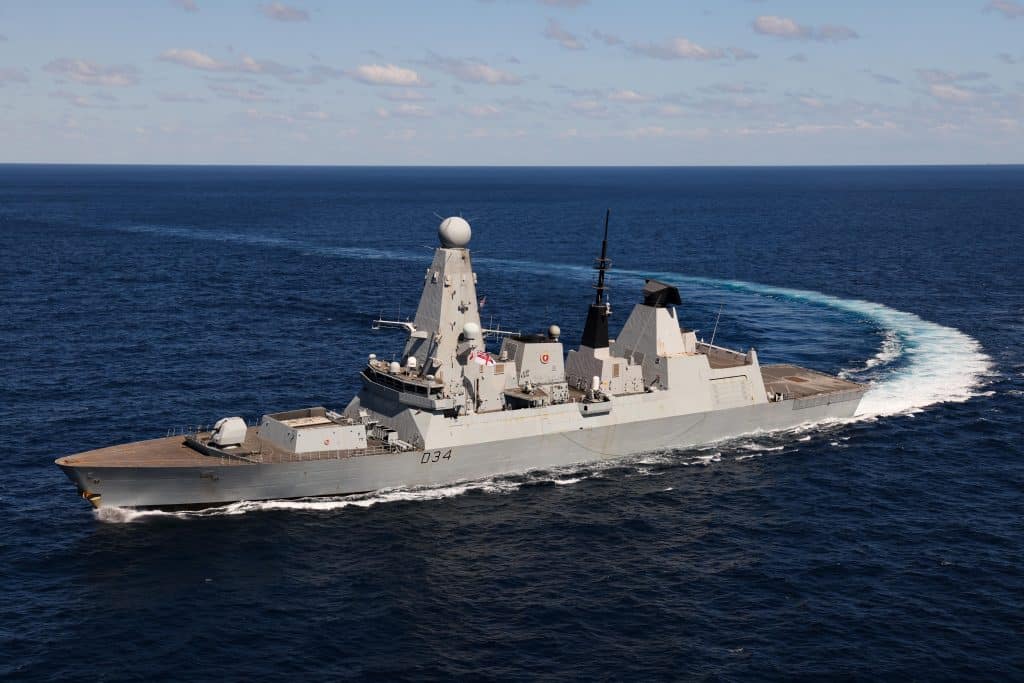
Pollard also confirmed the government’s commitment to two further ship fits.
The four fits will involve DragonFire units modified for onboard use including with a reduced footprint, but with improved capability through adding more advanced technology into the design, Julia Warren, MBDA Chief Engineer, told a media briefing. This will include reducing system size from a 40 ft container space to a 20 ft footprint to enable platform installation. “It’s about putting more effort into the detail design to make sure we can be really efficient with the use of space … to be able to get the best equipment into that more limited footprint,” said Warren.
Another area of focus is improving system automation, to enable DragonFire to be controlled by one RN operator in the ship’s operations room. “When there’s an engagement in an operational scenario, there’s a lot going on in a warship’s ops room. So, it’s really important that we can fit seamlessly into that environment and that a single operator can control the system,” Warren explained.
DragonFire will be integrated into the ship’s combat management system to allow it to contribute fully to the layered air-defence capability. In this process, “It’s really about understanding the procedures the RN has,” Warren added. “When they’re working in the ops room, they’re used to missiles and gunnery and have certain procedures they use to control firings …. We need to design the system so that – whilst it’s a different weapon and novel technology – the procedures used are familiar.”
A final focus area is enhancing system robustness for shipborne operation.
Delivered by an industry partnership involving MBDA, Leonardo, and QinetiQ, DragonFire is – according to an MoD statement – one of the most advanced DEW programmes in NATO, and the first high-power laser capability entering service from a European country. BAE Systems will support the programme through detail design for system integration onboard the Type 45s.