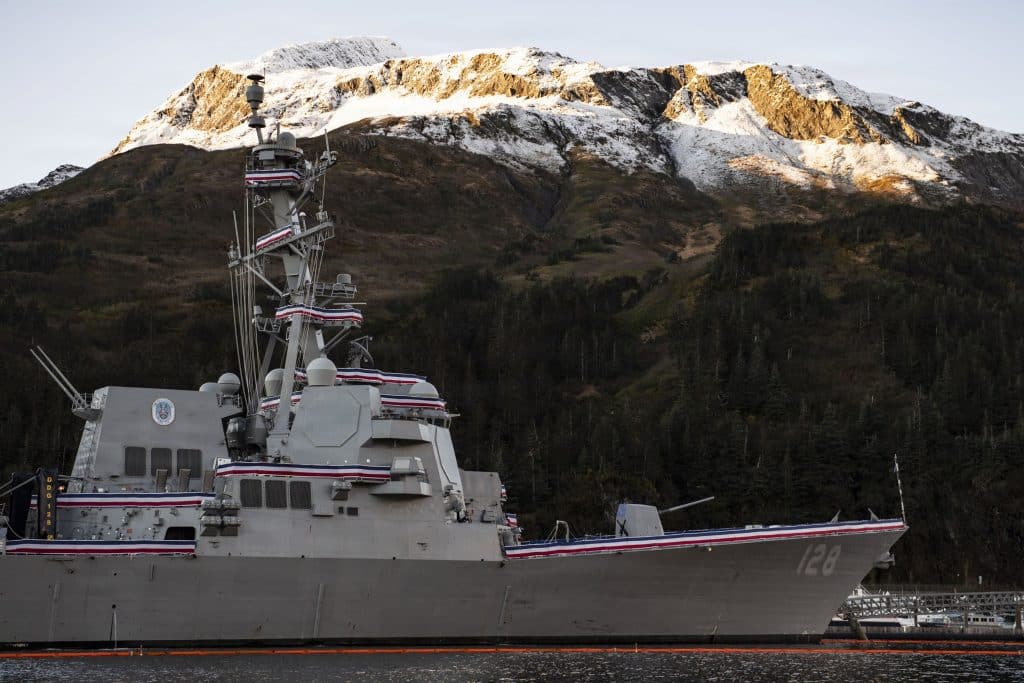
In early November, the French Navy’s Modernised Tripartite/Éridan-class minehunter arrived in the Baltic region for a two-month deployment, joining NATO Allied Maritime Command’s (MARCOM’s) Standing NATO Mine Counter Measures Group 1 (SNMCMG1). The group is MARCOM’s Northern European-focused mine countermeasures (MCM) force. Since Sagittaire arrived, SNMCMG1 has participated in the Finnish Navy-led, multinational ‘Freezing Winds’ exercise.
The Baltic’s strategic geography makes it a prime location for naval mine warfare (NMW) activities. Consequently, SNMCMG1 spends much time there, despite MARCOM’s area of operations for its two northern standing naval forces (the other being the escort ship-based Standing NATO Maritime Group 1) covering an area from the eastern Atlantic, to the eastern Baltic, and up into the High North.
France’s latest deployment of a ship to the Baltic is providing an opportunity to demonstrate the utility of the navy’s ‘manned/unmanned’ platforms mix in conducting NMW. In what is today termed a ‘hybrid’ approach, this mix mirrors the methods emerging in other NATO navies’ NMW capability developments.
Sagittaire’s MCM activities are also demonstrating a blend of established and emerging MCM conceptual approaches.
The ship’s MCM capabilities include: one DUBM 21E (TSM 2022 Mk III) hull-mounted sonar; two ECA PAP (Poisson Autopropulsé) 104 Mod 4 remotely operated vehicles (ROVs); and a team of explosive ordnance reconnaissance/disposal (EOR/D) divers. The diving team can also use its own portable, propeller-driven underwater vehicle that brings integrated sonar, GPS, and ECDIS capabilities to support diver minehunting activities.
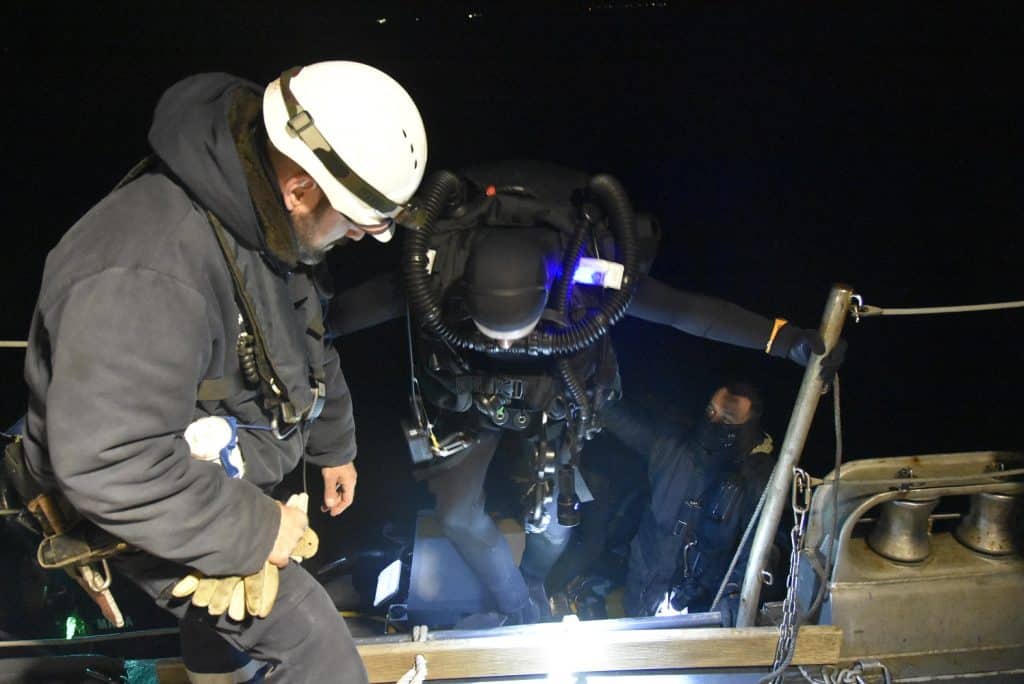
(Credit: French Navy)
Minehunting accuracy is enhanced by dynamic but precision positioning provided by Sagittaire’s power and propulsion set-up, plus an autopilot system that enables the vessel to stay fixed on a GPS point. The ship’s layout is designed to improve sound quieting: for example, the engine producing ship power is positioned one deck above the main machinery to reduce noise. The crew of 50 officers and sailors includes around a dozen NMW specialists, plus the diving team.
“The Tripartite minehunter is a good product: it works very well,” Commander Arnauld Boutroux, Sagittaire’s commanding officer (CO), told Naval News, in an onboard interview during ‘Freezing Winds’.
The navy’s future NMW capability development plans include procuring new MCM ‘mothership’-style manned vessels, under the Batiments de Guerre des Mines (BGDM) requirement, alongside delivering the unmanned platform-based système de lutte anti-mines futur (SLAM-F) programme. SLAM-F’s operational concept is based on using unmanned surface vessels (USVs) deploying either sonar systems or ROVs: the navy received its first SLAM-F capability packages in December 2024.
Sagittaire’s Baltic operations have shown that combined, ‘manned/unmanned’, MCM concepts work well in practice.
“First, we have sonar. With sonar, we can detect if something looks like a mine,” said Cdr Boutroux. “Next, we have two ways of identification: we send the PAP, with its black/white camera, to see if what we saw with the sonar is a mine; or we can ask the divers to go and see what it is.”
“Once you have identified the mine, you may have to explode it. Again, there are two ways: the PAP can put a load on the mine; or we can ask the divers to do it, depending on the mine type, and its depth,” Cdr Boutroux added.
The CO highlighted the PAP’s capabilities. He described it as a robust vehicle, deployed from the aft deck via the ship’s crane, operated via fibre-optic cable that also connects the ROV’s black/white camera, and able to deploy loads to the seabed. “We can conduct detection sometimes with more accuracy than other countries who operate very modern ROVs.”

Learning lessons
Sagittaire’s Baltic deployment is enabling the navy to learn various lessons emerging in contemporary NMW operations and activities, including in ‘Freezing Winds’.
“The types of mines are quite different,” said Cdr Boutroux. This brings the need to understand the explosive loads they carry, he added.
The French Navy is mostly used to finding World War Two-era ‘mine-like objects’ (MILOs) off its own coast. For ‘Freezing Winds’, different MILOs presented new challenges. Moreover, some mines on the Baltic seabed could have come from non-NATO actors’ activities.
During ‘Freezing Winds’, Sagittaire also was tasked to conduct live, ‘real-world’, operational minehunting, undertaking an MCM-standard grid-pattern area search with its hull-mounted sonar, finding a MILO, and then deploying the PAP and a pair of divers, who verified the object as an old exercise mine.
Cdr Boutroux added that the Baltic’s underwater conditions, including water colder and more turbulent than French coastal waters, different salinity, and siltier surroundings (due to the shallower, sandier seabed), present challenges for sonar and diver operations. The diving teams, and the PAPs, are used for environmental assessment to inform sonar optimisation.
Co-operation, including through communications, has been another learning point. The navy does not yet have the capacity to integrate its ROVs with vehicles deployed by other task group ships. Minehunting collaboration between ships is conducted instead by, for example, allocating sectors between them or sharing target data via formatted reports. On the latter point, Cdr Boutroux said “Depending on what the task group commander wants, perhaps every six hours we send a report, in a particular format, saying what we have discovered.”
As an MCM vessel CO, Cdr Boutroux said areas of future capability development he would be interested in seeing are capacity for NATO MCM ships to share integrated NMW pictures, and communication between different ships’ ROVs.
“Because we are minehunters, we are quite limited in communications. We see that frigates are very communications-capable platforms, with Link 22 etcetera,” said Cdr Boutroux. “We have very few systems. For example, we can’t share the whole picture between the minehunters.” Instead, the picture is developed manually onboard.
Noting the good progress the navy is making in improving integrated shipborne communications – as demonstrated in its new Amiral Ronarc’h-class FDI frigates – Cdr Boutroux said “I think the navy is quite focused on sharing the picture. It’s important in every warfare area. For surface warfare, it’s a huge thing.”
“Today, in mine warfare, it’s very important,” the CO added. “We’ve got more time to act when we’ve got a comprehensive picture.”
Naval News Comment
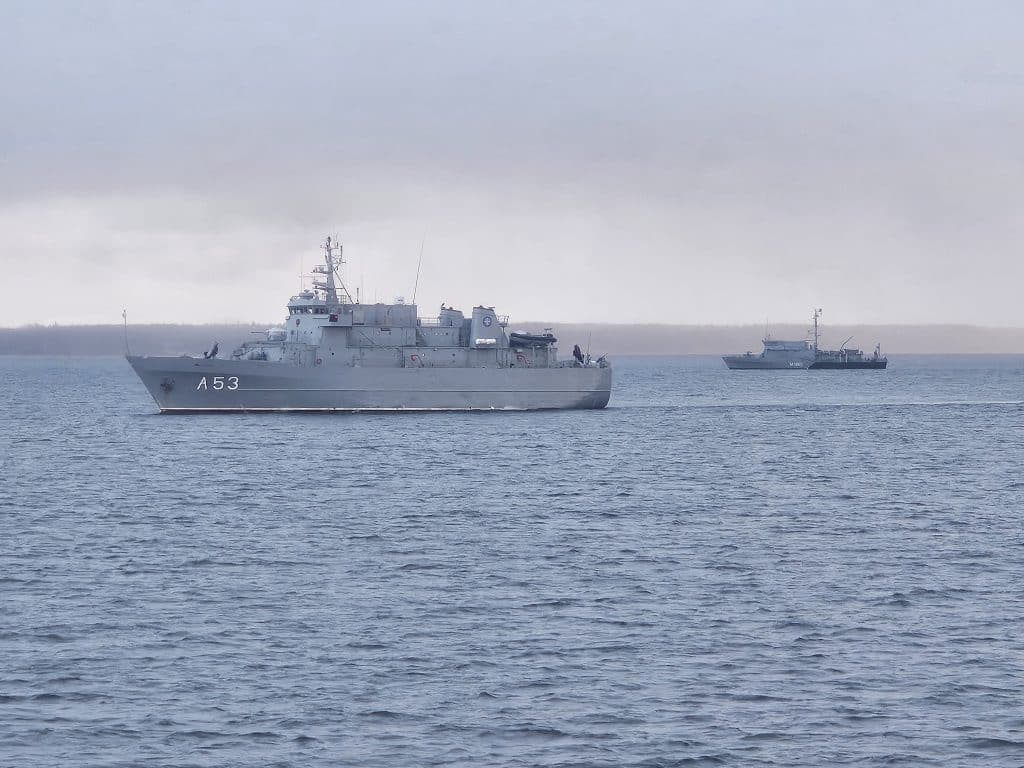
MCM is a very specific capability requirement in modern naval warfare, so may require specialised capability for both platform and effector.
Moreover, in contemporary naval operations in waters like the Baltic, the mine threat and consequent MCM requirement could be strategically significant.
The Baltic region’s maritime geography includes chokepoints in its approaches, archipelagic littorals in shallow seas in its southern region, strategically important islands throughout, and key NATO ports ranging from Copenhagen in Denmark, Kiel and Rostock in Germany, and Gothenburg and Stockholm in Sweden, across to Gdansk in Poland, Klaipeda in Lithuania, and Hanko in Finland. Such geography lends itself to significant opportunities for defensive and offensive mining.
If the current Euro-Atlantic security contest between NATO and Russia escalated into crisis or conflict relating to the Baltic States, for example, NATO shipping would need to move materiel and personnel through the Skagerrak/Kattegat Straits and across the Baltic to its ‘eastern front’, stopping at points along the way between Hamburg and Gdansk.