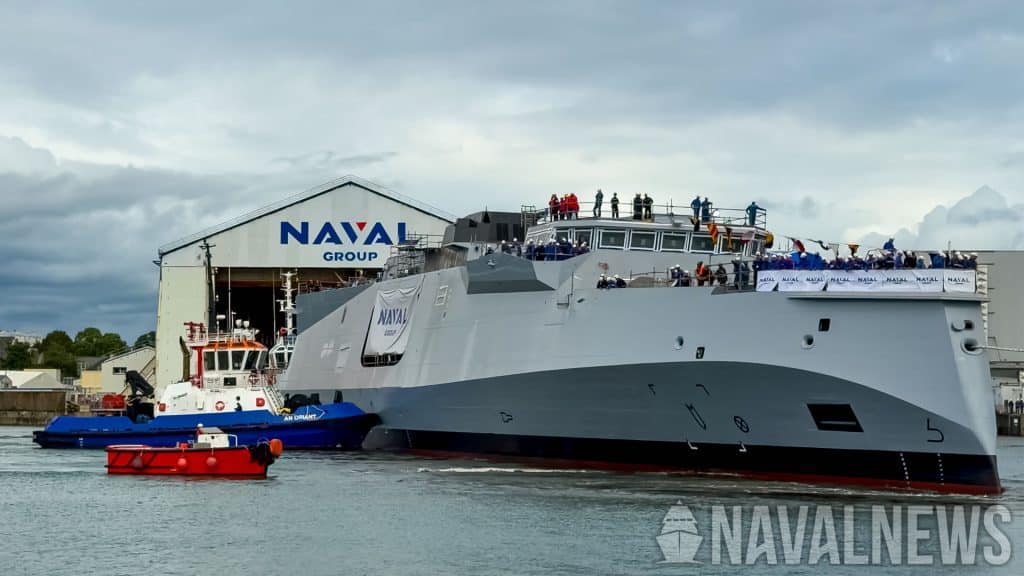
French shipbuilder Naval Group on May 16 conducted the “technical launch” of the second FDI frigate for the French Navy, Amiral Louzeau (D661). A Naval News cameraman was on site to document this major milestone for the program. The official launch ceremony, attended by French government and naval officials, is scheduled to take place tomorrow, May 19, 2026.
On the afternoon of May 16, tugboats from the Port of Lorient moved the hull of the future French Navy frigate Amiral Louzeau (D661) from Naval Group’s covered construction dock to the nearby outfitting quay on the western bank of the Scorff River. The vessel is now in place for the official launch ceremony of France’s second Amiral Ronarc’h-class (FDI) frigate, scheduled for Tuesday, May 19.
As part of this key milestone, the ship will receive its the final structural component, the integrated mast, the PSIM (Panoramic Sensors and Intelligence Module). This mast, along with the inverted bow, is a key characteristic of the FDI design. Standing 42 meters tall and weighing around 150 tons, the PSIM is assembled and fully tested independently before being installed on the frigate.

The Naval Group’s innovative mast is a separate module, manufactured independently of the hull and well in advance of sea trials. The integrated steel mast, incorporates the ship’s Command Information Center (CIC) with the latest version of the SETIS Combat Management System (CMS), a planning room for mission command staff during flagship operations, and one of the two digital data processing centers (the other is located aft in the hull for survivability).
The mast also houses the majority of the ship’s above-water sensors (SEAFIRE MFR, BLUEGATE IFF, PASE XLR EO-FCS, SENTINEL R-ESM, ALTESSE-H C-ESM & COMINT, TV & IR surveillance system, navigation and surveillance radars, communication antennas, etc.) providing continuous 360° surveillance.
The PSIM extends over several decks. Specifically, on Deck 5, there are the SEAFIRE radar arrays, which can be accessed by the crew if maintenance work on the system is required. On Deck 4 is the Data Center. On Deck 3, there is the planning and briefing room, while on Deck 2 is the CIC.
Increased firepower for French FDI frigates
As previously reported by Naval News, the first two FDI frigates will initially enter service equipped with 16-cell VLS arranged in two SYLVER A50 8-cell modules for the MBDA ASTER 15 and ASTER 30 surface-to-air missiles. The third ship will receive an upgrade to a 32-cell VLS configuration before entering operational service, while the final two frigates will be delivered from the outset with the full 32-cell arrangement. The first pair will subsequently be upgraded during first major overhaul, significantly enhancing the class’s overall firepower and air-defense capacity.
Importantly, the upgrade does not require any structural modifications, as the integration of additional vertical launch cells had already been anticipated in the original ship design. Greece has selected this expanded VLS configuration for its own Kimon-class (FDI HN) frigates, alongside the addition of a 21-cell RAM launcher and further survivability enhancements, including a comprehensive suite of decoy launching systems.
FDI Frigate: Fast production pace
Boasting an array of state-of-the-art sensors and weapons capable of facilitating a wide spectrum of modern naval operations, the 122-meter FDI unquestionably is one of the most powerful surface combatants in its class and one of the most sophisticated designs on a global scale. Bringing together the best of naval technologies on a compact platform, the 4,550-ton FDI is a powerful, multipurpose, fully digital and innovative frigate with the highest degrees of automation and control, designed to meet the evolution of threats.
The launch also marks another significant industrial success for Naval Group. The company has now succesfully launched five FDI frigates on schedule, three destined for Greece and two for France, out of a total of nine ships currently on order. Two ships have already been delivered (Amiral Ronarc’h, Kimon), while a third (Nearchos) is expected to follow in the coming months. Five FDI frigates are currently under construction simultaneously.
This performance stands in sharp contrast to several comparable naval programs worldwide, many of which continue to face major delays, budget overruns, restructuring, or even cancellation (Constellation-class for instance).
Check out Naval News’ recent video coverage highlighting the fast production pace of the FDI: