HII has announced the expansion of its Portchester, UK facility to augment its footprint in the UK and Europe for delivering and supporting maritime capabilities including uncrewed systems.
The Portchester development will enable HII – a US-headquartered naval crewed and uncrewed platforms and capabilities provider – to engage European countries more closely, especially the UK and the Royal Navy (RN), whose primary base is nearby at Portsmouth. The RN is transforming into a ‘hybrid navy’, integrating crewed and uncrewed systems with two focus areas being uncrewed surface vessels (USVs) and uncrewed underwater vehicles (UUVs).
Announcing the expansion work, HII said the new facility will support continuing development of its ROMULUS USV and REMUS UUV autonomous products in the context of RN and other European navies’ requirements. “The enlarged facility significantly enhances and strengthens the company’s presence in the UK and increases capacity and support for the UK RN and European partners that operate the REMUS line of UUV,” the company said.
Adding 6,500 ft2 in size effectively doubles the facility’s available floor-space, Nick Green – HII Unmanned Systems’ senior manager for international business development – told a 12 January media briefing. “This new facility will … allow us to have a completely flexible REMUS 620 support facility, as well as supporting the integration of our Odyssey Autonomous Control System (ACS) and the development of our new ROMULUS USV fleet for the UK and nearby continental Europe,” Green said. He added that work plans for the facility include – where permitted by licensing – basic-level REMUS 620 assembly; production, servicing, and support for REMUS 620’s associated torpedo tube launch-and-recovery (TTL&R) system; and existing support arrangements for in-service RN REMUS capability. The longer-term ambition is to be able to produce ROMULUS there, too.
“Our intent is to find ways to do production here in the UK to support our UK customers,” Duane Fotheringham, HII’s president for unmanned systems, told the briefing.
The facility focuses on uncrewed capability: however, it has capacity to encompass work in all of HII’s technology and mission areas, Fotheringham added.
The new facility was handed over in early January. Operations have begun in the expanded production space, using a phased plan for full utilization by Quarter 3 2026.
ROMULUS
In its statement, HII said “The facility … prepares the region for the deployment and sustainment of HII’s ROMULUS family of USVs – a modular, artificial intelligence (AI)-enabled line powered by HII’s Odyssey ACS and scheduled for availability in 2026.”
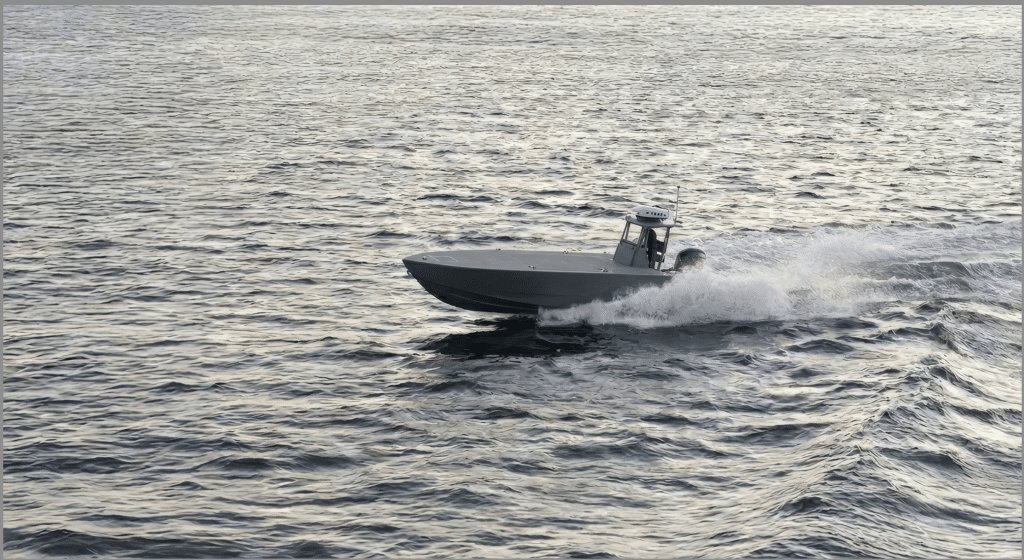
Fotheringham explained that HII has several ROMULUS variants in build, development, and testing in the US, including a 190-foot-long ROMULUS 190 vessel under construction at a Gulf coast shipyard. The USV is 30 percent complete, with launch, sea trials, and delivery – as the lead ROMULUS family prototype – all planned to occur before the end of 2026.
Constructed using commercial-standard hulls to underpin “rapid, repeatable production,” HII added that ROMULUS 190’s top speed is 25 kt and maximum range is 2,500 n miles, with capacity to carry four 40-ft ISO containers.
HII said ROMULUS is designed for global mission deployment and Odyssey-enabled extended autonomous operations. The USV’s flexibility and capacity enable it to support intelligence, surveillance, and reconnaissance (ISR), counter-uncrewed air system (c-UAS), mine countermeasures (MCM), and strike operations. HII said its autonomous operational capability includes open-ocean autonomy, multi-agent swarming, modular adaptability, and capacity to conduct launch-and-recovery (L&R) operations for UUVs and uncrewed aerial vehicles (UAVs).
“The facility will be a key part of the development for ROMULUS and the ability to do ‘drop-on autonomy’ on any vessel of opportunity [with Odyssey]. It’s a very large, flexible, open space, which allows us to bring in vessels internally,” said Green. “The intent is to get demonstration ROMULUS systems [across the Atlantic] to allow customers like the RN and other European navies to see its ability, and running with Odyssey on board.”
While no further timeframe details for conducting UK-based demonstrations were provided, Green added “A big part of what we want to do is demonstrate the capability of what we can do, because we believe it’s really pushing the boundaries of autonomy on surface vessels.”
REMUS

On REMUS, the RN is its longest-standing military operator. The navy uses REMUS 100, 300, and 600 vehicles for the MCM task, with the service’s most recent order (in 2024) encompassing three REMUS 100s and five REMUS 300s.
In three other UK-related REMUS capability developments, in September 2025 HII and Babcock International Group signed a memorandum of understanding to integrate REMUS vehicles with Babcock’s submarine Weapon Handling and Launch System (WHLS), to develop capacity for conducting submarine TTL&R from RN boats and other navies using Babcock’s WHLS; in October 2025, the USN conducted the first successful test-fixture TTL&R trial of REMUS 620, building on the TTL&R capability already instantiated in the REMUS 600 (which is operationally deployed onboard the Virginia-class nuclear-powered attack submarine [SSN] USS Delaware, under the Yellow Moray TTL&R operational technology programme); and in December 2025, Babcock and HII announced their co-operation on the former’s Autonomous and Remote Maritime Operational Response (ARMOR) Force architecture, designed to enable crewed platforms to command and control disaggregated uncrewed platforms and systems.
In July 2025, the RN conducted its own successful TTL&R test, with an L3Harris Iver UUV deployed from and returning to an Astute-class SSN, during Mediterranean testing.
“We continue to test our REMUS 620 for TTL&R,” said Fotheringham. “While we’re in the UK this week, we are going to visit Babcock and look at their UK weapons handling facility so we can understand more how [to] integrate with UK platforms.” This work includes HII and Babcock collaborating on developing the REMUS 620 and Yellow Moray technologies as options for the UK’s TTL&R capability development. “Those efforts are moving along quickly,” Fotheringham continued. “The capability is real. It’s in the water, it’s field-tested, and it’s operational.”
Naval requirements
To build North Atlantic deterrence and defence, NATO navies require sustained at-sea capacity and capability to support multi-domain operations, with sensing and strike mass generated by uncrewed systems being integral to such output.
The RN’s evolving operational requirements underpinning its contribution underline the uncrewed systems’ role. These requirements are based around three layered concepts: ‘Atlantic Bastion’ involves UUVs providing sensing mass integrated with crewed high-end platforms to protect key waters and sea lines of communication from anti-submarine warfare (ASW) and critical underwater infrastructure (CUI) threats; ‘Atlantic Shield’, the RN’s contribution to UK and NATO integrated air and missile defence (IAMD) and wider force protection, includes using USVs as sensor and weapons platforms; and ‘Atlantic Strike’ builds force projection capabilities to discourage adversaries from striking first.
The UK is underway with a procurement process for ‘Atlantic Bastion’, seeking a commercial mission partner, plus UUV capabilities in the water in 2026. It is also looking to test USVs in the ‘Atlantic Shield’ escort role in 2027.
REMUS has ‘Atlantic Bastion’ relevance. While the RN uses its REMUS vehicles predominantly for MCM, Green explained “As seabed warfare requirements increase, such as CUI protection, REMUS and its ability to conduct long-endurance patrols becomes more applicable.”
ROMULUS 190 fits with ‘Atlantic Shield’ and ‘Atlantic Strike’ in particular, with its ISR, c-UAS, and strike capacities. However, its UUV L&R capability means it could also support ‘Atlantic Bastion’.
“I think what we’re building is very relevant and timely, and I think we all understand the urgency of getting these platforms on the water [and] in our sailors’ hands,” Fotheringham concluded.
Author’s Comment
ROMULUS and REMUS bring integrated impact of their own, with the ROMULUS USV autonomous L&R capability meaning it can deploy REMUS UUVs. On 13 January, HII announced the successful shipboard test of its Sea Launcher autonomous L&R system, autonomously deploying and recapturing a representative REMUS UUV configured for real-world missions.