While the new frigates and ongoing production of Type 212CD submarines has been the main headlines of the Royal Norwegian Navy’s ongoing modernisation efforts, the acquisition of up to 28 new vessels of two ‘Standard’-classes is one of the more far-reaching and innovative parts of the programme.
Currently the Royal Norwegian Navy and the Coastguard, which is an integral part of the force, in addition to their frigates and submarines operate three large OPVs of the Jan Mayen-class and the Arctic OPV KV Svalbard. However, the force also include a large number of smaller patrol craft, minehunters, light corvettes, and other auxiliaries, spread out over twelve different classes. This makes maintenance and life-cycle support complex and resource-intesive, something the Norwegians now want to solve by rolling the capabilities of these into two new classes – 18 coastal standard vessel medium, and 10 offshore standard vessel large. This means the vessels will be used for a number of different tasks, including as patrol vessels and ISR-platforms, but also for mine warfare – both laying mines and for mine-countermeasures work – as well as having a limited anti-submarine warfare capability. The standardised vessels dedicated for Coastguard work will have certain modifications, but will also be capable of embarking the modular systems used by the Navy. The plan is to be able to start building the first vessel in 2027, with delivery in 2030, and there is also a hope that other allied navies will be interested in the concept.
There is broad interest in the standard vessels from a number of Norwegian yards and design bureaus. While Kongsberg Maritime issued a press release today, Norwegian offshore-heavyweight Ulstein, announced in mid-December 2025 a collaboration with Norwegian shipyard Larsnes Mek Verkstad to offer their designs for the Navy’s requirements.
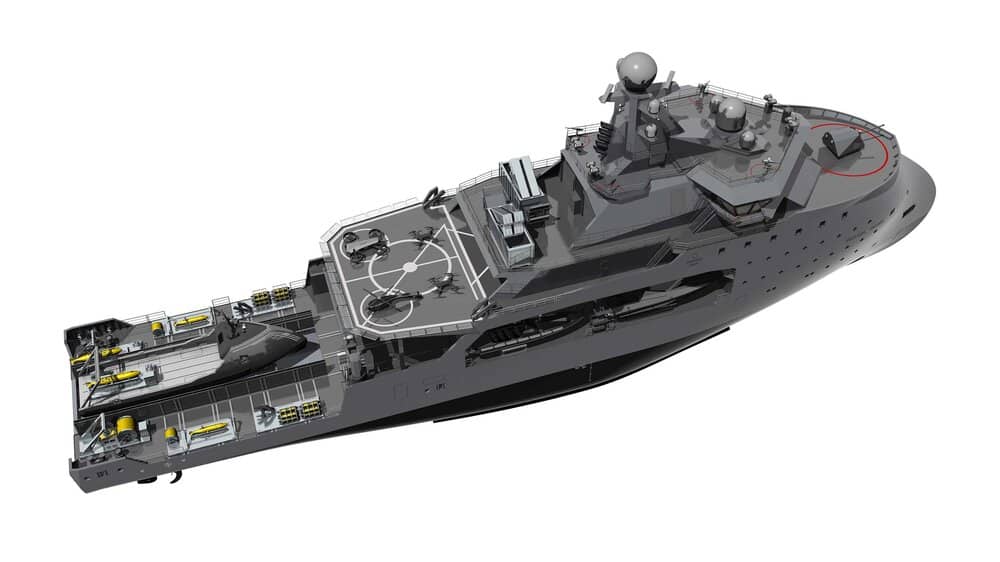
Ulstein is able to offer both design and engineering as well as their own shipyard, and the company is perhaps best know for its vessels for the offshore industry, many of the sporting the company’s inverted X-BOW design. Ulstein and Larsnes have together delivered 65 vessels ranging from 36 to 160 meters in length over the past 15 years, and while neither company is not known for a naval portfolio, the plan is to build upon their solid experience in the civilian field to offer two vessel designs with a focus on flexibility, modularity, and standardisation. The inclusion of Larsnes is significant, in that it increases the production facilities available, with the Larsnes yard having undergone significant investment and expansion in recent years. The larger design is for a sea-going 96 meter long vessel, while the coastal version is a 57 meter long design. The design language of both draws heavily upon the civilian offshore vessels where the companies have a proven track record, including the Ulstein X-BOW and high bridges well forward with ample space for mission decks and modular solutions further aft. Both vessels are designed to be able to handle a large number of different manned and unmanned systems, including surface-, subsurface, and airborne ones. Another detail of note is the focus on civilian systems and operating standards as asked for by the Navy, ensuring the ability to keep maintenance costs down, while also ensuring that civilian mariners can if needed be brought in with relatively limited retraining. The living and working conditions aboard are also set to be at a high level. A particular requirement by the Navy is that the vessels should be prepared for the phasing out of traditional fossil fuels during their lifespan, something likely aided by Ulstein’s system integration portfolio.