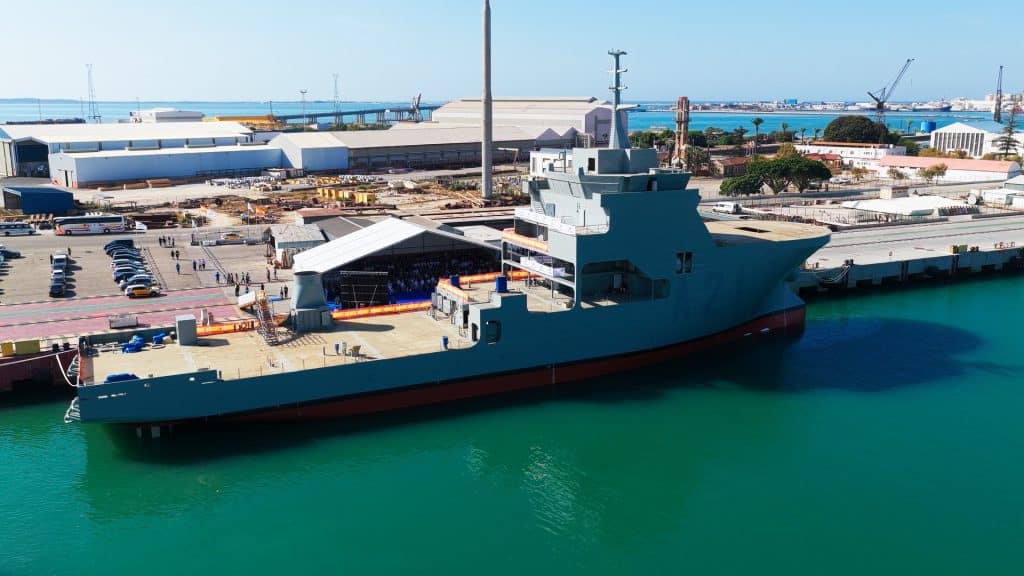
Colombian shipbuilder COTECMAR officially handed over the Ocean Patrol Vessel ARC 24 de Julio to the Colombian Navy on January 31 at Naval Base ARC Bolívar in Cartagena.
Admiral Juan Ricardo Rozo Obregón, Commander of the Colombian Navy, presided over the signing ceremony as the chief guest. The 93-meter vessel, which was launched in July 2025 and completed outfitting and sea trials within six months, represents the largest warship designed and built entirely in Colombia to date, marking a decade-long effort between the shipyard and the Navy from initial concept to delivery.
Technical Configuration
The ARC 24 de Julio displaces approximately 2,000 tons with a beam of 14 meters and a draft of 3.9 meters. The vessel is designed for extended maritime security operations, including patrol, surveillance, interdiction, and search and rescue missions in both Caribbean and Pacific waters. While COTECMAR has not released detailed specifications on propulsion and performance, the vessel’s dimensions place it in the standard OPV category with expected endurance suitable for Colombia’s extensive maritime zones.

The ship features a flight deck capable of operating medium helicopters, though no permanent aviation facilities appear to be included. This configuration aligns with Colombia’s operational requirements for periodic helicopter deployment rather than sustained aviation operations.
Construction consumed over 1,070 tons of steel, 11 tons of aluminum, and approximately 90 kilometers of cabling. The vessel incorporates what COTECMAR describes as modern design solutions focused on operational safety, efficiency, and extended service life, though specific systems have not been publicly disclosed.
Project Timeline and Industrial Impact
COTECMAR initiated construction in March 2023, completing the vessel in roughly two and a half years. The project generated 1,114 direct jobs and 2,228 indirect and induced positions across 343 national and international suppliers. This employment footprint extends beyond Cartagena’s industrial zone, involving Colombian manufacturing and service companies throughout the country.
Vice Admiral Luis Fernando Márquez Velosa, COTECMAR’s president, characterized the delivery as “a tangible demonstration of Colombian talent, national industry capacity, and the value of institutional collaboration to build complex naval platforms aligned with international standards.”
The vessel’s development began in 2016, following COTECMAR’s experience building smaller patrol craft and support vessels for the Colombian Navy. The ten-year timeline from concept to delivery reflects the technical learning curve for a shipyard transitioning from construction of foreign-designed vessels to developing indigenous designs.
Strategic Context
The ARC 24 de Julio arrives as Colombia pursues broader fleet modernisation under its PF2030 planning document. The Navy is simultaneously managing the PES frigate program with Damen Shipyards, which will deliver five SIGMA 10514-class frigates beginning in 2026. The OPV program represents a parallel track focused on building domestic design capability rather than licensing foreign designs.
COTECMAR, established in 2000, has evolved from performing maintenance and limited construction to managing complex shipbuilding programs. The company now operates as Colombia’s primary naval industrial base, having delivered patrol boats to Brazil, Guatemala, and Honduras while maintaining vessels for regional navies including the Royal Netherlands Navy.
The shipyard’s 186,000 square meter facility in Cartagena’s Mamonal industrial zone includes 11 docks and synchronous lift systems. COTECMAR employs what it describes as one of Latin America’s most capable naval design offices, though the ARC “24 de Julio” marks the first large combatant designed entirely by Colombian engineers.
Colombia joins a limited group of Latin American nations capable of designing and constructing ocean-going warships domestically, alongside Brazil and Chile. The delivery positions COTECMAR for potential export opportunities in the regional OPV market, though the company has not announced any foreign orders for the design.