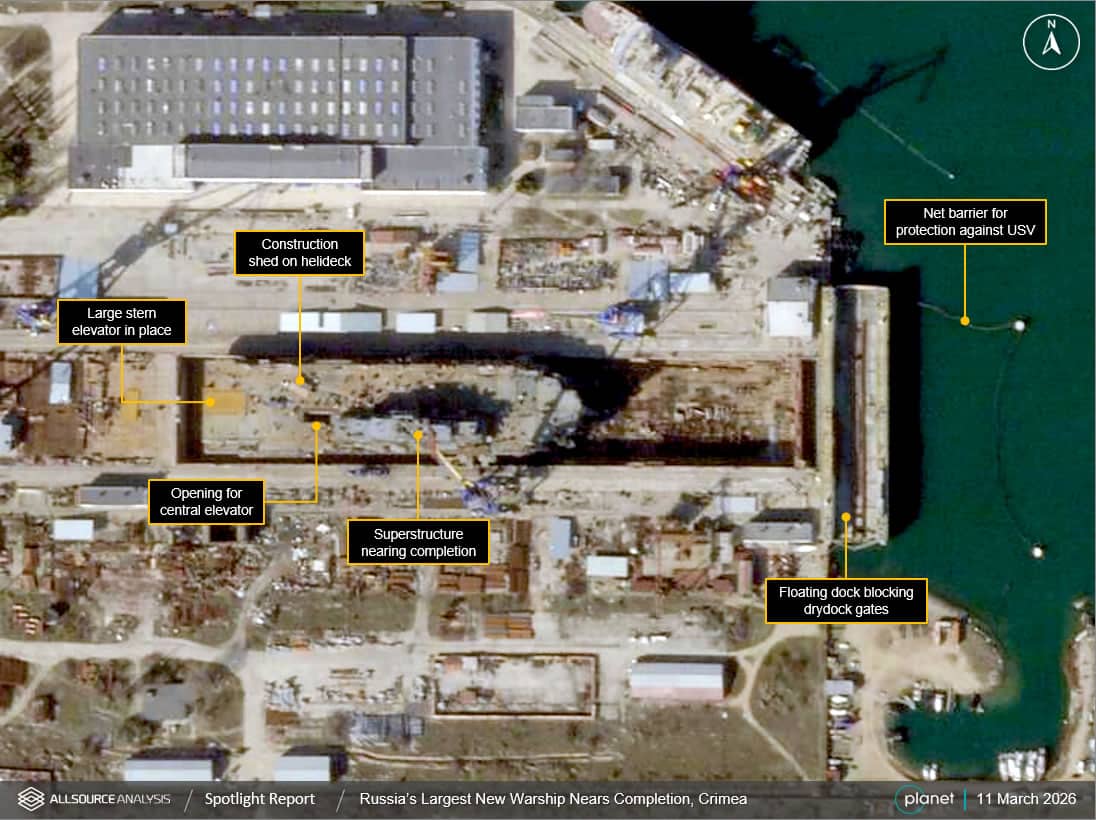
Recent satellite imagery, captured on March 11th, published by AllSource Analysis shows Russia’s newest amphibious assault vessel, the Ivan Rogov, at the drydock of the Zaliv Shipyard, in occupied Crimea. The vessel, the first of two, appears to be in a final stage of construction and is nearing the point where it could be launched. Several defensive measures were also observed aimed to defend the vessel against potential Ukrainian attacks.
The ongoing construction of the Ivan Rogov also indicates that this project has a high priority for the Russian armed forces, even in the face of the ongoing war in Ukraine.
Satellite imagery of the Zaliv shipyard on the Crimean Peninsula shows the construction on the Ivan Rogov nearing the stage where the vessel is ready to be launched in the water. The Ivan Rogov, located in the only available drydock of the Zaliv Shipyard, appears to have her superstructure completed while work is still ongoing on the helicopter deck. On the helicopter deck, several objects were observed scattered across which appear to be construction equipment. At the stern of the vessel, the large elevator to move helicopters from the helicopter deck into the hanger deck is already installed in place.
A large opening is still visible between the end of the superstructure and the stern elevator. This opening corresponds with the location where, according to available scale models of the Ivan Rogov-class, a central elevator will be installed. This elevator is too small to fit helicopters and will most likely be used to handle munitions and spare parts between the hangar deck and the helicopter deck, as well as serving as an additional elevator to move stores and equipment for regular ship operations. It appears that the central elevator will be installed shortly as the top cover of the elevator can be observed aft the drydock where a large metal plate with the same coloration as the helicopter elevator can be seen.
Project 23900, Ivan Rogov-Class

The Ivan Rogov-class amphibious assault ships are a class of two LHD type amphibious assault vessels ordered for service with the Russian Navy. They are part of Russia’s attempts to provide platforms for power projection, allowing its Naval Infantry units to deploy beyond Russia’s coastline for extended periods and secure Russia’s regional and global interests in manner similar as Western marine forces operate.
Initially, Russia sought to acquire two Mistral-class amphibious assault ships from France resulting in the construction of the Vladivostok and the Sevastopol at Saint-Nazaire, France. Russia allegedly planned to expand the class by later building two additional Mistral-class vessels in Russia as part of the deal with France. However France cancelled the contract and reimbursed Russian payments as part of sanctions against Russia’s annexation of the Crimea in 2014. France kept both ships after removing Russian equipment and technology, and later sold both vessels to the Egyptian Navy where they serve as the ENS Gamal Abdel Nasser and the ENS Anwar El Sadat.
This forced Russia to develop its own Amphibious assault ships, aided in part by technology transfers obtained under the French contract for the Mistral-class. This resulted in the Project 23900 design, later classified as the Ivan Rogov-class, helicopter carriers. On may 22nd, 2020, TASS agency reported that the Russian Ministry of Defense signed a contract with the Zaliv Shipyard for the construction of the two vessels of the Ivan Rogov-class. According to specifics mentioned by TASS, each vessel should be capable of deploying up to 20 helicopters, and transport a maximum of 900 Naval Infantry troops. A well deck at the stern is able to accommodate up to four landing craft, though Russian sources don’t specify if the Ivan Rogov-class will operate Serna or Dyugon-class landing ships to facilitate the ship-to-shore maneuver.
The keel laying ceremony was held on July 20th, 2020 at the Zaliv Shipyard with the hulls being named Ivan Rogov and Mitrofan Moskalenko. By end of February 2021, TASS agency reported that the requirements of the vessels were changed with the airwing now composed of a maximum of 16 helicopters and four S-70 Okhotnik UAVs used for reconnaissance and target acquisition. The vessels were expected to be delivered to the Russian Navy in 2026 and 2027 respectively. Russia’s invasion of Ukraine and subsequent economic sanctions have pushed this timeline to 2028 and 2029 respectively.
Analysis of historical images of the Zaliv Shipyard shows that only one amphibious assault ship is currently under construction inside the drydock. This is likely the Ivan Rogov, destined for Russia’s Pacific Fleet. The vessel takes up the majority of the space available inside the drydock, meaning that construction of the second ship, the Mitrofan Moskalenko can only start once the Ivan Rogov is launched.
A high stakes, but high risk project for the Russian Navy
Construction of the Ivan Rogov-class at Zaliv Shipyard has been continuing at a steady pace even though the project is faced with several difficulties. From a security point of view, the Zaliv Shipyard has found itself to be in range of Ukrainian missile and drone strikes since 2023 when Ukraine started its targeted campaign against Russian naval assets in the Black Sea in earnest. The shipyard appears to take the Ukrainian threat seriously and has placed a floating dock and a net barrier in front of the drydock to prevent Ukrainian USV attacks from striking the drydock and damage the gates. Further satellite imagery observations show that the entrance to the shipyard itself is also protected by barges and a net barrier, adding an additional layer of protection for the Ivan Rogov. As such, the Zaliv Shipyard has been taken the lessons learned by the Russian Navy into account and adopts a protection level similar to the one at the Russian naval base at Novorossiysk.
As for the missile and UAV threat, the shipyard benefits indirectly from its close location to the Kerch Bridge. This bridge, the only direct link between Russian and the Crimea, has been a vital target that Ukraine has sought to sever. Destroying the Kerch Bridge would largely cut off the Crimea from supplies, safe for maritime transports via the Black Sea and the land route through the Donbass. The high strategic importance of the Kerch Bridge means that Ukraine will focus on this bridge, rather than the shipyard while nearby Russian air defenses located near the Kerch Bridge can also serve to protect the Zaliv Shipyard.
A second point of view is the economic aspect related to the construction of the Ivan Rogov-class. Despite a Russian economy hard pressed under sanctions and sustaining five years of war in Ukraine, the Russian Ministry of Defense is still allocating funds and resources to the construction of the Ivan Rogov-class even though there is no immediate opportunity in using the vessel. Russia’s Navy and Naval Infantry are in need of modern amphibious assault vessels to replace the aging fleet of Ropucha and Tapir-class tank landing ships but even if these vessels are in service, there is little use or benefit to be gained from these vessels as long as Russia is forced to fight in Ukraine and remains limited in pursuing other goals on the global stage. It is also taking a risk, hoping that Ukraine will not damage or destroy the vessel once it is nearing completion.
High-value target once launched
Once the Ivan Rogov is launched, the risk of such a Ukrainian attack will increase as taking out the vessel will remove an important piece of military hardware and deal an economic loss to the Russians. In recent months, Ukraine has stepped up its attacks against air defense sites, both radars and missile launchers, across the Crimea. This stretches Russian air defense capabilities and might. If the Ukrainian campaign is sustained, it will lead to gaps which the Ukrainians can exploit to strike the Zaliv Shipyard.
Once the Ivan Rogov has left the drydock, it will loose the protection the floating dock has offered as a barrier against USV attacks though the vessel could be surrounded by a net barrier when moored inside the shipyard while undergoing final fitting out.
Even then, it will still be at risk from Ukrainian strikes which are able to directly threaten the Russian naval base at Novorossiysk. Keeping the vessel at Zaliv is risky but moving it out of the shipyard to another location might prove to be riskier. As long as the vessel is stuck at Zaliv Shipyard, the only threat the vessel is facing are Ukrainian missile and UAV strikes. Once at sea, the vessel will also need to be protected against Ukrainian USV attacks which have proven to be highly successful against both ships operating without an escort or against small Russian task forces. Russia’s best option would be to move the ship out of the Black Sea as fast as possible but this would require a large escort to deal with the missile, UAV, and USV attacks. A coordinated strike against the Ivan Rogov under escort could spell disaster for the Russians. And even if the vessel is able to leave the Black Sea, recent events have shown that Russian vessels aren’t completely safe in the Mediterranean either. Ukraine appears to be able to strike Russian ships in the Mediterranean with the latest attack being made against the Russian LNG tanker Arctic Metagaz which was struck between Libya and Malta by USVs on March 2nd.