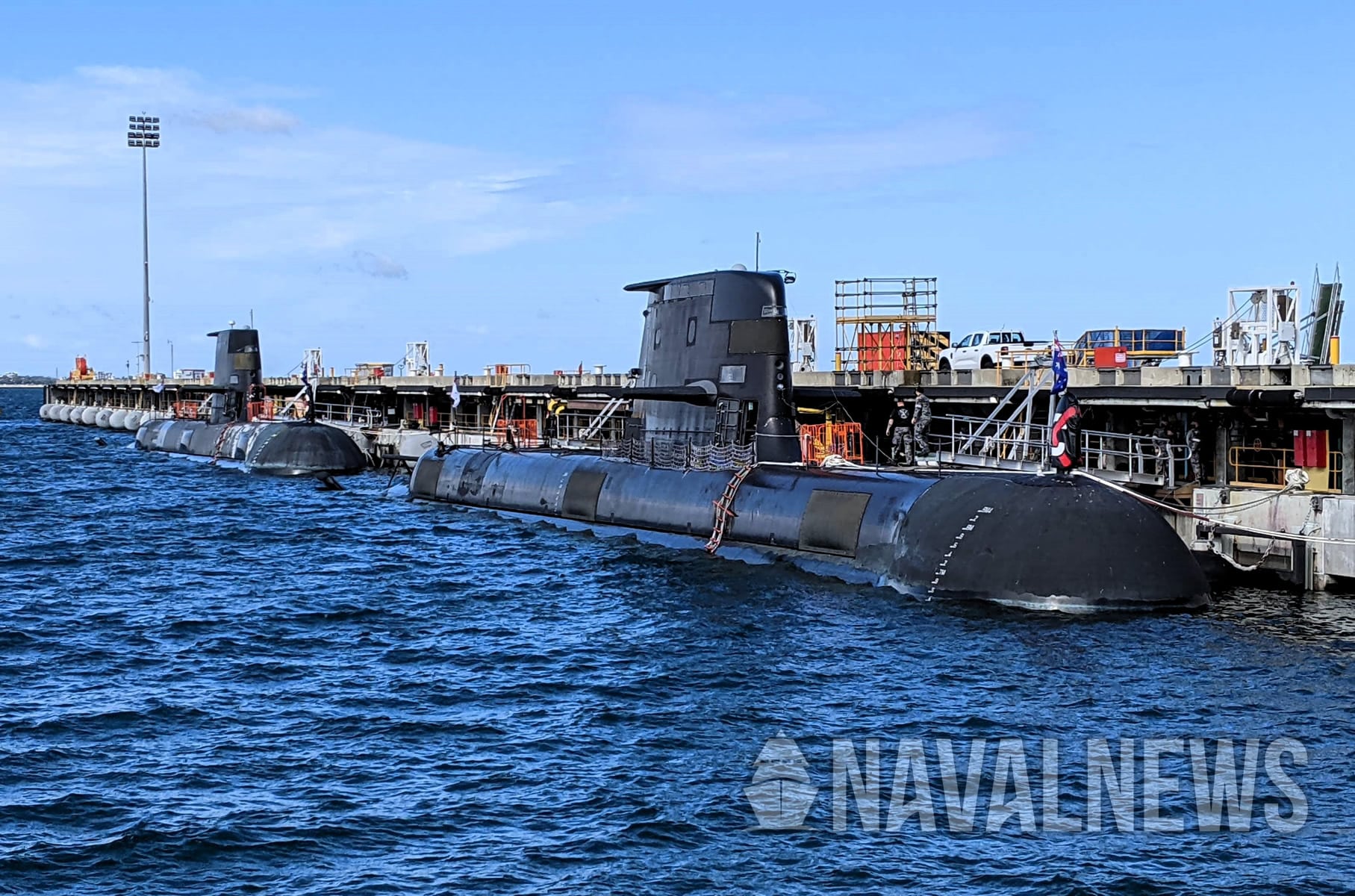
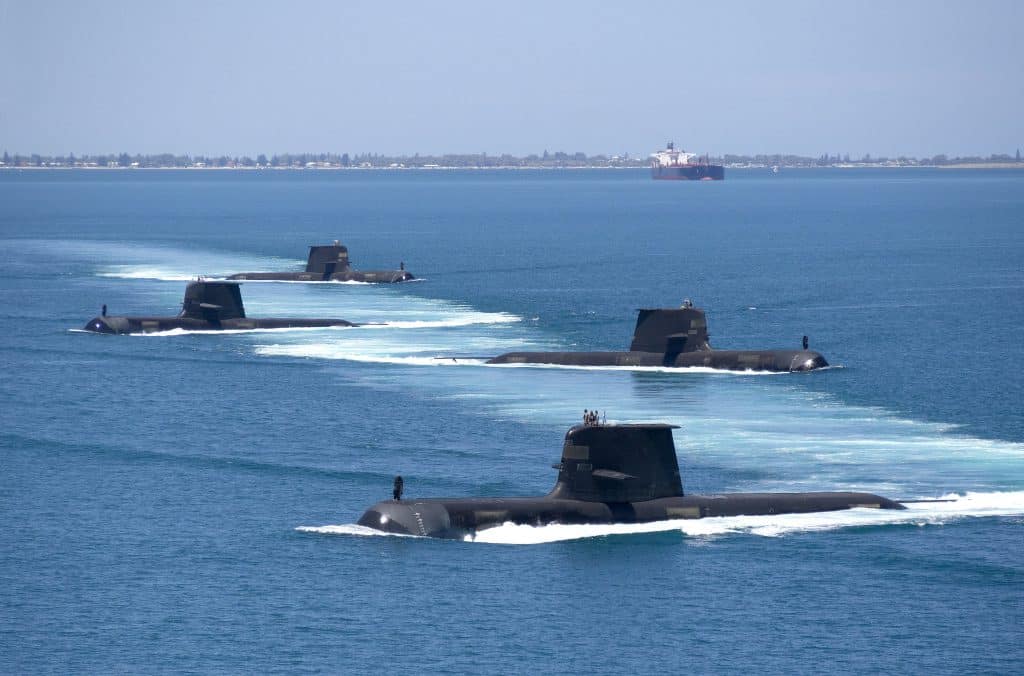
The Australian government on 19 May 2026 has officially announced the launch of the so-called “life of type extension effort” (LOTE) for the six Collins-class submarines operational with the Australian Navy. The event marks a significant milestone in a lengthy and convoluted history of modernising these submarines, while a new design could eventually replace the boats. Naval News provides an overview on the background and present scope for this project intended to keep the six submarines operational into the 2040s.
As outlined in the official release, modernisation will start with HMAS Farncomb, the second boat originally commissioned in 1998. Importantly, work on Farncomb “will include a detailed engineering assessment period to tailor its life of type extension upgrades and inform work required across the class.” In parallel officials intend to “accelerate and prioritise sustainment work on the fleet’s youngest submarines, commencing with HMAS Rankin.” The total cost of LOTE remains unclear at this stage. As part of the announcement the Australian government commits to related spending of A$ 11 billion, about U$ 7.8 bln, over a period of ten years.
Scope of LOTE remaining uncertain
Indicative in these statements, and supported by other Australian media reporting, is the notion that the six boats may not all undergo the same extent of modernisation. An example here is the need to replace and overhaul propulsion systems, including batteries and diesel engines. Reducing the scope of modernisation would implicitly entail operational restrictions on Collins-class submarines that do not complete the full LOTE-effort. Therefore, even though officials are empathetic that life extension-work applies to all six submarines, these characterisations may indicate limited operational readiness on some boats for the remainder of their service.
Official statements in 2024 confirmed more significant wear and tear for the submarines than previously anticipated. Examples outlined then related to severe corrosion on HMAS Farncomb, but also in a different form on HMAS Sheean, the fifth Collins-boat to enter service in 2001. Typical for life-extensions, similar to other overhaul-measures is that the full scale of work remains unclear until the first vessel undergoes detailed inspection. Because of the complex construction arrangement for Collins between Swedish Kockums and Australian builder ASC at the time, individual boats may also display different kinds of defects.
Collins-modernisation efforts dating back to 2009
The Collins-class submarines joined the Royal Australian Navy between 1996 and 2003. The average intended service life for submarines of this size and capability is approximately 30 years. Therefore, RAN would have required a successor design entering service by the mid-2020s, replacing all boats by the mid 2030s. The Collins-boats have experienced a more convoluted induction and operation with RAN than originally intended. Outcomes included varying levels of operational availability and significant efforts addressing these deficits.
The centre-left Australian Labour government under Kevin Rudd in 2009 in a Defence White Paper communicated a desire to expand the submarine fleet from six to twelve boats. This plan included transition from Collins to a successor design, to be built in South Australia.
The new type would then be joining the fleet from the mid-2020s, as noted. Importantly, that original plan already outlined an effort of transition from Collins spanning three decades. In this context the White Paper explicitly noted a need for modernisation on the existing submarine-fleet. The government intended related work to occur throughout the 2010s. Part of this modernisation would have been fitting out with new sonar-systems. Meanwhile, the successor design would have joined the fleet in two batches. The first six boats would have entered service by the early 2030s. A decision to produce an additional six boats for the fleet of twelve would occur by the late 2020s.
The Rudd-proposal experienced significant disruption over the next 15 years. One significant factor was a rapid succession of six different governments, and related changes in policy preferences. As a result, no modernisation work occurred during the 2010s. Instead, the Collins-class continued to operate unchanged, accumulating service-time with the related wear and tear on the hulls.
Successive shake-ups with French submarine-project followed by AUKUS
Modernisation-planning began taking shape with a government-decision to purchase twelve Attack-class conventionally powered submarines from French builder Naval Group in April 2016. The 2016 Defence White Paper and Integrated Investment Program established a modified timeframe for the effort. Collins-modernisation was to commence immediately for the sonar-replacement and further sensor- and communications enhancements. Also part of investments was a new submarine escape-and-abandonment system. By 2019 the boats were slated to start receiving an upgraded satellite communication system. The IIP 2016 estimated overall cost for these upgrade elements at up to A$ 3 billion. According to published timeframes, government intended work to be complete around 2027. Detailed planning therefore moved the bulk of the previous more notional modernistion timeframe well into the 2020s. Eventually, no significant work on Collins-upgrades would commence before Canberra terminated the French submarine-acquisition.

In 2021, the Liberal-National Coalition government of Scott Morrison cancelled SEA 1000 and the contracted agreement with Naval Group. Instead, Canberra now opted for nuclear-powered submarines under the AUKUS arrangement with the United States and the United Kingdom. A year later Morrison handed office over to the Labour Party under Anthony Albanese after suffering an election defeat. Albanese. in line with previous statements by Labour, maintained the established transition from SEA 1000 to AUKUS. The Labour-government then commenced detail work on AUKUS, somewhat mirroring previous Coalition governments on conventional submarines initiated by Kevin Rudd.
Optimal Pathway and delays of modernisation
The key outcome was the “Optimal Pathway”-arrangement announced in 2023. This element involves the United States supplying at least three Virginia-class SSN to RAN between 2032 and 2037. Such a “stop gap”-measure addresses new Australian SSN built in cooperation with the UK not entering service before 2040. Therefore, the Optimal Pathway replaces the initial submarines Australia intended to receive through the previous SEA 1000-approach. This nuance is relevant insofar as it means that contrary to some criticism about the substantial cost of Collins LOTE focusing on AUKUS as the motivating factor, the Optimal Pathway continues to reflect the replacement dynamic established by 2016.
In the wake of the 2016 White Paper, three successive federal governments delayed the beginning of modernisation on Collins-class submarines. As a consequence related work steadily morphed from a “mid-life” upgrade to life extension-measures. Such a life extension would now aim to achieve around 15 years of additional service time. The original modernisation scheme experienced a first reduction in scope in 2024. Canberra then dropped previous plans to integrate new Safran-made optronic sensor masts. This already funded work, intended to bring Collins-class boats in line with anticipated capability on the Attack-class, was now moot with the abrupt changes in 2021. Naval News understands Safran is still under contract to deliver the masts to Australia, but these are expected to be stored indefinitely and never be used. The Australian DoD at the same time also abandoned the idea of integrating torpedo tube-launched Tomahawk cruise missiles on the submarines.

Conclusion
The now announced work, and cautionary qualification of the extent of modernisation for all six Collins-class submarines represents the second time LOTE faces revision. Timeframe constraints in particular are now starting to impose their full weight on the effort, which according to original intentions around 2009 would have ended around the present time.
The dynamic, as it has played out over recent years, suggests further delays and additional cost beyond the ten year-investment in the recent statement are plausible. An effective decade-long delay in Collins-modernisation now shapes up as an additional pressure point for the RAN heading into the 2030s. The service by then will be busy inducting the first Virginia-class SSN, while still managing the complex shuffle of Collins-boats through their up to two years of LOTE docking. Once HMAS Farncomb has completed her work establishing the related scope and cost for LOTE, the RAN will likely reach another decision-point regarding how many Collins-class submarines the service intends to operate for how much longer.