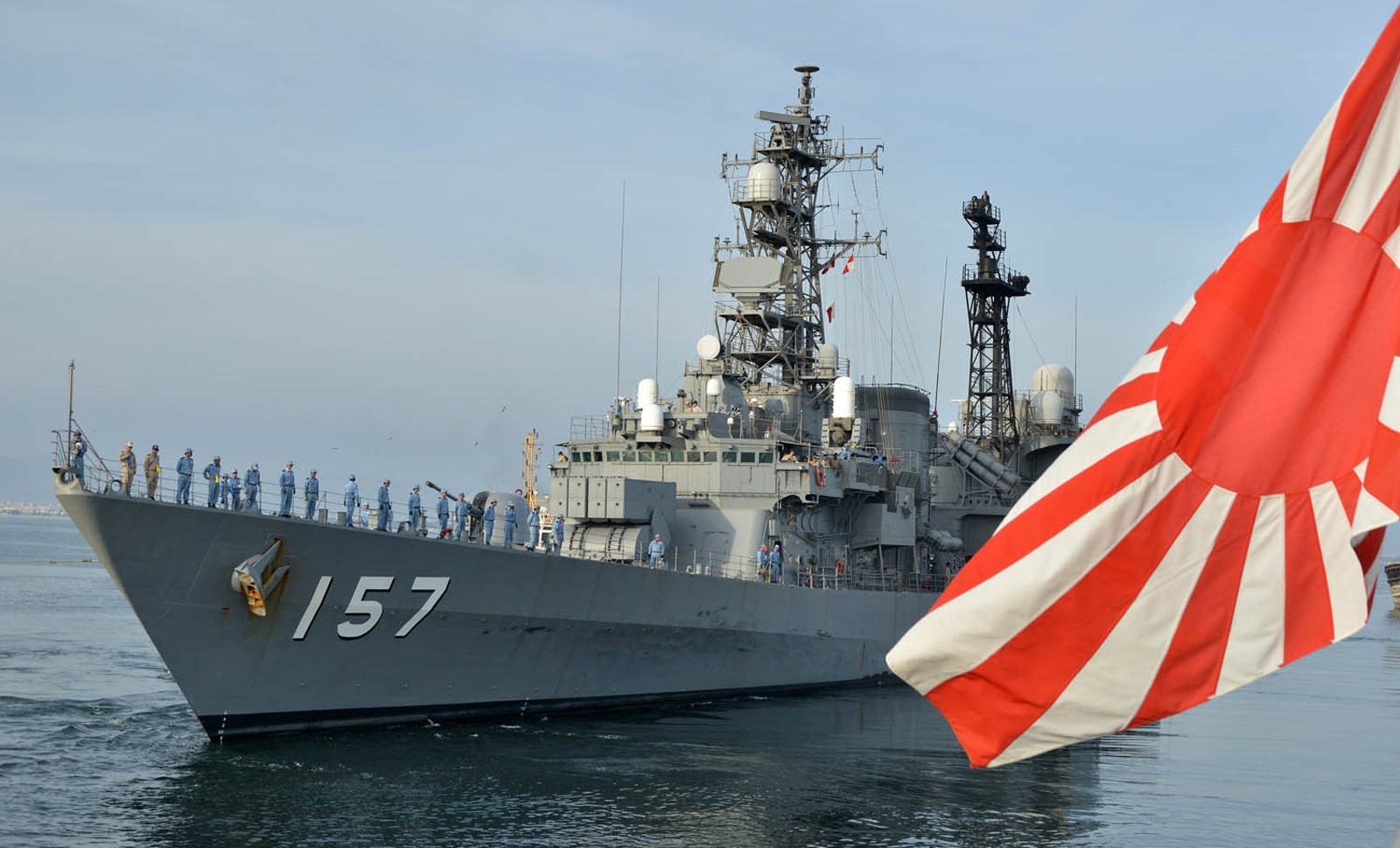
Japan and Indonesia have agreed to begin working-level discussions on the possible transfer of used Japan Maritime Self-Defense Force (JMSDF) Asagiri-class destroyers, marking another step in Tokyo’s expanding defense export policy and highlighting how Japan is tailoring naval cooperation to the specific requirements of regional partners.
Japanese Defense Minister Shinjiro Koizumi met Indonesian Defense Minister Sjafrie Sjamsoeddin in Tokyo on June 5. According to Japan’s Ministry of Defense, Sjafrie expressed a desire to “materialize” defense equipment and technology cooperation, including the transfer of Asagiri-class destroyers. The two sides agreed to discuss training, maintenance, and operational support through a working-level framework established in May.
The move comes two months after Japan revised its defense export rules to permit the transfer of lethal defense equipment, including naval vessels, under specified conditions. Since then, Tokyo has accelerated defense cooperation with like-minded countries, including the Philippines, Indonesia, and New Zealand.
“I held talks with Indonesian Defense Minister Sjafri Sjamsoeddin, who is visiting Japan. We were able to agree to start discussions on the transfer of the destroyer “Asagiri,” thereby further strengthening ties with Indonesia. This will expand substantive collaboration through destroyers on a broader scale, with “Mogami” to Australia, “Arikuma” to the Philippines, and “Asagiri” to Indonesia. It is a solid step toward contributing to peace and stability in the Indo-Pacific region. Gratitude for the friendship with Minister Sjafri.”
Japanese Defense Minister Shinjiro Koizumi on X
What makes Indonesia’s interest particularly noteworthy is the contrast with the Philippines, which is currently pursuing the transfer of used Abukuma-class destroyer escorts. While both vessels belong to the JMSDF and share similar anti-surface and anti-submarine capabilities, they were designed for different missions and offer significantly different levels of capability.
Both classes are armed with a 76 mm naval gun, Harpoon anti-ship missiles, ASROC anti-submarine rocket launchers, and lightweight torpedoes. However, the key differences lie in air-defense and aviation capabilities.
The approximately 2,000-ton Abukuma-class destroyer escort (DE) carries a single Phalanx Close-In Weapon System (CIWS) but lacks surface-to-air missiles. It also has no helicopter hangar and relies primarily on shipborne sensors and weapons for anti-submarine operations. With a crew of roughly 120 sailors, it is relatively economical to operate and maintain.
By contrast, the approximately 3,500-ton Asagiri-class destroyer (DD) is equipped with an eight-cell Sea Sparrow surface-to-air missile launcher, two Phalanx CIWS mounts, and facilities to operate an SH-60J anti-submarine warfare helicopter. These features provide significantly greater air-defense, surveillance, and anti-submarine capabilities, making the class a more capable multi-role surface combatant.
The two classes also differ in propulsion and age. The Asagiri-class is powered by a Combined Gas And Gas (COGAG) arrangement consisting of four gas turbines driving two shafts, while the Abukuma-class employs a Combined Diesel Or Gas (CODOG) configuration with two diesel engines and two gas turbines driving two shafts.
The practical implication of this difference is that the Abukuma’s CODOG arrangement gives it better fuel economy at cruising speeds, which suits its coastal patrol role, while the Asagiri’s all-gas-turbine COGAG setup prioritizes speed and power output, consistent with its open-ocean destroyer profile.
The Asagiri-class is the oldest destroyer class still in active JMSDF service. Eight ships were built beginning in 1988, and one has already been retired. By comparison, all six Abukuma-class destroyer escorts commissioned from 1989 remain in service, although they are expected to be phased out gradually in Japan as newer platforms such as the Mogami-class frigates enter service.

For the Philippine Navy, the Abukuma-class appears well suited to its immediate requirements. The Philippines faces persistent challenges in the South China Sea, including confrontations with Chinese Coast Guard vessels and maritime militia forces. In such scenarios, anti-surface and anti-submarine capabilities are important, while advanced air-defense systems are often a secondary consideration.
The Abukuma-class also offers practical advantages. Its smaller size, lower operating costs, and reduced manpower requirements would make integration into the Philippine Navy comparatively straightforward. Japan could potentially transfer all six ships of the class as a package as the JMSDF replaces them with newer Mogami-class frigates, simplifying logistics, training, and sustainment.
Indonesia’s requirements are considerably different. As the world’s largest archipelagic nation, Indonesia must monitor and defend vast maritime areas stretching from the Malacca Strait to the waters surrounding the Natuna Islands. Such missions demand longer endurance, wider surveillance coverage, and greater operational flexibility.
The Asagiri-class addresses those needs more effectively through its embarked helicopter capability and stronger air-defense suite. Indonesia also has experience operating larger surface combatants, making the transition to a vessel of Asagiri’s size and complexity more manageable.
The prospective transfers suggest that Japan is developing a more nuanced approach to defense exports. Rather than offering a single platform to multiple countries, Tokyo appears increasingly willing to match available equipment with the operational needs of individual partners. If the proposed Abukuma transfer is primarily intended to strengthen frontline maritime deterrence in the South China Sea, the Asagiri discussions could be viewed as supporting Indonesia’s role as a leading maritime power in Southeast Asia. Together, the two cases demonstrate how used JMSDF vessels are becoming tools of Japan’s broader strategy to strengthen regional maritime security partnerships while expanding its defense industrial and diplomatic footprint across the Indo-Pacific.