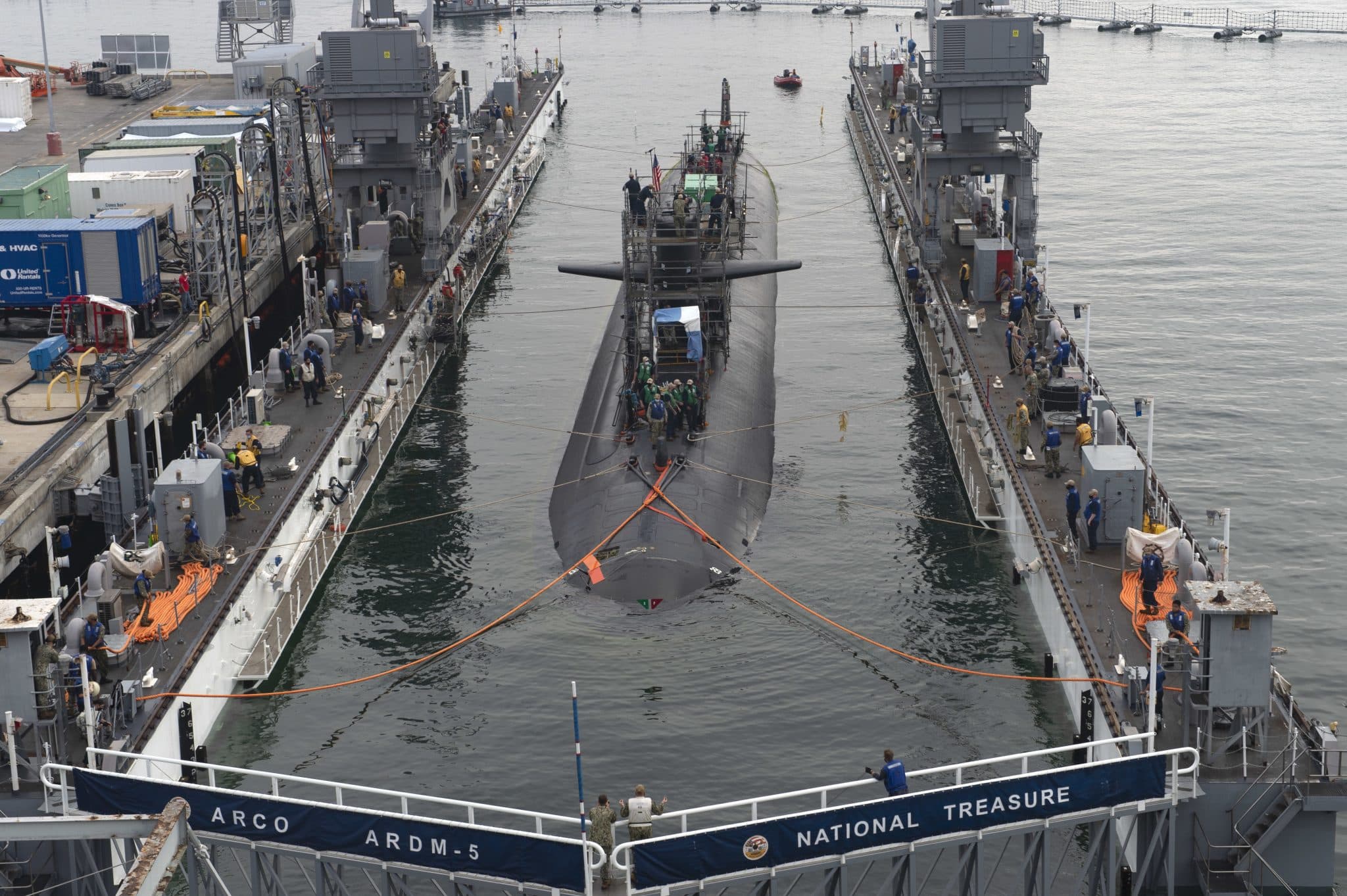
The Australian government has announced the selection of Leidos Gibbs and Cox to design a floating dry dock supporting AUKUS infrastructure.
Australian Department of Defence press release
AUKUS is taking another important step, with the Albanese Government selecting a designer for the submarine contingency dry dock capability in support of Australia’s conventionally-armed, nuclear-powered submarine fleet.
Leidos Gibbs and Cox Australia has been selected to lead the preliminary design for a contingency dry dock, which will be established in Western Australia to support our future nuclear-powered submarine capability.
This announcement reflects the Albanese Government’s considered approach to delivering this capability and forms part of the Government’s broader investment in Western Australia across HMAS Stirling and the Henderson Defence Precinct for sovereign shipbuilding and the sustainment of our surface vessels and submarines.
Selecting the designer to provide floating dry dock design services will ensure Australia is ready to undertake critical repairs and maintenance for the nation’s future nuclear-powered submarines from the early 2030s, ahead of the requirement to conduct submarine depot-level maintenance from the late 2030s.
This contingency dry dock capability is a critical pre-condition of Australia receiving its first Virginia class submarine and will provide a critical contingency capability for Australia and its partners.
These vital maintenance capabilities will be established in accordance with domestic processes and regulatory requirements, and consistent with Australia’s international obligations to maintaining the highest standards for nuclear safety, security and safeguards.
In addition to supporting a strong, sovereign industrial base, a contingency dry dock capability will play a vital role in ensuring Australia can sustain and operate its future submarine fleet and work with our partners in the United States and the United Kingdom to support security and stability across the Indo-Pacific region.
This design work is underpinned by the Albanese Government’s investment of an initial $12 billion to deliver the Defence Precinct at Henderson which, alongside the Government’s record investments in AUKUS and shipbuilding, will support 10,000 direct jobs over the next two decades in Western Australia.
Quotes attributable to Deputy Prime Minister, Richard Marles:
“AUKUS is delivering the capabilities Australia needs to keep our nation safe.
“The contingency dry dock capability is a critical step in building a sovereign submarine sustainment system.
“This investment ensures Australia will have the infrastructure, workforce and industrial capability required to support our future nuclear-powered submarines.”
Quotes attributable to Minister for Defence Industry, Pat Conroy:
“AUKUS is happening right now.
“The development of infrastructure at Henderson will position Western Australia at the centre of our submarine sustainment enterprise.
“This is another example of AUKUS delivering long-term industrial capability and highly skilled jobs for Australians.”
-End-
Naval News comments:
The submarine contingency dry dock capability aims to bridge the time needed to establish new graving docks at the Henderson Defence Precinct, which Naval News has previously outlined. As a floating dock this facility aims to provide flexible maintenance support for facilities across Henderson and the adjacent HMAS Stirling. However, considering the inherent mobility of floating docks, such a capability can notionally also support Australian naval maintenance in more distant locations, such as South Australia or on the Australian east coast.
The selection of Leidos Gibbs and Cox Australia must be seen in the context of existing, longstanding relations between Gibbs and Cox Australia and the Royal Australian Navy. Spanning six decades, the company has provided concept and design support and engineering programme assurance covering every recent combatant effort for RAN, from the Perth-class FFG to the Hunter-class DDG. Leidos acquired Gibbs and Cox in 2021, combining the ship design firm with its maritime systems division as a wholly owned subsiduary.