Belgium’s long-running plan to replace its ageing M-class frigates has entered a new and potentially consequential phase. Defence Minister Theo Francken has publicly stated that the joint Dutch-Belgian frigate programme is moving “completely in the wrong direction” on both delivery dates and price, an outcome he described as unacceptable.
Tayfun Ozberk story, additional reporting by Xavier Vavasseur
The remarks matter because Belgium and the Netherlands had already committed to the Anti-Submarine Warfare Frigate (ASWF) programme led by Dutch shipbuilder Damen. The project was intended to deliver four ships, two for each navy, replacing the Belgian and Dutch Karel Doorman-class frigates. But the programme now faces a procurement problem: an increasingly ambitious design, a stretched industrial schedule, and a bill that has grown far beyond early expectations.
Speaking to Belgian outlet VTM NIEUWS, Francken said Belgium remains in discussions with the Dutch government. At the same time, however, he announced that Brussels will launch a Request for Information (RFI) process aimed at other European frigate builders. He explicitly named Italy, France, Germany, Spain and Türkiye. That is five countries, rather than four, and it is an important distinction. Belgium is not merely seeking leverage in negotiations with Damen; it is signaling that it is prepared to examine a much wider set of industrial and naval options.
“In October, I will make a decision on the program. We urgently need new frigates in any case. The current ones are truly worn out.”
Belgian Defense Minister Theo Francken to VTM NIEUWS
Francken previously voiced his concerns twice, during National Defense Committee hearings of the Chamber of Representatives in Brussels.
On July 17th, Francken said: “As I indicated during the committee meeting on July 1, the future of the ASWF program currently remains uncertain. At this moment, there is no clarity regarding the final schedule, nor regarding the budgetary impact. The Netherlands still needs to present more concrete options regarding the various points, where the time factor remains of paramount importance, particularly in light of the recent events involving the Leopold I. The ships are simply worn out. All possible options are currently still on the table. Crucial elements are still missing to make a clear decision, and these will be investigated further in the coming period. A clear, feasible, and valid solution for the ASWF program and for the Navy is urgently needed. I am aware of this. I am fully engaged in this. More news regarding this will follow in the autumn.“
While on July 1st, the Belgian Defense Minister said: “Today, the ASWF program finds itself in rough waters, undoubtedly a deliberate pun.
The project, which is being carried out binationally with the Netherlands within the framework of BeNeSam, is grappling with technical and design-related problems. The margins of the original hull design ultimately proved insufficient, which led to a design crisis. In (…) 2026, a new, larger design was proposed, which, however, entails additional costs and further delays. A key decision point regarding the program is expected when the Netherlands presents concrete options. Regarding the delivery schedule, there is currently no definitive or reliable timeline.
An earlier schedule aimed for commissioning around 2031. However, following a previous extension, recent signals point to further delays of two to three years. The legal and contractual leverage available to Belgium to avoid additional costs being unilaterally passed on is the refusal to accept contractual adjustments for cost increases that were not contractually foreseen. Belgium takes such decisions jointly with the Netherlands by unanimous vote in the Joint Steering Committee, as provided for in the memorandum of understanding. This summer it must become clear whether the current cooperation model with the Netherlands can be continued, or whether Belgium must make other strategic choices to avoid a serious gap regarding maritime capabilities.
In summary, the situation today remains very uncertain. There is still no clarity regarding the final schedule. The budgetary impact is still subject to negotiations, and alternative solutions are being explored but have not yet been finalized. So no, I do not expect that. We have already met, the Netherlands has made a number of proposals, additional studies still need to be conducted, and we will look into these during the summer and autumn.”
The original ASWF programme was built around close Dutch-Belgian cooperation, common logistics and shared operational requirements, particularly in anti-submarine warfare. Yet those advantages become less persuasive if the vessels arrive too late. The Belgian Navy’s current frigates are old, increasingly expensive to maintain and nearing the limits of their practical service life. A replacement programme that slips into the mid-2030s creates an uncomfortable capability gap for a country that still expects to contribute to NATO maritime operations in the North Atlantic, Baltic and wider European waters.
Belgium ASWF: Which alternatives ?
The alternatives mentioned by Francken are varied. Each country and shipbuilder will carefully review the RFI before submitting proposals. We don’t know what the exact requirements are. Italy could offer the FREMM EVO (which has just been selected by Portugal, in addition to the Italian Navy) or the PPA design, both of which reflect Italy’s experience in building multi-purpose surface combatants. France’s most obvious candidate would be Naval Group’s FDI frigate, a compact but heavily equipped design now entering service with the French and Hellenic Navy and recently selected by Sweden. Germany could point to a TKMS MEKO-based solution (which was just selected by the Germany Navy in place of the Damen-designed F126) or Rheinmetall’s GMF-120 compact frigate design. Spain’s Navantia would likely promote the F-110 design. The Spanish shipbuilder has a brand new shipbuilding facility in Ferrol to support this program and is able to scale up production and produce F-110 hulls at pace.
Belgian Minister’s Interest in Turkish Defence Industry
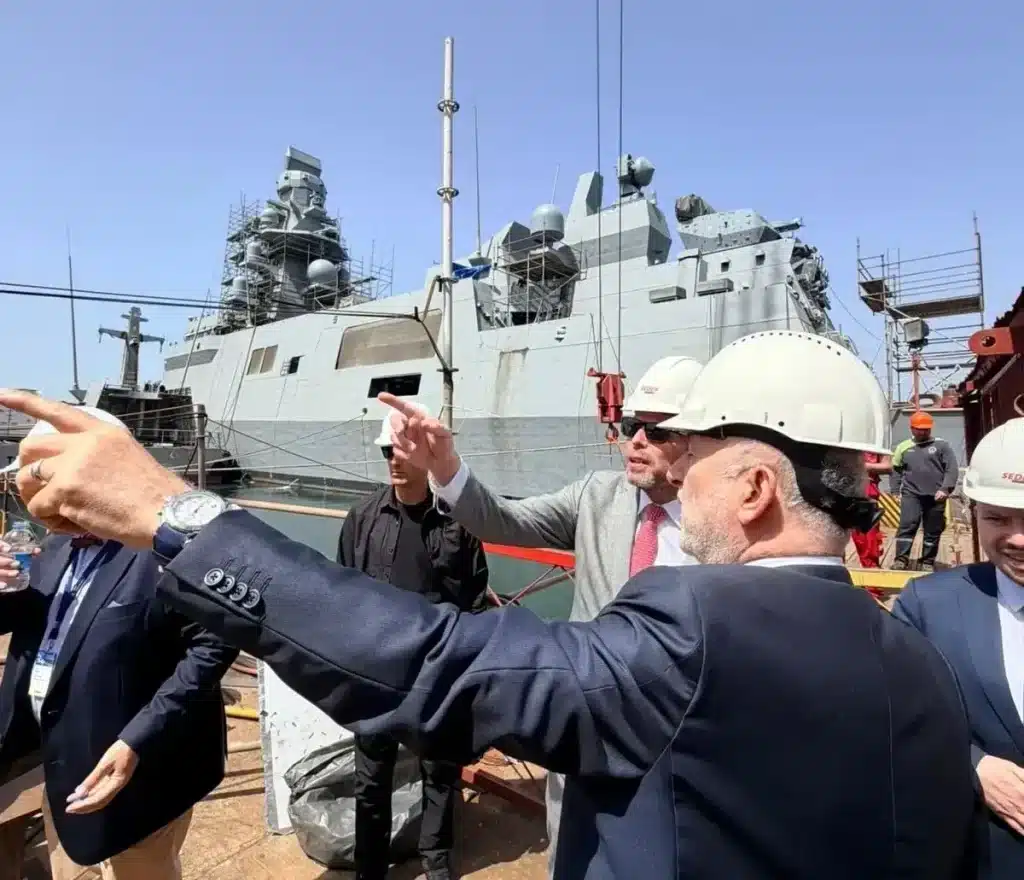
Türkiye is the most politically interesting entry on the list and have surprised many. Turkish shipyards could present the I-class frigate as a readily identifiable option, while larger future designs may also be marketed depending on Belgian requirements. The I-class is not a direct ASWF equivalent and would require adaptation to Belgian sensors, weapons and NATO integration standards. Still, Türkiye’s attraction is clear: its naval industry has demonstrated a capacity to build a broad range of warships at pace, including corvettes, frigates, amphibious vessels and auxiliary platforms.
Francken’s interest did not emerge in a vacuum. During his visit to Türkiye in May, the Belgian minister toured Istanbul’s Sedef Shipyard and engaged with Turkish defence companies. He described Türkiye as an emerging maritime power and highlighted what he saw as the country’s ability to produce naval systems quickly and at competitive cost. Those remarks should be treated as political observations rather than proof that a Turkish deal is imminent. Visiting a shipyard and praising industrial capacity is not the same as endorsing a final platform, signing a contract or resolving the difficult questions of combat systems, armaments, support and sovereign maintenance.
Nevertheless, the visit has strengthened the perception that Turkish industry is now part of Belgium’s serious procurement calculation. Reports have linked Sedef to potential interest, but no official Belgian decision has confirmed a Turkish shipyard, a specific design or a contract structure.
For Brussels, the real test is not simply whether another country can offer a cheaper frigate on paper. It is whether that ship can meet Belgium’s anti-submarine warfare requirements, integrate smoothly with NATO allies, be delivered before the current fleet becomes untenable, and remain affordable through decades of operation.
Francken’s October decision will therefore be more than a contract choice. It will determine whether Belgium preserves the Dutch-Belgian naval partnership around Damen’s ASWF programme—or accepts that operational urgency, cost and industrial reality require a different course.