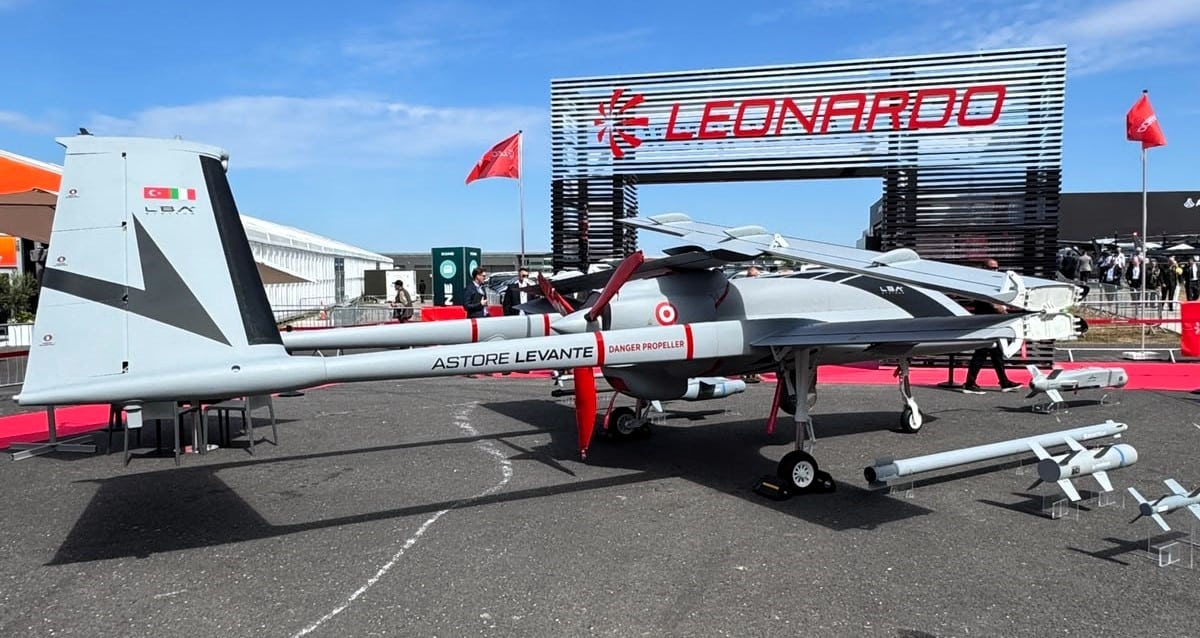
At the 2026 Farnborough International Airshow, the newly operational Leonardo-Baykar joint venture, LBA Systems, unveiled its first product: the Astore Levante. Based on Baykar’s Bayraktar TB3 carrier-capable UCAV and equipped with Leonardo mission systems and payload options, the aircraft is aimed squarely at the growing European naval unmanned aviation market.
The announcement is significant because the programme is already moving beyond the exhibition stage. Leonardo said the first batch of Astore Levante systems is now in production at its facilities in Italy and is expected to be delivered to an Italian end-user before the end of 2026. The company did not formally identify that end-user in its Farnborough announcement.
Astore Levante is based on the TB3. Designed for operations from short-deck ships, the TB3 has folding wings, reinforced landing gear and autonomous take-off and landing capability. It is already in service with the Turkish Naval Forces aboard the amphibious assault ship TCG Anadolu, where it has been employed for shipborne ISR and strike missions. During NATO’s Steadfast Dart 2026 exercise, TB3s conducted autonomous launches and recoveries from Anadolu and carried out live MAM-L precision-guided munition firings.
The TB3 is also entering the export market. Indonesia has been announced as its first export customer, with plans to procure both land-based and shipborne variants. The programme therefore arrives in Europe with operational experience in Turkish naval service and a confirmed international customer.
At Farnborough, LBA Systems presented the aircraft with a wide range of Leonardo payload options. These include the LEOSS-T electro-optical/infrared targeting turret; the Gabbiano T-80UL 360-degree surveillance radar; the Osprey 20/30 multi-mode AESA surveillance radar; the SAGE digital ESM/ELINT suite; and the Brite Storm stand-in jammer. The displayed option list also included the ULISSES ultra-light acoustic system for anti-submarine warfare applications, along with Leonardo’s IFF 428 identification system and SDR SRT-800 software-defined airborne radio.
The range of payloads underlines LBA Systems’ intention to offer a modular multi-mission aircraft, rather than a single fixed configuration. Potential roles include maritime surveillance, targeting, electronic intelligence, electronic warfare and anti-submarine warfare support.
The Italian Navy is expected to be a key operator. As previously reported by Naval News, Italian Navy Chief VAdm Berutti Bergotto said in March that the service plans to acquire the TB3 through Leonardo and operate it from the aircraft carrier Cavour. The carrier already operates F-35B STOVL fighters, and a fixed-wing UCAV would add an organic long-endurance ISR and armed capability to its air wing.
By combining a TB3 platform already operating at sea with Leonardo’s sensors, integration capabilities and Italian production base, Astore Levante offers a near-term route toward an interoperable European carrier-based drone capability.
Naval News comments
The presentation of the Astore Levante at Farnborough marks a pivotal transition for carrier-based uncrewed aviation.
For approximately a year, the baseline Bayraktar TB3 has been conducting routine, fully autonomous take-offs and landings aboard the Turkish Navy’s flagship, TCG Anadolu. Beyond initial trials, the platform’s operational value was firmly established during NATO’s Steadfast Dart 2026 exercise in the Baltic Sea, where TB3s flew over 230 sorties under harsh winter conditions, performing autonomous shipboard recoveries and conducting live strikes with MAM-L smart munitions. This demonstrated to Alliance members that shipborne UCAVs are no longer a future concept, but an operational reality capable of reshaping naval aviation doctrine.
The platform is also making international strides. Indonesia was announced as the first export customer for the TB3, procuring both land-based and shipborne variants. Notably, during Indo Defence 2025 in Jakarta, scale models of the TB3 were displayed aboard a model of the Giuseppe Garibaldi aircraft carrier. Following the finalized transfer of the former Italian flagship to the Indonesian Navy, the TB3 is widely expected to form the core of Garibaldi’s aviation wing.

With the Italian Navy Chief VAdm Berutti Bergotto publicly confirming Italy’s intent to acquire the TB3 via Leonardo for deployment aboard the aircraft carrier Cavour, the integration of the Leonardo-equipped Astore Levante variant is virtually certain.
Now slated to operate across three distinct flat-top vessels—TCG Anadolu, Cavour, and Giuseppe Garibaldi—the TB3/Astore Levante family establishes a compelling operational blueprint. Operating high-end manned fighters like the F-35B carries substantial flight-hour costs and wear on airframes. For low-to-medium stress missions such as long-endurance ISR, armed reconnaissance, screening, and anti-submarine warfare support, deploying a low-cost, highly autonomous UCAV offers an unmatched force-multiplier. As navies worldwide reassess carrier air wing economics, the adoption of shipborne UCAVs like the Astore Levante on large amphibious and carrier decks is set to become the standard rather than the exception.