Naval Group unveils a more heavily armed, multirole MP-OPV for Lithuania, backed by the SHIELD Lab initiative.
On July 1, 2026, Naval Group and four Lithuanian research institutions signed a Letter of Intent (LoI) in Vilnius to establish SHIELD Lab, a maritime defence innovation laboratory supporting the Lithuanian Navy’s future capability development.
The initiative, involving Kaunas University of Technology (KTU), Klaipėda University, the Baltic Institute of Advanced Technology (BPTI), and the Center for Physical Sciences and Technology (FTMC), is part of Naval Group’s industrial cooperation proposal for Lithuania’s Multi-Purpose Offshore Patrol Vessel (MP-OPV) programme.
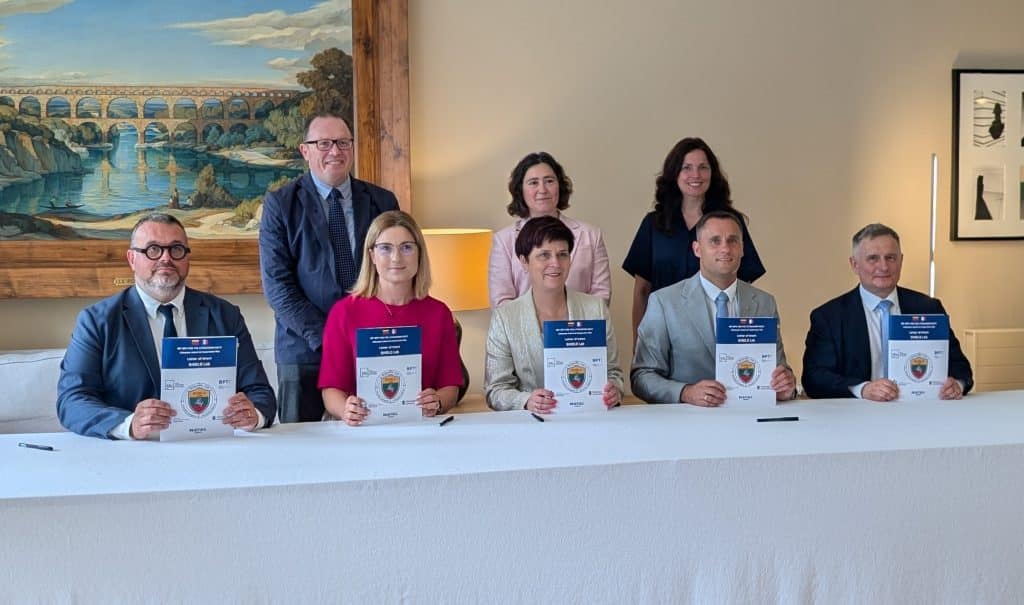
SHIELD Lab will focus on the Lithuanian Navy’s research priorities, developing a dedicated R&D roadmap for the future MP-OPV programme, advancing technologies for the international VANTAGE programme, and supporting other collaborative defence innovation projects.
Through the initiative, Naval Group aims to establish Lithuania as a long-term industrial partner within its global ecosystem through shipbuilding cooperation, industrial integration, technology transfer, and capability development.
Updated MP-OPV Design
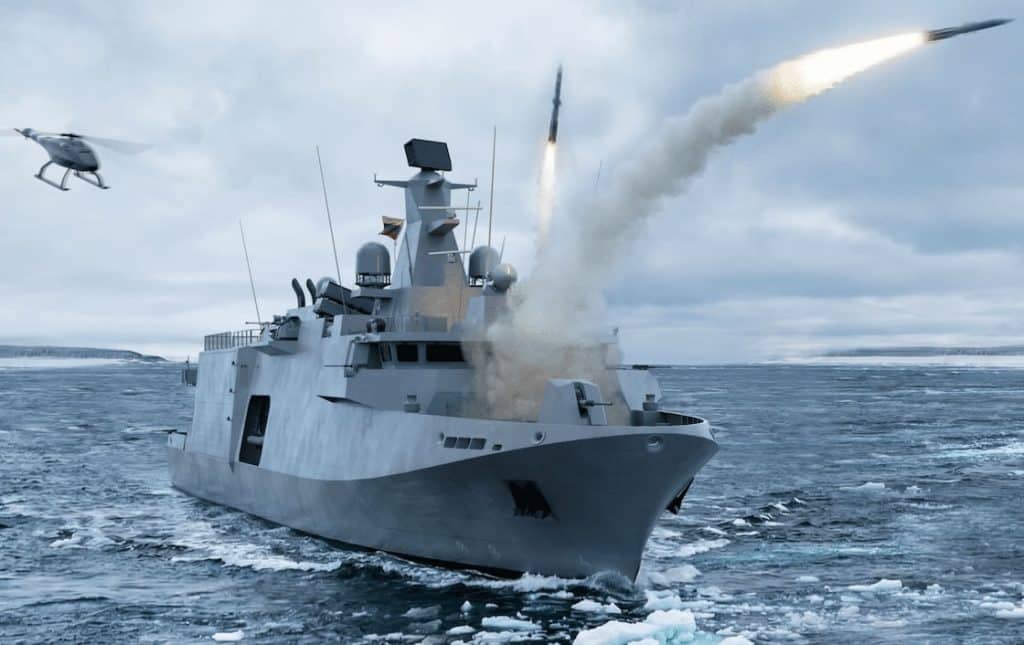
Naval Group also unveiled the latest iteration of its MP-OPV design, reflecting discussions with the Lithuanian Navy and incorporating requirements tailored to the customer’s operational needs. Compared with the earlier concept of MP-OPV, the updated design as seen on the above image features a substantially heavier combat system, approaching corvette-level capabilities, including an OTO 76mm main gun, a VLS for surface-to-air missiles (possibly CAMM or VL MICA), two quadruple anti-ship missile launchers (for Naval Strike Missile) and two MARLIN 30mm RWS. The CGI also shows a new radar up mast, which looks to be Hensoldt’s TRS-4D. The design previously featured a radar dome (likely with Thales NS series radar inside). A STIR 1.2 fire control radar (FCR) was also added. The VTOL UAV flying next to the vessel is the V-200 by UMS Skeldar. The vessels are shown operating in icy waters, meaning the hull is ice-reinforced (at least “basic ice class”).
The MP-OPV is a highly modular and heavily armed platform derived from Naval Group’s Mine Warfare Platform (MWP), developed for Belgium and the Netherlands under the rMCM (City Class) programme, while retaining a high level of commonality with the six 2,800-ton MCMVs ordered by each country.
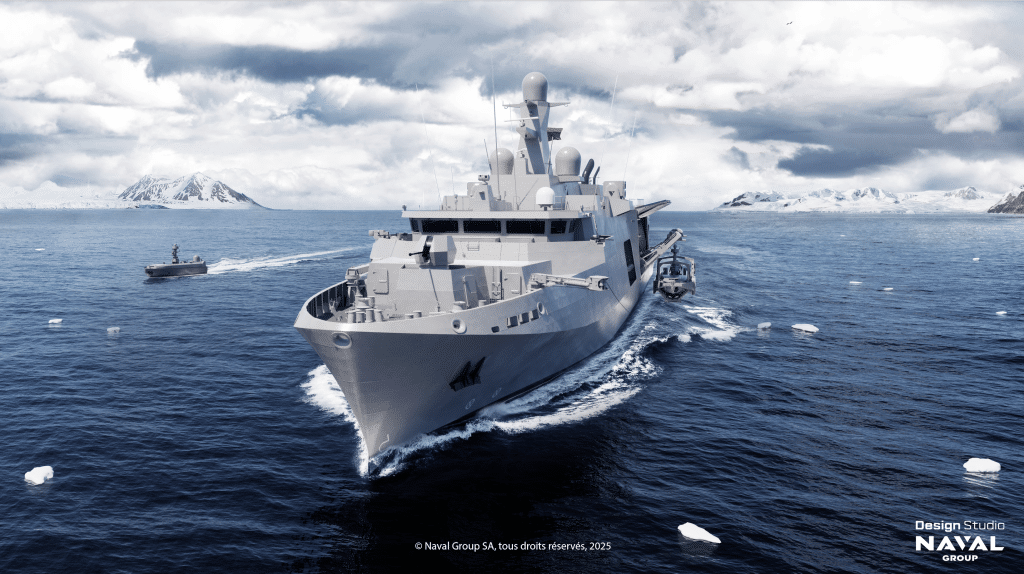
Contacted by Naval News, Naval Group explains the MP-OPV enhances the “Multi-Purpose” character of the Belgian-Dutch MWP. While the latter derives its multi-role capability from its mission bay, which allows it to launch and recover, in a wide range of sea conditions, any type of drones, and 12.5 meters long, the MP-OPV not only adopts this “core concept,” proven through the rMCM program, but also significantly enhances the versatility of the vessel with an extended stern deck, allowing the installation of eight 20-foot containers (which facilitates the integration of mining systems or other containerized systems) as well as a reinforced flight deck, enabling the landing of a 6-ton class helicopter, facilitating the deployment of special forces, for example.
Furthermore, the native self-defense capabilities of the MWP are considerably enhanced and supplemented, equipping the MP-OPV with armament that allows it to engage any aerial target and any surface target at significantly increased distances, meeting the Lithuanian need. The Lithuanian Navy plans to fully modernize its fleet through the acquisition of 4 multirole, modular drone deployment vessels through a national acquisition program.
VANTAGE Project
Naval Group aims to maximize the integration of systems and subsystems developed by the Lithuanian defence industry into the MP OPV solution. Naval Group is committed to introducing technologies that are new to the market, providing a competitive edge for the MP-OPV and, in the longer term, for other Naval Group vessels in both domestic and export markets.
As an example, Naval Group plans to launch the VANTAGE project (Versatile Airborne Network for Threat Assessment, Geolocation and Engagement), a containerized, ship-based, multi-layered drone System of Systems (SoS) designed to enhance maritime security and operational awareness.
VANTAGE will strengthen close-range protection against emerging aerial and surface threats while extending the ship’s surveillance capabilities. By integrating mature and responsive drone technologies from Lithuanian companies, the system will improve early detection, threat assessment, and graduated response options across a wide operational range.