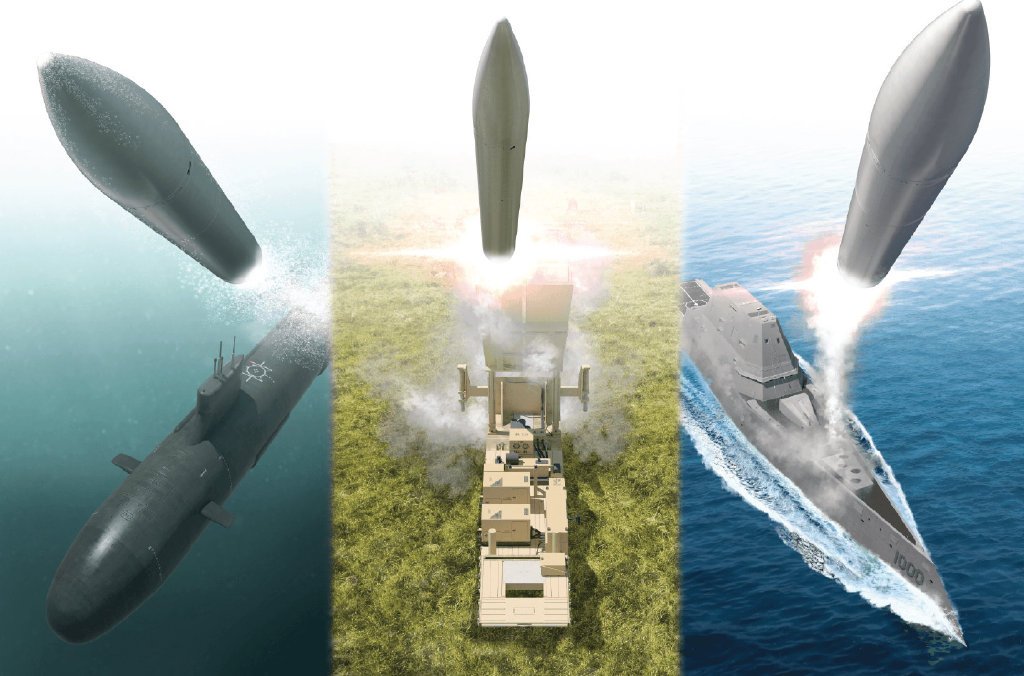
The U.S. Navy’s next-generation undersea developmental efforts aim to drastically expand the deployment methods from which the service’s Conventional Prompt Strike (CPS) hypersonics can be launched from and increase their production rates.
Headed by the Portfolio Acquisition Executive Strategic Systems Programs, the service’s organization responsible for the development and sustainment of Submarine-Launched Ballistic Missiles and new hypersonic weapons, the Next Generation Undersea Security Initiative includes several focus areas encompassing the Navy’s conventional prompt strike portfolio.
According to the solicitation, the office includes provisions that plan to support the firing of conventional hypersonic missiles through what is described as “flexible deployments” via new novel launch systems.
“Solutions can include, but are not limited to, containerized launchers, air-transportable launcher systems, or large Vertical Launch System (VLS) modification/integration into Navy surface and undersea platform,” reads the document.
With the rise of adversaries such as China in the Pacific, the U.S. Navy has developed Conventional Prompt Strike (CPS) to deliver strikes across extended ranges at a quicker rate compared to other capabilities, such as strike aircraft and subsonic cruise missiles. The service will field the hypersonic aboard the Zumwalt-class guided-missile destroyers, each slated to equip 12 of the CPS, and future variants of the Virginia-class nuclear attack submarine.

Developing new systems to support hypersonic launches beyond the existing Large Missile VLS’ undergoing installation on the Zumwalts can provide American commanders with an expansive strike capability. Air-transportable launchers enable the rapid insertion of these long-range missiles into austere locations. Meanwhile, containerized missiles can be carried across a variety of warships and unmanned surface vessels or in a dispersed deployment scheme.
The undersea security initiative is eyeing solutions that could increase the annual production of CPS into the hundreds. Focus areas covering advanced solid rocket motors and thermal protection systems demand bids that are able to be scaled for production at a cost-effective rate.
Aside from increasing the methods of launching CPS and increasing hypersonic production rates, the initiative also wants to support the development of new conventional warheads.
These demands come amid comments the service’s top surface warfare chiefs regarding the role and scale of hypersonic deployment across Washington’s fleet in the coming years. At Surface Navy Association 2026, RAdm. Derek Trinque, director of the Navy’s Surface Warfare Development Office (N96), stated the need to proliferate hypersonics across the fleet. In testimony to Congress in May, Adm. Daryl Caudle, the Chief of Naval Operations, highlighted how the Containerized Capability Campaign can bring much-needed firepower and capabilities to the fleet at a faster pace compared to previous efforts.
In recent years, industry has developed new launching systems and furthered solid rocket motor production capabilities. In 2023, Lockheed Martin told Naval News that the development of its Growth-VLS would be able to the hypersonics envisioned to be carried by the DDG(X) program. The Pentagon recently turned to Castelion, a firm focusing on the production of low-cost hypersonics, to provide a high-speed strike capability for the Navy’s carrier fighter aviation.