The US Navy has awarded CoAspire a $70M agreement to develop the CHAOS cruise missile, a low-cost, ground-launched anti-ship weapon for coalition partners.
CoAspire press release
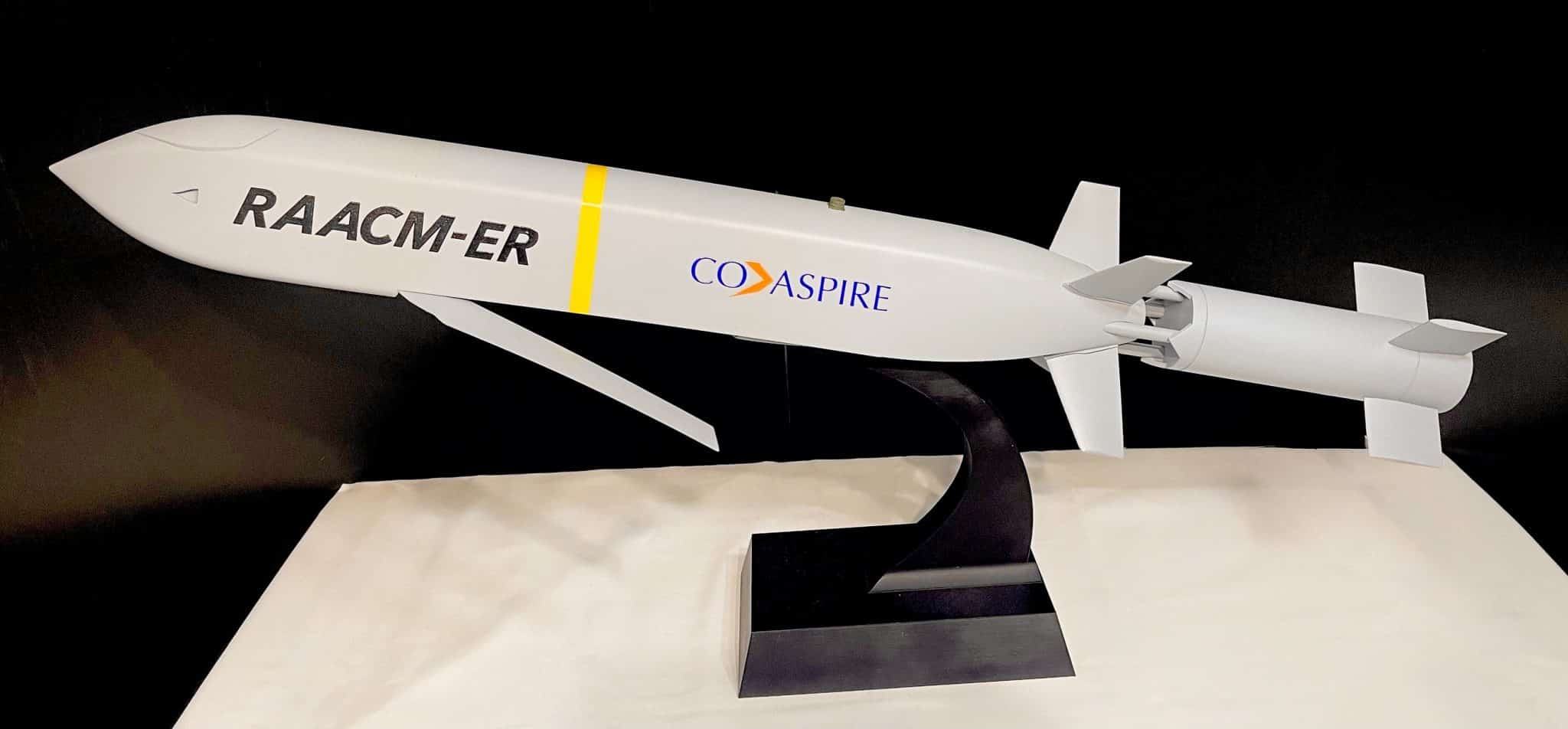
The U.S. Navy has selected CoAspire’s Rapidly Adaptable Affordable Cruise Missile-Extended Range (RAACM-ER) Ground-Launched variant for its new Coalition Heterogenous Affordable Offensive Strike (CHAOS) program. Under a $70m Prototype Other Transactional Agreement (OTA) with CMG Networks on behalf of Naval Aviation Systems Consortium, CoAspire will design, build, test, and deliver to Program Acquisition Executive for Munitions and its program office, PMX-201, an affordable, ground-launched, mid-range, cruise missile system that can attack both land-based and moving maritime targets.
The end-use Foreign Military Sale (FMS) customers are allies and coalition partners needing an affordable yet highly effective maritime strike weapon that can be easily manufactured at scale. CoAspire’s solution uses the RAACM-ER, combined with a booster and launcher system, to create RAACM-ER Ground-Launched. CoAspire’s’ RAACM-ER Ground-Launched—adapted for the specific requirements of CHAOS—is comparable to the RAACM‑ER GHOST variant used in the OUSW R&E and U.S. Army PAE Fires-funded Low-Cost Containerized Munition (LCCM) program.
“CoAspire is thrilled to support the U.S. Navy with this much-needed, affordable, mid-range maritime strike weapon,” said Doug Denneny, CEO, owner, and founder. “We, and our 56 first-tier suppliers across almost every state, are excited to support PMX-201, NAVAIR, and our coalition partners with an affordable cruise missile solution.”
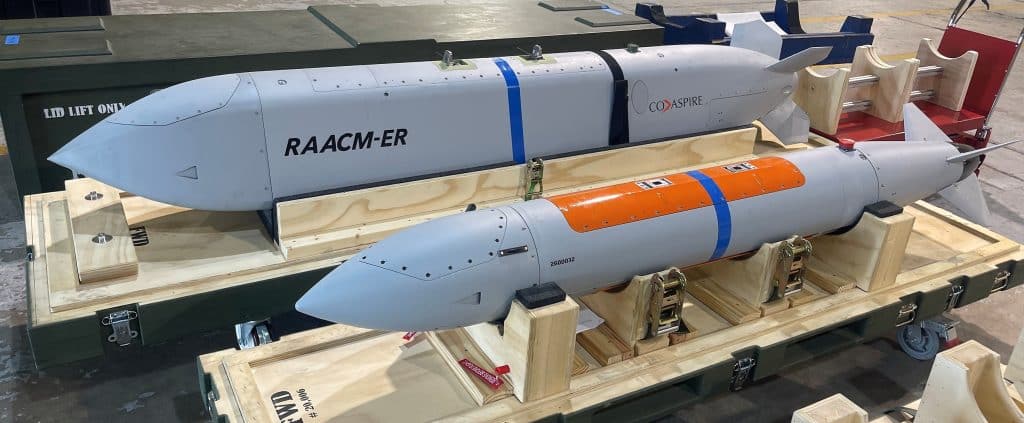
CoAspire’s RAACM Family
CoAspire’s RAACM family of affordable cruise missiles offer multiple variants to support air, surface, and ground-launch solutions. The RAACM-ER utilizes additive manufacturing to allow for maximum payload capacity. An additive approach also allows for rapid modifications and a reduction in tooling and touch labor that results in cost reductions and program improvements without breaking a production line for re-tooling. It also allows for the development of new variants in months compared to years needed by other missile manufacturing methods.