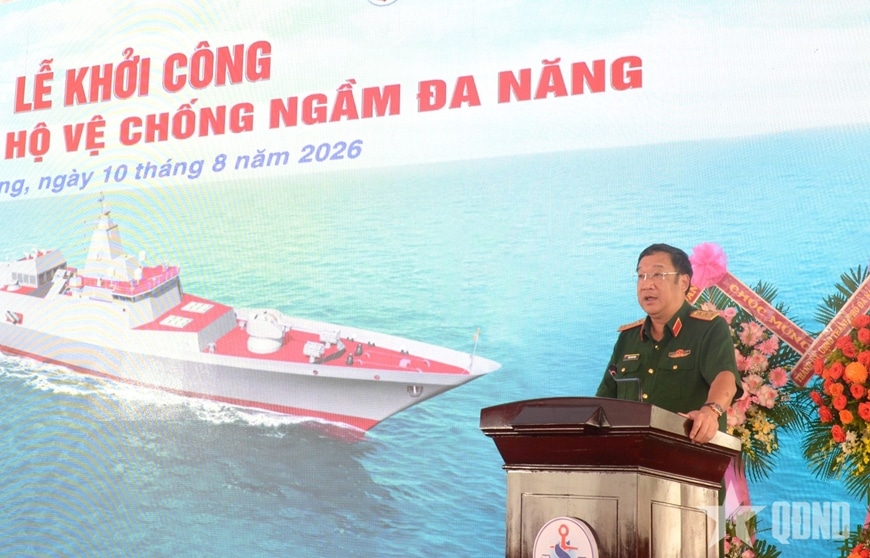
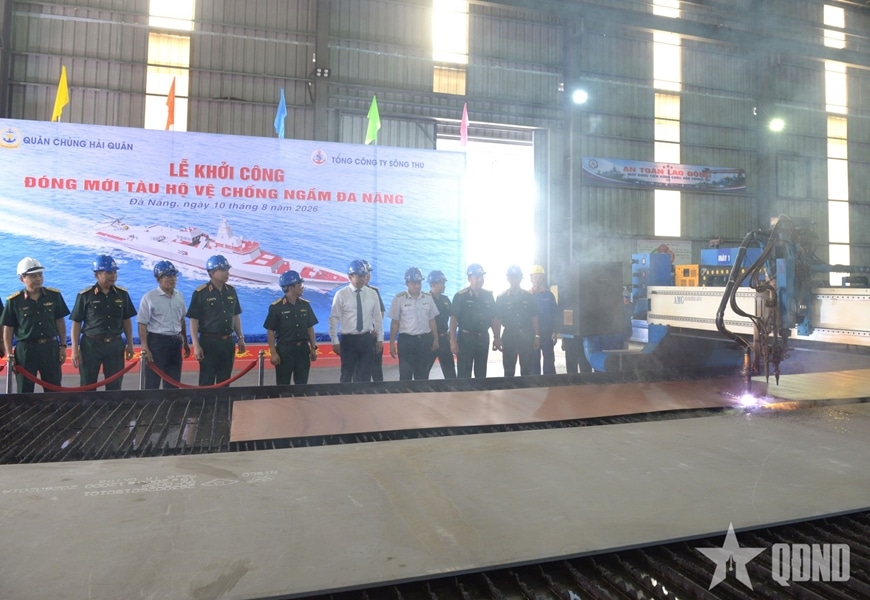
On 10 August 2026, Vietnam held a ceremony to initiate construction of a brand new type of indigenously designed, multipurpose frigate for the Vietnam People’s Navy (VPN).
The chosen shipbuilder of this anti-submarine warfare (ASW) frigate is Song Thu Corporation. It is unclear how many vessels will be eventually produced, but the first is now under construction at Song Thu’s shipyard in Da Nang.
Vietnam’s Transition to Indigenous Shipbuilding
Vietnam has traditionally relied on the USSR, now Russia, for much of its military kit. Examples include four Gepard 3.9-class (Project 11661) frigates and six Project 636.1 Kilo-class submarines. However, Hanoi is seeking to diversify away from relying solely on Moscow so it can be far more independent in terms of defence equipment.
This new type of frigate can be fairly described as a domestic design, since it has a high percentage of indigenous systems and weapons. Indeed, General Pham Hoai Nam, Vietnam’s Deputy Minister of Defence, affirmed at the 10 August ceremony that the ship has a very high proportion of domestically developed weapons and technical systems. He asked national agencies and business units to treat this shipbuilding programme as a key political task that requires the focus of all their resources and close coordination.
Earlier reports suggested Vietnam was going to build a 4,000-tonne, 125m-long warship based on a heavily modified Russian Project 11356R Admiral Grigorovich-class frigate. However, those reports proved erroneous, for Vietnam’s multirole frigate likely displaces somewhere between 2,500 and 3,000 tonnes. It appears slightly larger than the 2,500-tonne Gepard 3.9 design, and some sources suggest it is in the order of 105m long.
Design and Sensors
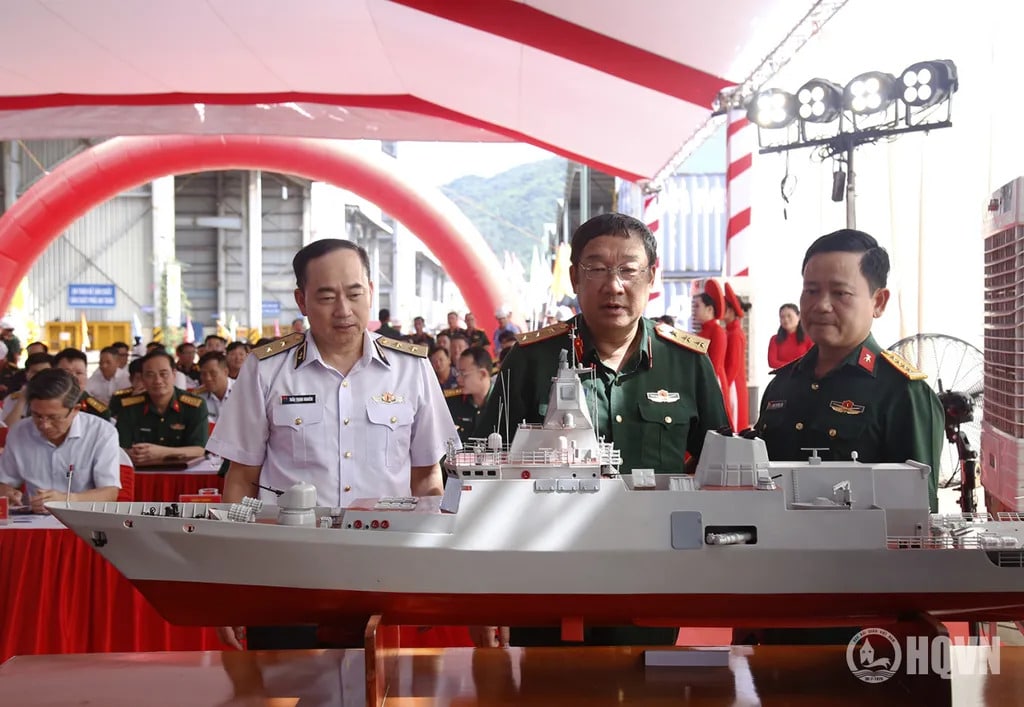
Unfortunately, no official specifications have been released yet, but some details can be ascertained from a scale model and a rendering that were present at the formal ceremony.
In terms of armaments, beginning from the bow, there is a pair of RBU-6000-style anti-submarine weapons, behind which is mounted an AK-176-based 76mm naval gun that Vietnam’s Z173 and Z125 Factories are already producing. There are also two eight-barrelled chaff launchers in this area (and another two at the stern near the hangar).
Next up is a vertical-launch system featuring twelve cells, this divided into two sets of six. It is unclear what type of missile will fit in these cells, which appear quite large (at least if these model details are shown to scale). There is speculation they might quad-pack Viettel’s under-development TLĐK-01 surface-to-air missile that possesses an estimated 70km range. This would require the military-owned company to have developed a naval version of the missile.
On top of the bridge are two twin launchers for man-portable air defence system missiles. These launchers come from the Z131 Factory and could be used for countering drones. Atop the amidships superstructure are two quad launchers for anti-ship missiles, presumably for Viettel’s VCM-family missiles. There are also two trainable double 533mm torpedo launchers inside the hull, plus a pair of AK-630M-type 30mm close-in weapon systems from Factory Z173 aft of the funnel.
At the stern are a landing deck and a hangar able to accommodate a helicopter such as the Ka-28s that the VPN operates. Above the bridge superstructure is a phased-array, multifunctional radar with four fixed panels, presumably developed by Viettel. There is another fire control radar above that too, and the combat management system and electronic support measures will come from Viettel.
The frigate’s propulsion includes four engines, likely two diesels and two gas turbines, though no details are yet available on their exact provenance. As an ASW platform, it will have a hull sonar, and potentially a towed array sonar too.
Vietnam expects it to take 36 months to build the new frigate, its most sophisticated naval vessel project to date. Of course, this is an ambitious timetable, especially for Vietnam’s most sophisticated naval shipbuilding programme to date.
Strategic Imperatives in the South China Sea
Hanoi is pursuing a national defence industry policy emphasising self-control, self-reliance, self-efficacy and modernity. One Vietnamese news agency gushed, “The project is the result of wisdom, bravery, aspiration and self-reliance, marking an important development of the defence industry, the military shipbuilding industry as well as the ability to master core technology, research, design, manufacture of weapons and equipping techniques in the country.”
On 28 July 2016, the 14th Party Central Committee issued Resolution No. 20 that pledged Vietnam would become a “strong country of the sea”. This is important, since China encroaches and threatens other South China Sea claimants such as the Philippines and Vietnam. Modern vessels are therefore needed to protect and assert Vietnamese sovereignty in the Spratly Islands, since Vietnam lost control of the Parcel Islands to China in 1974.
This new frigate being manufactured by Song Thu Corporation also reflects the trend for Southeast Asian navies to modernise their surface combatant fleets with larger, multirole vessels.
Vietnamese Domestic Naval Projects
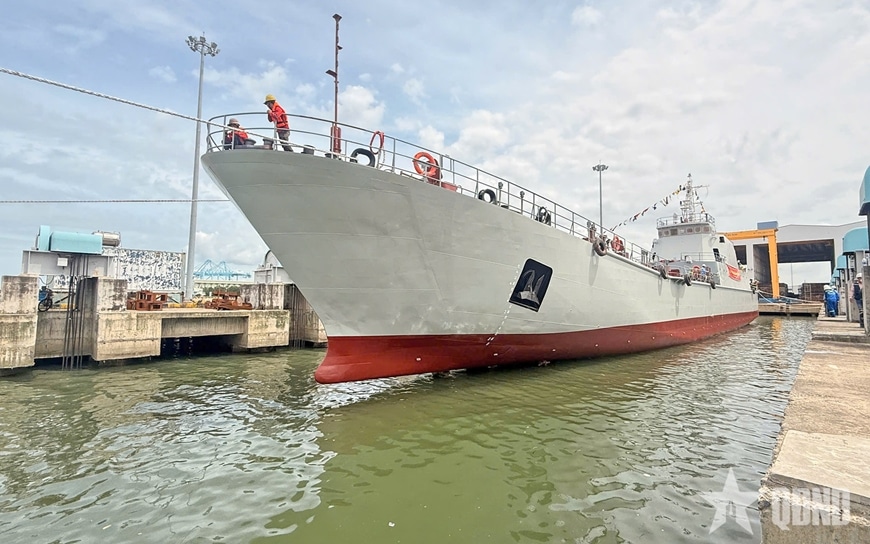
While this multipurpose ASW frigate represents Vietnam’s blue-ribbon project, the country has a number of other naval projects on the go too. Song Thu Corporation for example, is nearing completion of a second submarine rescue vessel for the VPN, after construction kicked off in March 2025. It will join an earlier one christened Yết Kiêu (pennant number ‘927’) and commissioned in 2021. This vessel displaces 3,950 tonnes and is 93m long.
The Naval Technical Institute also implemented the TN-75 domestic submarine project from 2020-25. This state-level project produced a 75-tonne midget submarine, demonstrating Vietnam’s ability to domestically design and manufacture mini-submarines. The TN-75 can dive 200-300m, stay underwater for seven days and carry a commando squad of 6-7 personnel. It performed its maiden test dive in 2022, and just one is known to exist presently. Yet to be revealed by the Vietnamese authorities are a TN-300 300-tonne mini-submarine design, and a new type of minehunter.
On 6 August 2025, Ba Son Corporation launched a VDC-01 landing ship at its shipyard in Ho Chi Minh City. At that point it was 80% complete. Although an indigenous project, it is presumed to be based on the Soviet-era Project 770 (Polnocny-class) medium landing ship.
On 24 July 2026, the X55 Factory launched the third ST-294 troop transport vessel; the second had been accepted into service in early 2024. This class employs a 36.5-long aluminium alloy hull, and they will be used for patrol and troop transport duties in Military Region 9 in the Mekong delta area of southwest Vietnam.
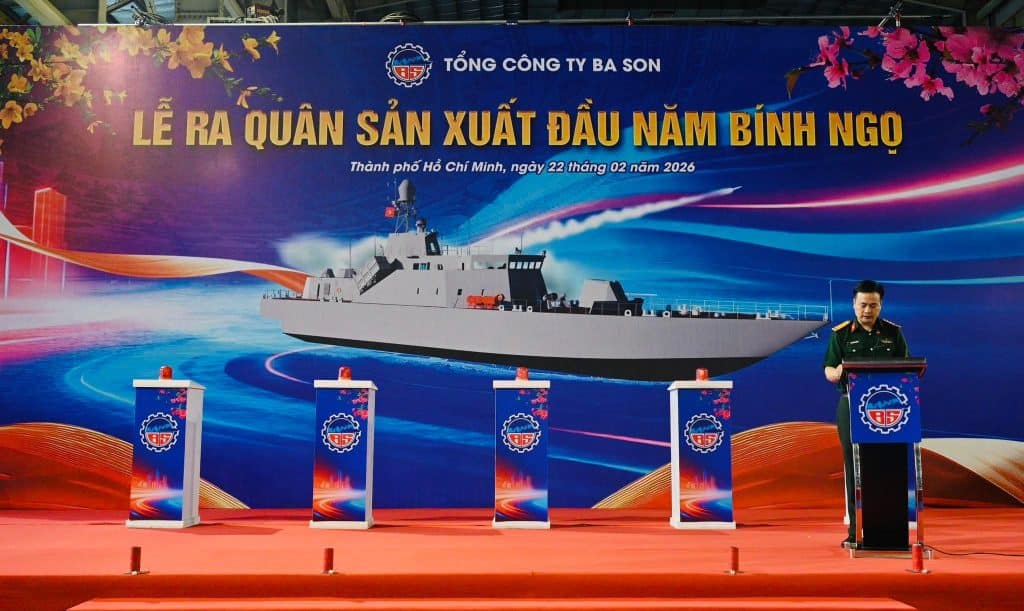
Elsewhere, Vietnam commissioned a single PS500 guided-missile corvette in 2001. Built locally, it was based on the Russian Pauk-class. Ba Son Corporation is now building further examples of this approximately 850-tonne craft. Construction of the second unit (simply called A2) started in Ho Chi Minh City on 28 October 2025, and as at 8 April 2026 it was 13.6% complete. On the same day, Ba Son celebrated the start of construction of the third and fourth PS500 craft, which are creatively known as A3 and A4. The second vessel is due for completion next year, with delivery to the VPN by September 2028. Meanwhile, an anticipated order for the fifth and sixth vessels has not been announced yet.