Lockheed Martin has received an indefinite-delivery, indefinite-quantity contract worth up to $1.2 billion to produce the U.S. Army’s Precision Strike Missile (PrSM) Increment 2, following a second flight test of the weapon’s maritime-strike capability.
The award covers initial procurement, potential future orders, follow-on production and continued development of the new PrSM variant. It marks a significant step for the Army’s effort to add mobile maritime-strike capability to its long-range fires portfolio, using launchers already fielded across the force.
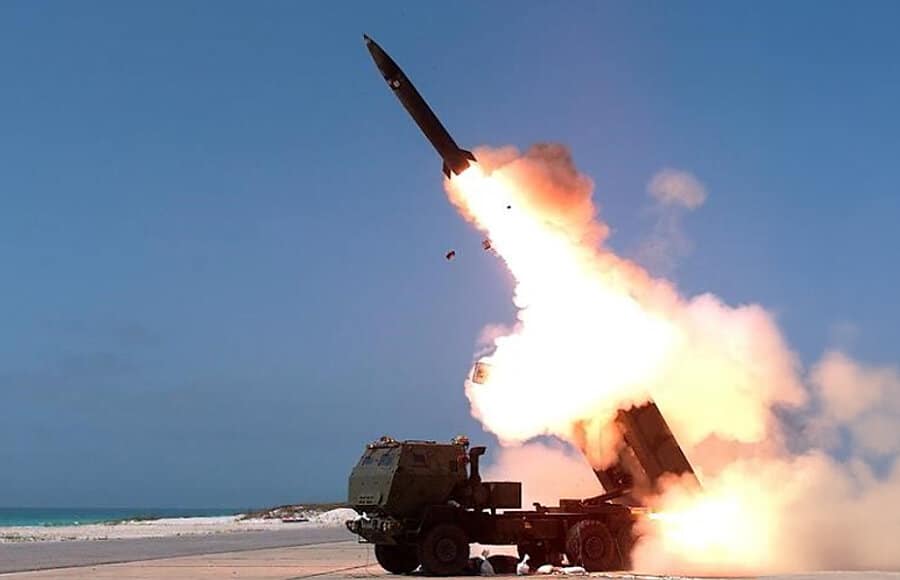
According to Lockheed Martin, the second Increment 2 flight test took place in August after an initial test in March. The missile was launched from an M142 High Mobility Artillery Rocket System (HIMARS), deployed protective covers during flight and engaged its target. Lockheed Martin said the test generated critical flight data, while additional Increment 2 tests are scheduled for 2027.
PrSM Increment 2 adds a multimode seeker intended to allow the missile to engage moving land and maritime targets. This separates the weapon from the baseline Increment 1 PrSM, which was developed principally as a long-range surface-to-surface missile. The Army and Lockheed Martin have previously indicated that the anti-ship mission will be a major focus of the expanding PrSM family.
“This award marks an important step in delivering PrSM Increment 2 to the warfighter,” said Dave Griser, Lockheed Martin vice president for Precision Fires Launchers and Missile. “We’re ready to move from flight testing into production and provide the Army with an expanded long-range precision fires capability.”
The program’s maritime role has been taking shape for several years. During Exercise Valiant Shield 2024, the U.S. Army’s 3rd Multi-Domain Task Force and the Tennessee National Guard fired two baseline PrSMs from a prototype Autonomous Multi-domain Launcher during a SINKEX against the decommissioned amphibious transport dock USS Cleveland (LPD-7). The event represented the first Army employment of an anti-ship ballistic missile outside the United States.
As Naval News reported in 2025, Lockheed Martin characterized Increment 2 as the PrSM variant that would add a seeker for maritime targets, while Increment 1 retained the baseline surface-to-surface mission. The company also said that later variants would further broaden the family’s capabilities: Increment 3 is intended to introduce a lethality enhancement, while Increment 4 is expected to combine extended range with an anti-ship seeker.
The new contract therefore arrives as the Army is pursuing an increasingly layered approach to ground-based maritime strike. PrSM Increment 2 is designed to give HIMARS units an ability to threaten moving targets at distances beyond those available to traditional guided rockets, while retaining the launcher mobility that makes HIMARS attractive for dispersed operations.
That mobility is particularly relevant in the Indo-Pacific. HIMARS can be transported by C-130 aircraft and deployed by maritime means to austere locations, allowing Army and Marine units to operate from islands and coastal areas near important maritime chokepoints. U.S. forces have repeatedly exercised such concepts in the region, including deployments and ship-to-shore movements involving HIMARS-equipped units in the Philippines and Japan.
Increment 2 will not be the longest-range maritime PrSM envisioned by the Army. The service is also accelerating its Increment 4 effort, which seeks a weapon capable of engaging moving maritime and land targets at ranges of 1,000 km or greater, including in GPS-contested environments. Program documents have identified the Indo-Pacific as a key operational environment for that future missile.
Still, Increment 2 could be the more immediate bridge between the Army’s existing long-range fires force and its desired maritime-strike mission. Its use of HIMARS means the capability could potentially be integrated into formations already trained to rapidly deploy, disperse and relocate launchers across littoral terrain.
Lockheed Martin said it is expanding capacity to quadruple PrSM production while continuing work on future increments. The company will now begin producing the initial Increment 2 missiles in parallel with further flight testing and system maturation.