South Korea’s DAPA has approved development for the Ship-to-Ship Missile-II, a stealth, turbofan-powered Anti-Ship Missile designed to double the ROK Navy’s strike range.
The Defense Acquisition Program Administration (DAPA) approved the acquisition strategy for the Ship-to-Ship Missile-II (함유도탄-II) program during the 177th Defense Project Promotion Committee meeting on August 11, 2026. The domestically developed weapon is to be acquired under a program spanning 2028–2039, with an estimated total cost of KRW 1.63 trillion ($1.15 billion). Development is scheduled for 2028–2033, with production targeted to begin around 2034. The missile is expected to equip platforms including the future KDDX Batch-I and Batch-II destroyers.
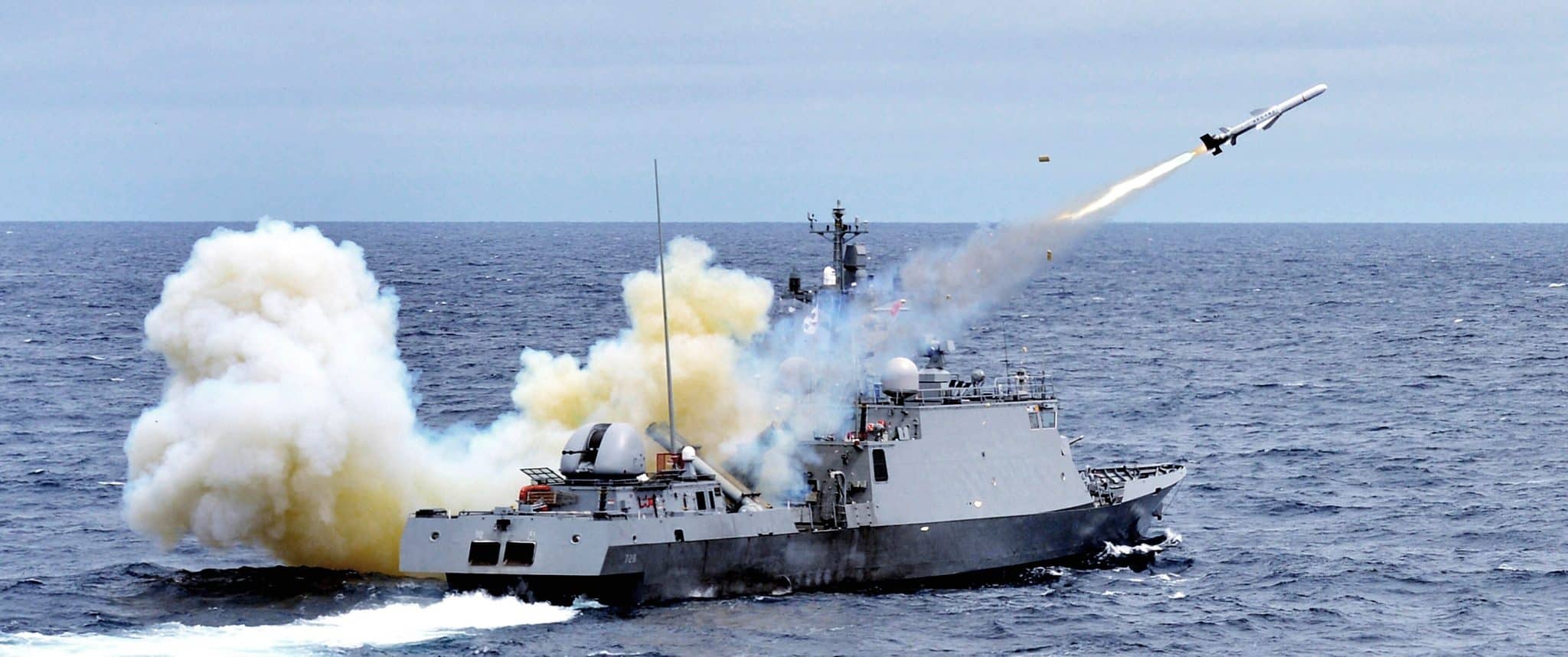
The new Anti-ship Missile (AShM) is intended to extend the Republic of Korea (ROK) Navy’s surface strike range beyond the well-utilized and currently exported Haeseong (SSM-700K C-Star). With Haeseong’s range generally estimated at approximately 150–180 km, its successor is expected to roughly double that figure. DAPA has confirmed increased range as a core program objective, aligning with public reporting placing the anticipated range at approximately 300–360 km while remaining subsonic.
Ship-to-Ship Missile-II is expected to feature a low-observable airframe and replace Haeseong’s turbojet propulsion with a turbofan engine. These design choices point toward a weapon optimized for extended-range engagement and reduced radar cross-section. The Agency for Defense Development (ADD) is expected to lead development, with domestic defense companies manufacturing prototypes.
The increased range reflects a changing regional maritime threat environment. DAPA officials have indicated that the growing anti-ship missile capabilities of neighboring countries informed the requirement. Pyongyang’s broader naval modernization drive—including the construction of 5,000-ton-class destroyers like the Choe Hyon and Kang Kon—provides additional context for South Korea’s efforts to upgrade its surface-strike capabilities.

Speculation persists that the new AShM program could draw heavily on technologies developed for the Cheonryong (KALCM, Korean Air-Launched Cruise Missile) cruise missile, particularly given its low-observable design and turbofan propulsion. Reusing these technologies could provide a foundation for development, though adapting them to a maritime domain requires overcoming distinct engineering hurdles, such as moving-target detection and identification, sea-skimming flight profiles, and surface-launch booster integration.
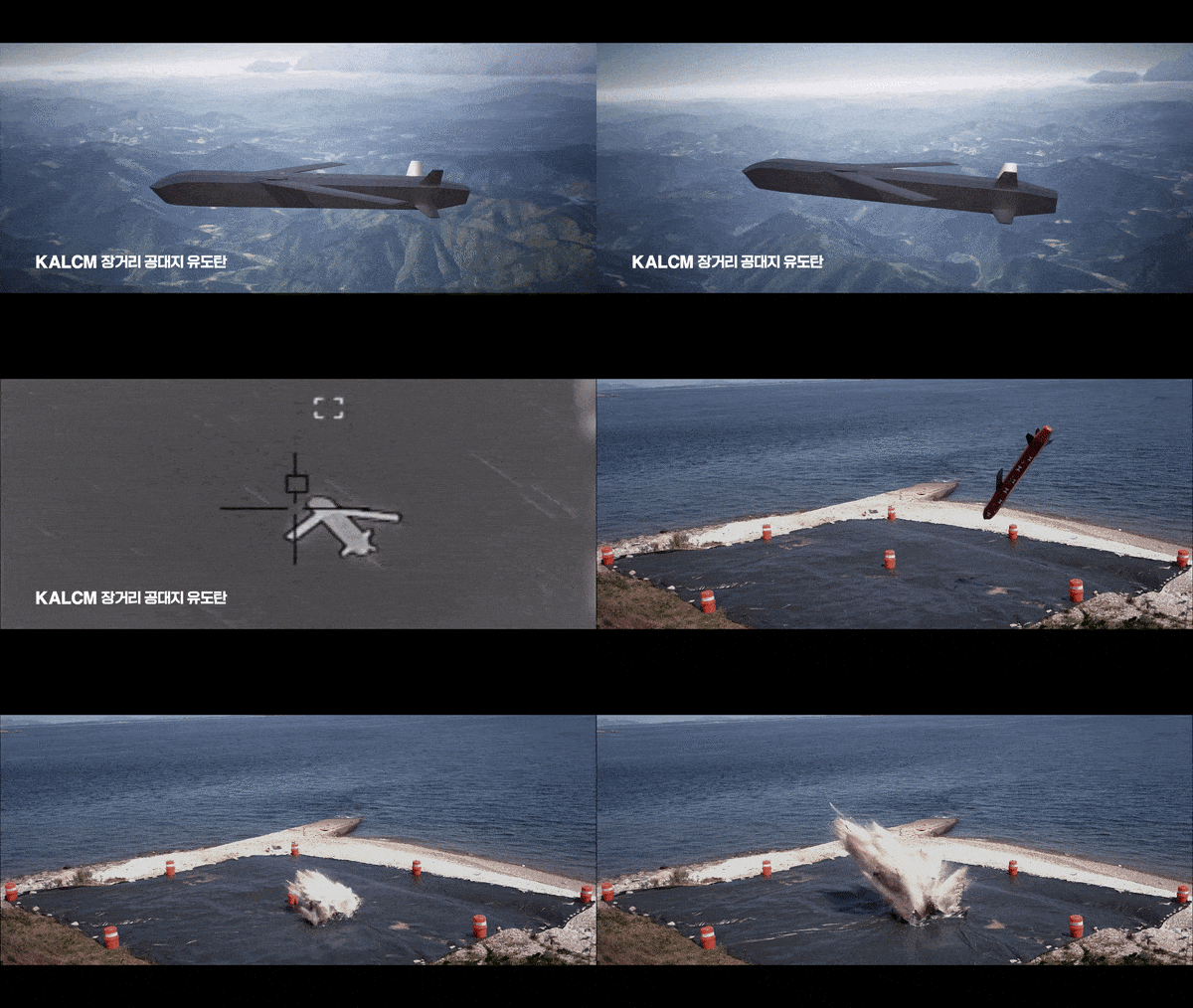
The potential maritime application of South Korea’s air-launched cruise missiles has a long public history. Speaking with Naval News at ADEX 2019, LIG Nex1 representatives noted that integrating an Imaging Infrared (IIR) sensor could theoretically allow KALCM to track moving targets at sea. However, at ADEX 2025, LIG continued to position KALCM primarily for land-attack missions while acknowledging its growth potential. Consequently, applying Cheonryong technologies to the Ship-to-Ship Missile-II is distinct from directly marinizing KALCM itself.
This evolutionary pathway closely parallels the United States’ development of the AGM-158C Long Range Anti-Ship Missile (LRASM) from the AGM-158B JASSM-ER. Just as LRASM adapted an existing land-launch/air-launched stealth architecture for maritime strike with a multimode sensor suite, South Korea is positioned to leverage its cruise missile investments for a new generation of naval firepower. Whether Ship-to-Ship Missile-II will adopt comparable autonomous targeting capabilities remains to be officially disclosed.