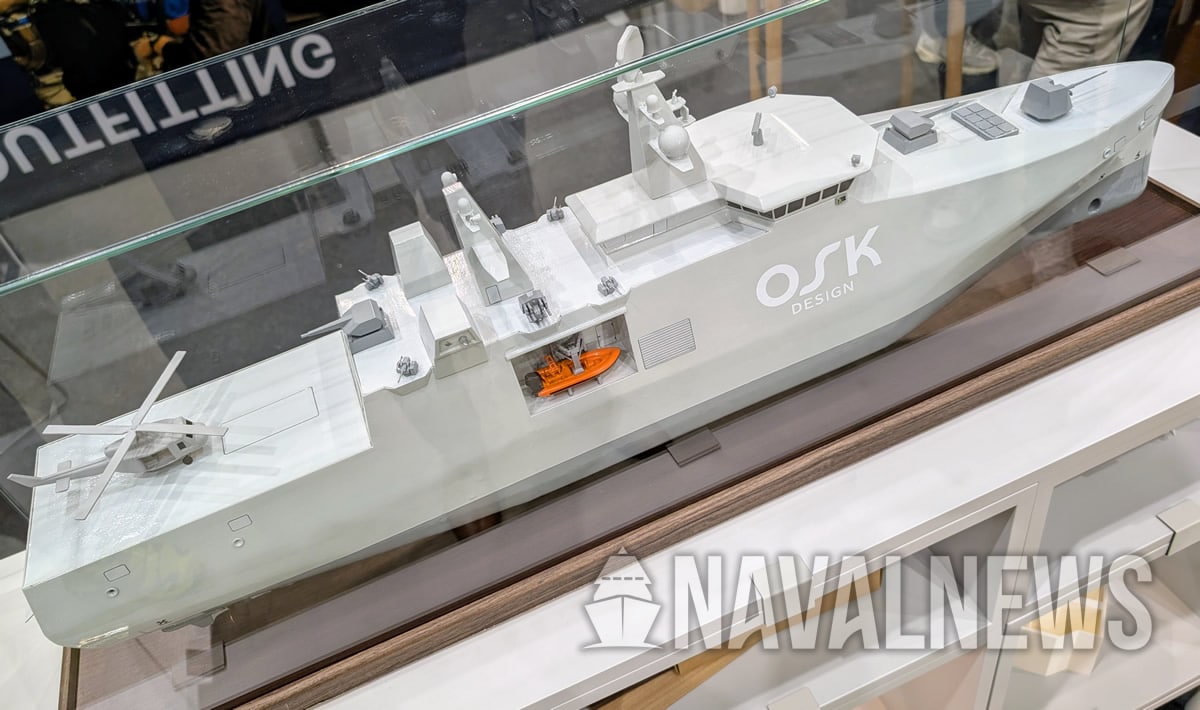
OSK Design unveiled a 95-meter Coastal Corvette concept at DALO Industry Days 2026, offering the Royal Danish Navy a heavy-armed, modular solution to fill its fleet capability gap.
At the DALO Industry Days 2026, Naval News caught up with Lars Povl Jensen, Head of Defense at OSK Design, to discuss the company’s latest naval concept: a 95-meter Coastal Corvette tailored for the Royal Danish Navy. According to Jensen, the design addresses a perceived capability gap within the Danish fleet structure, sitting squarely between traditional frigates and unmanned vessels.
The new corvette concept is heavily inspired by an earlier patrol ship design that OSK Design developed for the Lithuanian Navy, known as the Pakunas. However, to meet broader operational demands, the engineering team lengthened the hull and narrowed the beam slightly to enhance speed and agility. The result is a nimble surface combatant capable of exceeding 25 knots, powered by a combined diesel-electric and mechanical drivetrain (CODLAD) driving either two propellers or pod drives. The propulsion arrangement also incorporates a battery pack designed to enable low-noise operations and efficient energy storage.
In terms of main specifications, the Coastal Corvette features a length of 95 meters, a beam (width) of 14 meters, and a draft of 4.5 meters. The platform is powered by a 20 MW CODLAD propulsion system driving either two propellers or pod drives, which enables a top speed of over 25 knots.
Heavy Armament and Sensor Suite
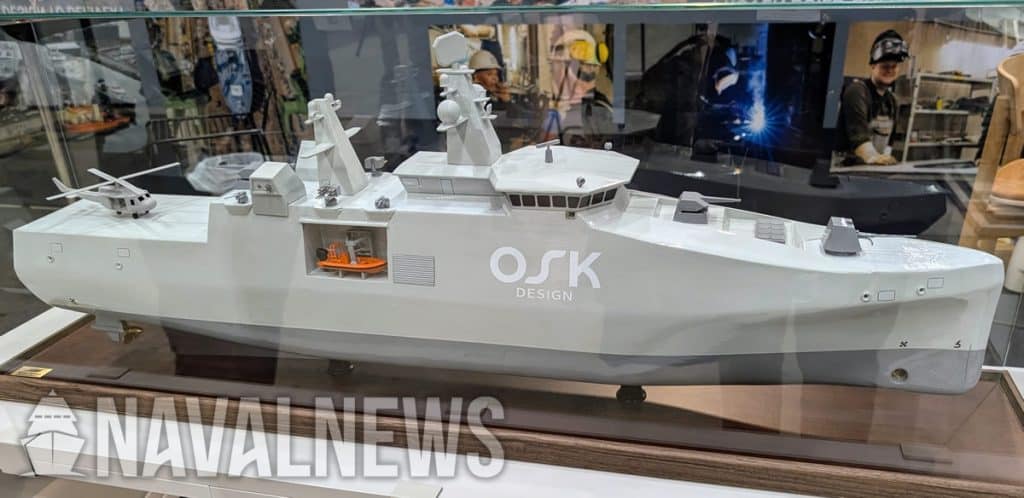
Despite its compact corvette footprint, OSK Design has packed the platform with a heavy armament suite. Jensen emphasized that the vessel features significantly more self-defense and firepower than typically found on ships of this size—a deliberate design choice meant to counter evolving drone and asymmetric threats in modern littoral warfare.
Proposed armaments include:
- Main gun: Up to 76mm
- CIWS: Up to 35mm secondary defense
- Remote Weapon Stations: 2 to 4 stations
- Anti-ship missiles: 8 to 16 launchers
- Vertical Launch System (VLS): Up to 16 cells
- ASW: Dedicated torpedo tubes for anti-submarine warfare
Matching this offensive punch is a robust sensor and combat management suite. The layout features a 3D air surveillance radar with a range exceeding 120 nautical miles, an integrated fire-control radar, electronic support and countermeasure (ESM/ECM) systems, electro-optical/infrared (EO/IR) sensors, and a hull-mounted sonar alongside an optional variable-depth sonar.
Modularity and Crew Capacity
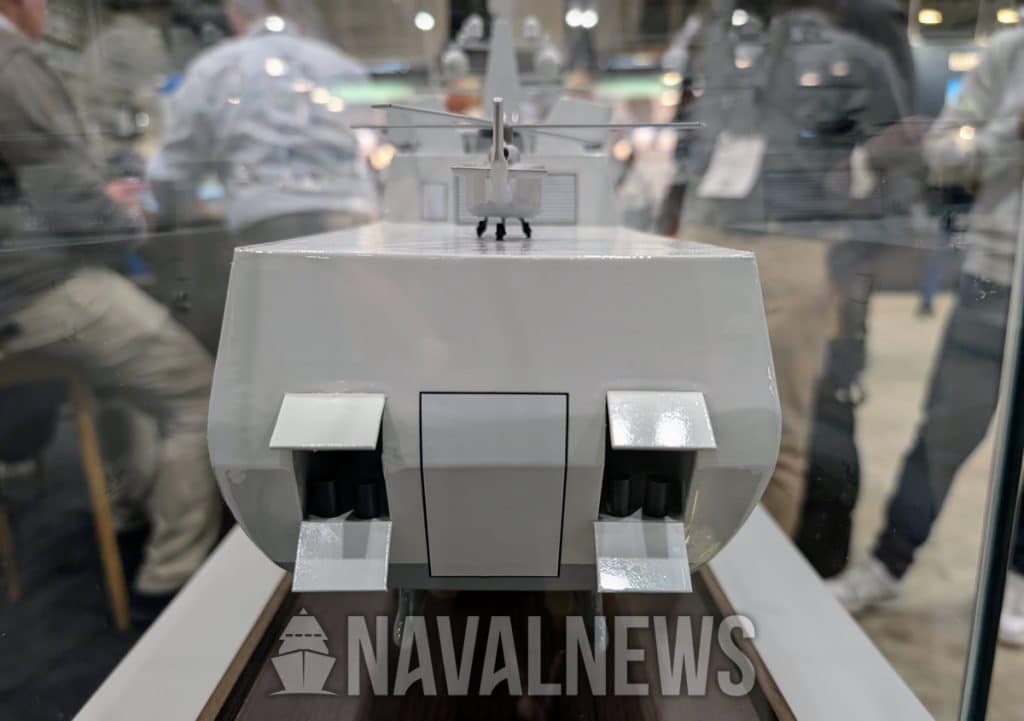
Flexibility and modularity form the backbone of the vessel’s architecture. The aft section features a spacious, configurable mission bay with capacity for up to six ISO 20-foot container positions. This area is engineered for rapid reconfiguration, supporting the deployment, recovery, and management of uncrewed surface vehicles (USVs), uncrewed underwater vehicles (UUVs), and aerial drones. The vessel can also lay sea mines via this mission bay. Additionally, the ship includes an aviation deck capable of handling a medium-sized helicopter of up to 10 tonnes, complete with hangar facilities, a UAV control center, and on-deck refueling capabilities.
The sensor and combat management suite matches the vessel’s offensive punch, featuring a proposed 3D air surveillance radar with a range exceeding 120 nautical miles, integrated fire-control radar, electronic support and countermeasure (ESM/ECM) systems, electro-optical/infrared (EO/IR) sensors, and a hull-mounted sonar alongside an optional variable-depth sonar.
Operating all of these capabilities requires a lean core footprint. The corvette is designed for a permanent crew of 45 personnel, with additional accommodations for up to 25 mission team specialists, bringing the total capacity to 70 personnel.
Notably, the Coastal Corvette is part of a broader, emerging family of ice-class vessels from OSK Design that share underlying architectural similarities, including concepts previously pitched for Arctic frigate requirements. While its primary operational stomping grounds are envisioned as the Baltic Sea, North Sea, and Mediterranean, the design retains the flexibility to transit into North Atlantic waters.
By combining frigate-level sensors and modular adaptability with the lower operating costs of a corvette, OSK Design is presenting the Danish Navy with a versatile answer to future maritime security challenges. Naval News understands that the Danish Ministry of Defense is keen on the corvette concept generally to fill the fleet’s capability gap, and defense officials are expected to formally propose the initiative to the Danish government.
Check out our video coverage on OSK Design’s new coastal corvette design: