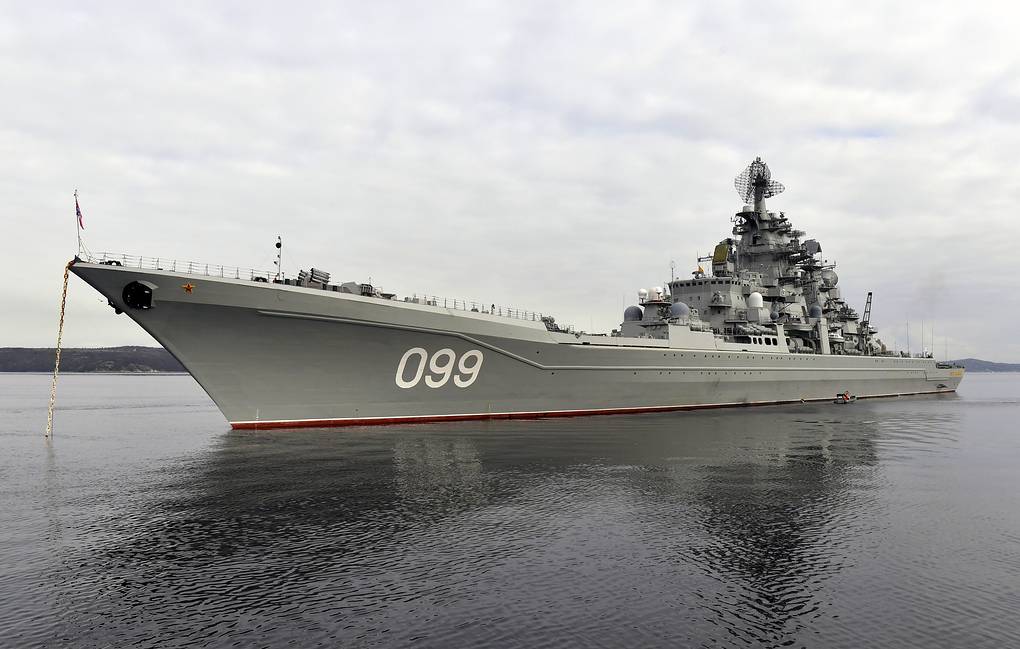
The Russian Navy has officially canceled modernization plans for the Kirov-class / Project 1144.2 “Orlan” nuclear battlecruiser Pyotr Velikiy, permanently sidelining the Northern Fleet’s largest surface combatant amid ongoing budget constraints.
First reported by the Russian state-owned news agency TASS, a special commission reportedly decided to cancel plans to modernize the aging Capital Ship after her sister ship, the Admiral Nakhimov, completed her own modernization period. The cancellation comes from the reportedly dismal state of the Pyotr Velikiy herself, making a round of upgrades to a similar standard of the Nakhimov too costly. Despite this, the aging flagship will remain in limbo between modernization and scrapping as further action is decided upon.
“The Commission has already taken a preliminary decision, the final one has not yet been announced – the cruiser is not subject to restoration. The ship has a certain degree of wear and tear.”
– Vladimir Maltsev, Head of the All-Russian Movement of Support of the Fleet via TASS
The delays in modernization work carried out aboard the Admiral Nakhimov likely also served to compromise the Pyotr Velikiy’s upgrade plans, with prolonged restoration work delaying delivery of the Nakhimov by ~8 years from 2018 to 2026, extending the total time for the modernization to ~12 years. These delays likely cannibalized substantial amounts of funding set aside for Pyotr Velikiy to undergo the same modernization work, as estimates for the cost of the Nakhimov’s refurbishment soar as high as $5 billion dollars.
The Russian Navy operated Pyotr Velikiy as the sole active Kirov-class battle cruiser in Russian Navy service for roughly 25 years, during which she participated in numerous exercises, embarked on several lengthy deployments (often taking her several thousands of kilometers away from her home port in Severomorsk), and took part in combat operations in the Mediterranean Sea during Russia’s intervention in Syria. In late 2022, the Pyotr Velikiy docked at Severomorsk for the last time, awaiting final decision on what would have been her first real modernization period during her over 2 decade long career.
An Upgrade No More

Pyotr Velikiy did actually receive a number of improvements over base Project 1144 hulls, even if modernization to the 1144.2M Nakhimov standard will not take place. Her upgrades over the original design included the addition of the S-300FM surface-to-air missile system, with the 48N6 missile offering increased range over the original S-300F. Additional upgrades included a new phased-array Tomb Stone guidance radar, installation of up to 128 3K95 Kinzhal short range surface-to-air missiles, and 6 Kortik close in weapons systems.
A modernization along the standard carried out on the Nakhimov would result in the removal of most of the components associated with the S-300FM, the removal of the main armament of 20 7,000kg P-700 Granit (SS-N-19) supersonic anti-ship missiles, and the stripping of any outdated radars, non-functioning electronic systems, and aging basic components.
Modernization to the 1144.2M standard would instead see the installation of 80 universal strike VLS cells in the place of the P-700s, housing 3M22 Zircon Hypersonic land attack/anti-ship missiles, P-800 Oniks supersonic anti-ship cruise missiles, or 3M14T/3M54T Kalibr type land attack/anti-ship missiles. In the stead of the S-300FM, the ship could have carried up to 96 S-400 (SA-21 Growler) type missiles, offering a longer ranged and increasingly varied selection of missiles from the older S-300FM, paired with modernized communications and radar equipment.
Decline of the Russian Surface Navy

The Pyotr Velikiy lists amongst the latest casualties of another round of budget constraints placed upon the Russian Navy, echoing the series of retirements and scrappings that took place following the fall of the Soviet Union, during a period of limited funds and financial troubles which left a meager budget to maintain the once expansive Soviet blue water-fleet. Even as little work was directed towards the Russian Navy, the submarine force captured most of the attention and money during the subsequent re-building period, leaving the Russian surface fleet with a chronic lack of funds.
The Russian Navy’s sole aircraft carrier, the RFS Admiral Kuznetsov, also fell victim to a tightening Navy budget, with modernization work paused in 2025 following a dockyard period fraught with accidents and missteps. These two losses leaves only 3 capital ships left in Russian Navy service, the Admiral Nakhimov and two Slava-class cruisers, the Marshall Ustinov in service with the Northern Fleet, and the Varyag, the current flagship of the Russian Pacific fleet. However, budget constraints caused by the war in Ukraine could claim either Slava-class cruiser, with both ships serving for ~40 years without a major overhaul.
The war in Ukraine itself has gone on to claim the Slava-class cruiser, Moskva, as the first of the 10,000 ton cruisers suffered a cruise missile strike, later causing her to sink. Ukraine has largely corralled the rest of the Black Sea fleet’s surface ships in the old home port of the Black Sea Fleet at Novorossiysk, with recent strikes leaving 2 of 3 modern Admiral Grigorovich-class frigates heavily damaged, alongside damage sustained to a number of Black Sea corvettes by drone and missile strikes.
Future Fleet Composition
These losses leave the Russian surface Navy in an extremely precarious position, as many older Soviet built surface combatants begin to age out of service, with only costly modernization periods preventing the exiting of a substantial amount of the Russian Navy’s blue water assets. The Udaloy-class of destroyers, long the backbone of Russian fleets, could suffer heavily from this fact, with many of the Udaloys reaching 35-40 years in age, with only 3 Udaloys stated as either completed or undergoing moderization to the new Marshal Shaposhnikov standard.
These factors leave the future Russian Navy as a mainly frigate and corvette based surface force, relying upon the still in production Steregushchiy-class of large corvettes, Gremyashchiy-class of large corvettes, and the Admiral Gorshkov-class of frigates to reconstitute fleet numbers. Construction and retirement circumstances essentially eliminate most of the blue water or force projection capabilities of the Russian surface Navy, apart from the occasional deployment of a force constituted around the Admiral Nakhimov.
Instead of maintaining the surface fleet, the Russian Navy instead chose to dump most of the resources it possessed into maintaining and expanding it’s submarine fleet. An emphasis on submarines results in the ongoing build out and upgrading of new fleets of Borei-class Nuclear Powered Ballistic Missile Submarines (SSBN) and Yasen-class Nuclear Powered Cruise Missile/Attack (SSN(G)N) submarines. This also manifests in the retention of late cold war era Akula-class SSNs, Sierra-class SSNs, Delta-IV type SSBNs and Oscar-class SSGNs, alongside increased numbers of special missions submarines.