Stark and MBDA have combined to offer a new capability package designed to support NATO requirements for projecting strike capability into the North Atlantic, to build alliance deterrence and defence.
On 28 September, Stark revealed the development of its new Vanta-12 uncrewed surface vessel; the USV is set to bring a fit of MBDA’s Sea Venom anti-ship/land-attack guided weapon.
This announcement follows the USV’s participation in ‘REPMUS 2026’ – the Portuguese Navy/NATO co-hosted operational experimentation (OPEX) activity that conducts robotic experimentation and prototyping with maritime uncrewed systems, and which takes place annually each September around Portugal’s Tróia peninsula.
In a statement, Stark described Vanta-12 as an artificial intelligence (AI)-enabled USV designed to enhance capacity and persistence in at-sea patrols, and in sensing, targeting, and strike against maritime threats. Its modular, adaptable concept enables rapid mass production and capability upgrade, Stark added. It is designed too, the company continued, to integrate various warfare capabilities, including missile, loitering munition, and anti-submarine effectors; electronic warfare systems; and intelligence, surveillance, and reconnaissance (ISR) sensing technology.
The ability to quickly build Vanta-12 en masse – enabled by uncrewed systems’ affordability relative to exquisite, crewed assets – also means the USV can help rapidly scale weight of fire by generating platforms and effectors in numbers. Its pairing with Sea Venom illustrates this point. “MBDA are here because we recognised four or five months ago that the direction of travel is going to need to deliver the ability to launch missiles,”Stephen Brian, Stark’s Maritime Director, told a media briefing at ‘REPMUS’.
The Vanta series – which includes the four-metre Vanta-4 and six-metre Vanta-6 variants, alongside the 12-metre Vanta-12 – is designed to be sensor and effector agnostic, Brian said. For example, Vanta-12’s ISR sensor fit could consist of any sensor required by a customer.
Vanta-12 has a 1,200 n mile range at patrol speeds, with sprint speed in excess of 40 kt. According to the Stark statement, it can remain at sea “for weeks”. In its current configuration, it can operate effectively in Sea State 4 and remain on station in up to Sea State 6.
Concept to capability
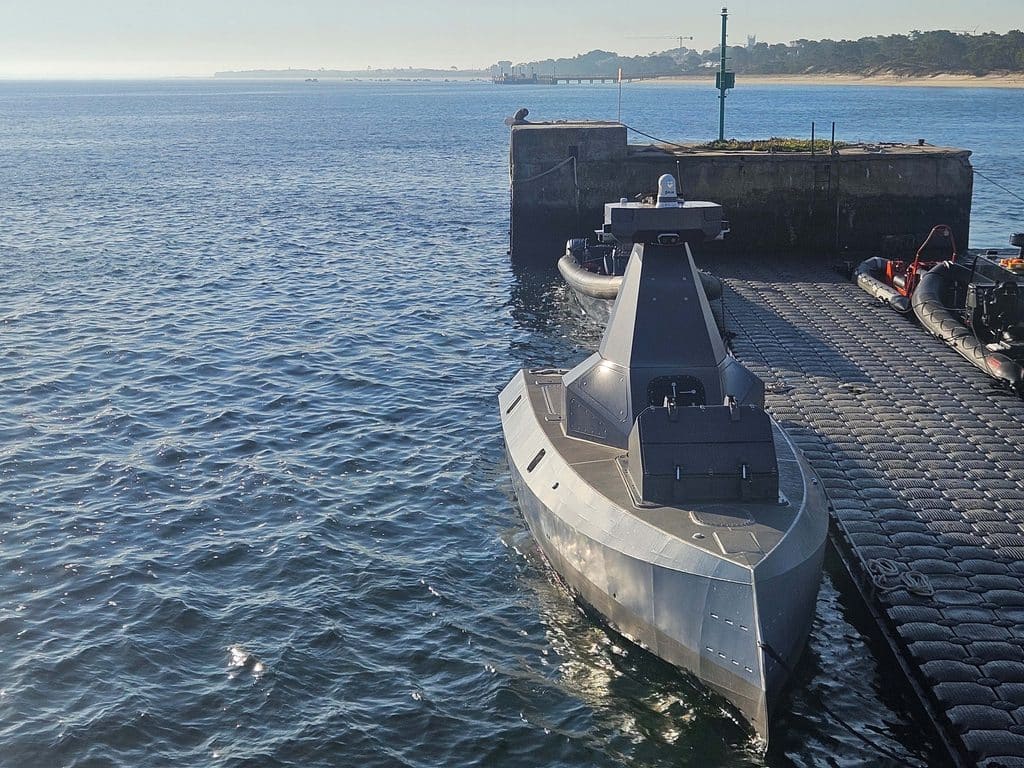
Vanta-12 was conceived as a platform in October 2025. In mid-2026, the first vessel completed build, entered the water, and began sea trials, which included harbour and sea acceptance activities.“In that time, we’ve also integrated with MBDA to put on … Sea Venom,” Brian added.
Using a box launcher fit, four Sea Venoms can be fitted at the USV’s aft end. For’ard on the vessel, a 10-cell launcher carries Stark’s Cascade loitering munition, which can deliver a 5 kg warhead out to 100 km.
The flexibility in capability enabled by the USV’s modular design is illustrated by the fact that Stark has, Brian said, already completed integration work to accommodate a laser weapon onboard. Such design modularity could enable capabilities like towed-array sonars or lightweight torpedoes to be embarked too, he added.
The USV’s sensor/effector combinations are integrated around Stark’s Minerva command-and-control (C2)/mission autonomy software. Again, this core part of the USV’s capability is designed as a modular, open architecture. Minerva is the core C2 pillar in this approach, with other software drivers added depending on the system being integrated, Brian explained. For Sea Venom, he said, “We’re working through the full integration …. We’ve taken those first tentative steps including concepts; we now have two laptops sat together talking.”
The two companies are also seeking to integrate the USV’s software architecture into other C2 infrastructures, like the UK’s digital targeting web.
“Ultimately, we want to be able to have a ‘system-of-systems’ solution that can plug into a digital targeting web and provide a really usable capability. I don’t think it’s that far away from us,” Andrew Blackburn, Naval Systems Executive at MBDA, told the ‘REPMUS’ briefing.
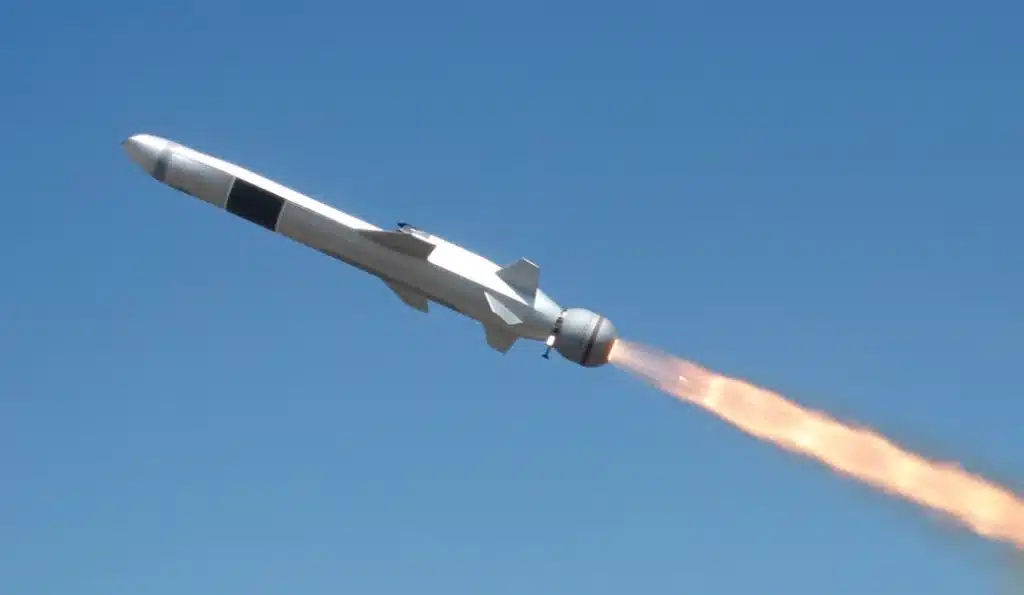
As regards Sea Venom – which is already in service on French Navy and UK Royal Navy (RN) maritime helicopters – MBDA is adapting it for surface launch. This reflects increased operational demand amongst NATO and other navies to deploy precision strike capability in complex littoral environments. According to Janes, the 2.5 m long solid-propellant weapon carries a 30 kg high-explosive semi‐armour piercing blast/fragmentation warhead. Blackburn said its range is up to 30 km, depending on environmental conditions.

REPMUS output
‘REPMUS’ itself continues to evolve to reflect NATO navies’ broad shift towards ‘hybrid’, crewed-uncrewed force structures. This evolution is demonstrated in its OPEX focus on conducting complex, high-level serials involving crewed and uncrewed platforms.
For example, in a ‘REPMUS 26’ serial, the Portuguese Navy M-frigate NRP Bartolomeu Dias worked with around 30 uncrewed aerial vehicles (UAVs) and USVs to defend a maritime exclusion zone against attack from over 60 UAVs and USVs.
According to Stark’s statement, Vanta-12 participated in simulated combat missions, including integrating with surface vessels and other USVs.
Regarding Vanta’s onboard capabilities, although Stark has test-fired Cascade regularly to date, at ‘REPMUS’ it took this capability a step further. “We launched one, fully digitally, through Minerva from a Vanta,” said Brian.
Mixing capabilities
Both Stark and MBDA are focused on supporting European and NATO defence and security needs. Various NATO navies – including, but not limited to, Denmark, Germany, the Netherlands, Norway, and the UK – are at various stages of establishing, and balancing the mix in, their ‘hybrid’ crewed/uncrewed force structures.
The UK RN, for example, is mixing such capabilities to generate its ‘Atlantic Fleet’ structure, within which ‘Atlantic Bastion’ focuses on underwater warfare, ‘Atlantic Shield’ on integrated air and missile defence, and ‘Atlantic Strike’ on long-range power projection to deter adversary attacks.
Vanta-12, with the capabilities it has and those it could have, can support all three ‘Atlantic Fleet’ elements.
For ‘Atlantic Shield’, back in 2025 the RN announced its aim to trial uncrewed escort platforms for its crewed surface ships within two years. In April 2026, the UK Ministry of Defence announced plans to accelerate delivery of a large USV (LUSV).
Another layer to NATO navies’ ‘hybrid’ concepts is delivering therein a mix of higher- and lower-end capabilities. “We deliver the high-low mix today,” said Brian. “You’re already at high-low [if] you’ve got a Vanta-12 operating with an [RN] Type 45 destroyer or Type 23 frigate …. Then you look at the platform [with Cascade and Sea Venom]; we’re mixing high-low there too.”
In the Gulf, Red Sea, and Ukraine conflicts, protagonists are expending large volumes of conventional ordnance (ballistic and cruise missiles, plus uncrewed systems). Alongside illustrating requirements to build conventional mass, this also underlines the need to disperse launch platforms.
Here, Brian explained, Vanta-12 and its volume, capabilities, and rapid construction enable navies to both increase and disperse ‘magazine depth’.
“When you add that to the range of the platform and the fact it’s not manned, you can take a much more aggressive threat posture and really act as a deterrent,” Blackburn added.
Industrial deterrence

Stark sees Vanta-12 as adding another layer to deterrent effects, with its design and concept aiming to generate relatively rapid build, and at various shipyards including in different countries. This provides both capacity (including to build at scale) and redundancy.
“Industrial deterrence is what modern warfare increasingly demands, and what Vanta-12 has been designed to deliver,” Mike Armstrong, Stark’s UK Managing Director, said in the Stark statement.
While currently building the USV in the UK, Armstrong told the ‘REPMUS’ briefing the company already has partnering agreements in place with Danish and German shipyards. He stressed too that the company is not just looking at traditional naval yards. “There is huge capacity within the shipyard ecosystems within the UK and in Europe,” he said. “We want to work with existing suppliers and retool what wouldn’t necessarily have been a defence supply chain.”
The Vanta model does not lock in to using one shipbuilder, Brian added. In the UK alone, Brian explained, there are several yards Stark could use, including one the company is already working with that offers capacity to establish multiple production lines for large USVs.
“We don’t want to deliver vendor lock-in; we want to deliver capability,” Brian said.
Vanta-6 has already been procured by Germany, and Stark told Naval News that the company’s production capacity is ready to meet any orders placed.
Across the rest of 2026 and into 2027, Stark will be taking Vanta-12 to various Nordic exercises to demonstrate and develop its capabilities, and will seek opportunities to further enhance its autonomy, Armstrong explained. He added that, especially if working with naval customers, the company sees options to continue developing Vanta-12’s capability.
Understanding operator requirements is crucial, Brian added. Perhaps the core, upfront question Stark addresses is defining why the USV is needed, when set against such requirements. “That’s why MBDA are here,” Brian explained. “Working with MBDA and Sea Venom, that is a single line of activity; but working with them and generating a philosophy about how do we scale this to other weapons systems, that’s what we’re doing.”
Naval News Comment
Vanta’s integration of proven systems also underlines a further, significant factor in NATO’s North Atlantic deterrence equation.
For example, RN First Sea Lord and Chief of Naval Staff General Sir Gwyn Jenkins has stressed his navy’s focus on fighting with what is available.
Underlining Stark’s emphasis on delivering at speed, as illustrated by the first Vanta-12’s rapid build, the USV’s modular fit enables it to carry various sensors plus effectors like Cascade and Sea Venom that are already here.