China is building more submarines, of more classes, than any other country. It has several brand-new ambitious design readying for series production and is forging ahead in the uncrewed space. But this unique trimaran design appears the strangest of them all.
Somewhere in the Eastern Pacific, a snorkel mast skims the ocean’s surface, the only visible sign of a vessel lurking below. An encrypted signal arrives, carrying target data. The vessel rises, revealing a distinctive trimaran hull unlike that of any other navy’s submarine. This unique configuration provides greater stability on the surface. Moments later, two large hangars built into the central hull slide open, and 16 missile tubes rise into firing position. Nearly 1,500 km (930 miles) away, an enemy carrier battle group lies within range. This is no ordinary submarine; it is a vessel unlike any other in the world.
The above scene illustrates how new submersible warship is expected to operate. Previously described as a Semi-Submersible Arsenal Ship, it has yet to receive an official designation or Western reporting name. The vessel is currently being tested in Huludao on the Bohai Sea. Originally built in the southern city of Guangzhou, it was ferried to the north of China via the port of Dalian earlier this year.
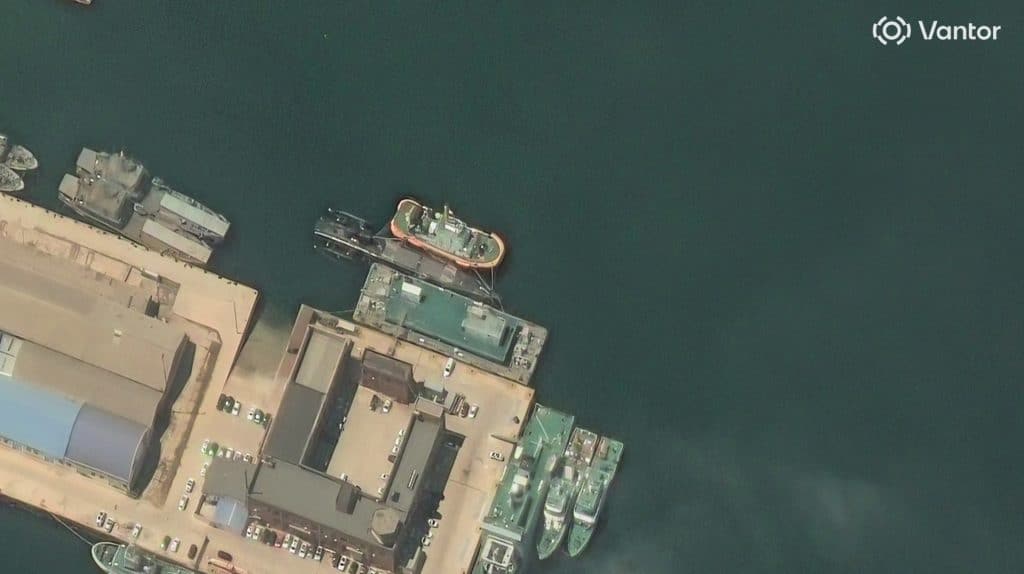
It is, for sure, a completely new category of warship. Fresh analysis suggests that it is best thought of as a submersible warship, which is uncrewed, and yet needs to come to the surface to launch its weapons.
16+ Missile Tubes
The new submersible warship built by China likely has 16 strike-length missile tubes occupying much of its central hull. Currently we can be confident that there are at least 8 tubes, but more probably 16-18 in total assuming both hangars are identical. The tubes are arranged in two circular clusters which are stored horizontally in hangars. To launch the missiles the vessel will logically have to surface, the hangar doors opened and the missile tubes elevated into a vertical position.
As is the case with secretive naval projects, vessel has not been reported or named in Chinese media. We do not have a clear official narrative on its role or status. The following observations come from what can be gleaned by open-source intelligence (OSINT), principally commercial satellite imagery.
It is likely that the missile tubes carry anti-ship or land-attack missiles. We can infer that the exact type of missile chosen, and China has many suitable types, is one which is intended for surface rather than submerged launch. This leads to the hypersonic YJ-20 missiles normally associated with the Type-055 cruiser, being a contender.
Unique Hull Form, and likely Uncrewed
The vessel is clearly submersible but, as indicated by its prominent snorkel, is intended to run on diesels even when submerged. Its trimaran hull form, with outrigger hulls towards the stern, appears optimised for surface transit and stability on the surface. This latter factor may be a driver since the missile tubes, when erected, must make the vessel somewhat top heavy.
The outriggers also sport ducted propellers (‘screws’), possibly of a pumpjet type. Logically the vessel will have a set of screws or water jets on the main body for the diesels, and electric screws on the outriggers.
Dr. Rachel Pawling, Principal Consultant and K39 Consulting and lecturer in ship design, has calculated the vessel’s likely internal make-up. She estimates that the ship displaces around 900 tonnes fully submerged.
Dr. Pawling notes that the weapons hangars take up so much volume, that the rest of the internal space must be extremely cramped. So much so, that it appears unlikely that there is space for a crew. Yet the vessel has an open navigation bridge on top of its fin (sail). The obvious explanation is that this is only for a human pilot during entering and exiting ports. Most large uncrewed vessels have some form of bridge like this to simplify port operations.
Concept of Operations
There has always been a blurred line between submersible warships and true submarines. There have been numerous designs designed to fight on the surface which can partly or fully submerge. Indeed until World War Two submarines were mostly surface vessels which could submerge.
Dr. Pawling suggests that the new type is similar to Cold War Soviet cruise missile submarines like the Juliett Class. That was a diesel submarine which had to surface to launch its powerful anti-ship missiles. It could pop-up to attack high-value warships from unexpected directions.
The main differences will be that modern missiles, such as the YJ-20 hypersonic missile, will have much longer ranges and be able to target both land and sea targets. This means that they will be dependent on external targeting. This makes this vessel a transporter and launcher, a small part in a larger distributed network. What is more, the Chinese vessel will carry far more weapons than the 4 SS-N-3 Shaddock carried by the Juliett Class.
This vessel will remain subject to analysis and speculation. China appears in no hurry to explain it to the outside world, and there is much which remains unclear. The ports it has been observed in do not match those associated with either China’s large uncrewed surface vessel (USV) or uncrewed submarine (XLUUV) programs, suggesting that it is distinct from either program.