By TASS Russian news agency
The system, its key units and devices are being modernized. In particular, upgraded phased antenna arrays, passive detector, computers are being designed. Work is underway to switch to modern element base.
Tor was created in late 1970s by the Moscow Electro-Mechanical Research Institute (NIEMI). It was accepted into service in the spring of 1986. Tor has to engage in air and missile defense at the battalion level. It can defend important administrative, economic, and military facilities, as well as first echelons of ground formations against antiradar and cruise missiles. The complex can control the airspace and automatically down all air targets unidentified by the friend-or-foe system.
The system is armed with vertically launched antiaircraft guided missiles with a range of 12 km and altitudes of up to 10 km. The upgraded radar can detect stealth aircraft: jets, helicopters, cruise missiles, as well as precision munitions and air bombs.
The weapon has been numerously upgraded in its lifetime. The most advanced option is Tor-M2. It is serially supplied to the Defense Ministry. In 2019, it signed a contract worth 100 billion rubles for Tor-M2 delivery up to 2027.
Tor-M2 is tracked due to operations in offensive and defensive motorized infantry or armor formations. In 2019, the Defense Ministry and Kupol enterprise signed a contact for Arctic Tor on two-section tracked DT-30 transporter of Uralvagonzavod. The combat vehicle has a high all-terrain capability and can overcome ditches, float, and operate in minus 50-degree frost. It is armed with 16 missiles, which can destroy targets several seconds after detection. The complex successfully fulfils missions in any situation, including active electronic warfare.
The Kalashnikov Group presented its vision of Tor-M2 development at Army-2020 forum. It displayed SKKSh-586 wheeled undercarriage produced by the machine-building plant in Mytishchi. The vehicle is made of aluminum alloys to provide protection against bullets and explosions without additional attached devices. It helps better use the interior and decrease the weight. SKKSh-586 has a high all-terrain capability and can float due to two waterjets to overcome water obstacles. The undercarriage has a hydro-mechanical gearbox, onboard information controls, the main and standby power sources, heating, ventilation, air conditioning and video monitoring systems.
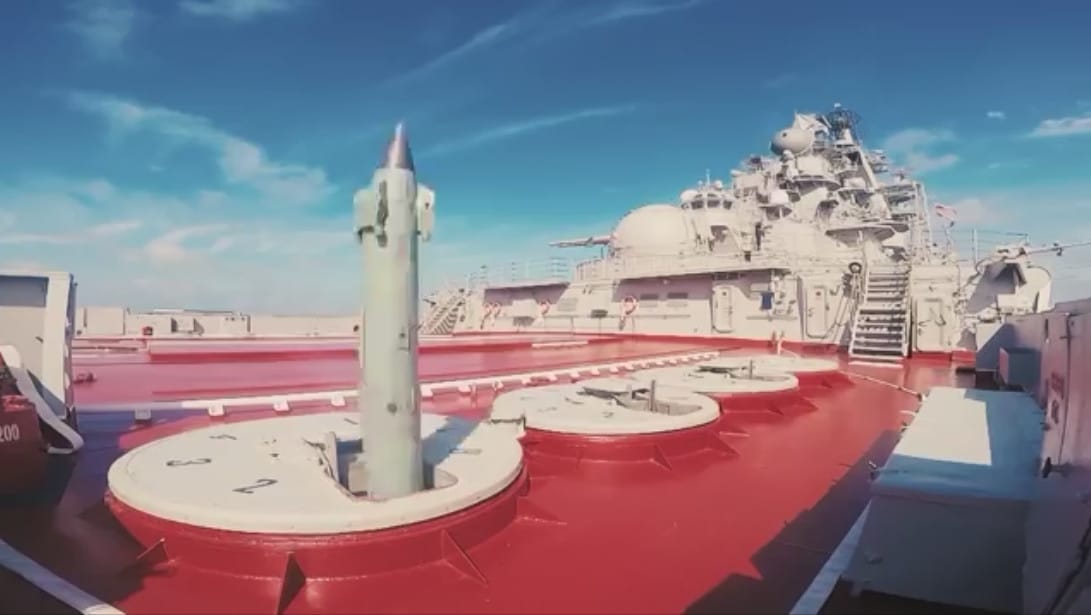
The seaborne Tor already exists. It is the short-range Kinzhal 3K95 system. Warships with a displacement of over 800 tons have been armed with it since 1989. The Admiral Kuznetsov aircraft carrier, the Petr Veliky and the Admiral Nakhimov heavy nuclear cruisers of project 1144, big antisubmarine ships of project 1155 and frigates of project 11540 are armed with it. Each revolving launcher carries eight antiaircraft guided missiles.

The seaborne Tor-M2 is likely to have the same characteristics as its latest ground option. The only problem is an additional illumination radar in the guidance system. However, Altair enterprise in Moscow resolved the problem in 1990s. The Admiral Nakhimov begins trials in 2021 and is likely to become the first carrier of seaborne Tor-M2.
The revolving launchers are likely to be replaced by vertical ones. They will accelerate the reaction to target destruction, as they carry more guided antiaircraft missiles, the Independent Military Review said.