This story was originally published by Megan Eckstein, USNI News on August 8, 2019
Program Executive Officer for Ships Rear Adm. Bill Galinis told USNI News that questions about what the Large Surface Combatant needs to be and significant pressure on the annual shipbuilding budget are forcing the service to think about what the Arleigh Burke program will look like beyond the current multiyear contract for the Flight III configuration.
The Large Surface Combatant program is meant to replace both the Ticonderoga-class cruiser and the DDG-51s, and previous documents from the Pentagon showed LSC acquisition beginning in Fiscal Year 2023, following heel-to-toe behind the end of the current contract for Flight III DDGs that ends in 2022.
However, USNI News first reported in March that LSC acquisition had fallen to a 2025 start date – though the Navy pushed back at the time and said it could accelerate the program to resume that planned 2023 start date if industry were able to support a faster design process.
Galinis told USNI News today that the Navy is now looking at 2026 or possibly later to begin the Large Surface Combatant.
“We’re even considering right now, as we have these conceptual discussions on the Large Surface Combatant, do we need something beyond even a Flight III on the 51s? And again, I tell people, the budget always gets a vote, so you’ve got to think about what the Navy is doing over the next five to 10 years in terms of ship construction: we’ve got frigates coming online, Columbia (ballistic missile submarines) hands down is the top priority, we’re recapitalizing the sealift fleet, we need to continue building Virginias (attack submarines), we just executed a two-carrier buy,” he said during a panel presentation at the American Society of Naval Engineers’ annual Fleet Maintenance and Modernization Symposium.
“So competing priorities; where do you fit in there for the surface fleet and how do you continue to move forward with improving and getting that current combat system upgrade?”
Asked about what might come between the current Flight III design and the Large Surface Combatant, Galinis told USNI News after his panel that “we are in the very early stages of that – again, to try to keep up, to pace the threat, to outpace the threat.”
“And then also balance, you’ve got evolving requirements, you’ve got evolving threat, and you’ve got budget pressures and what the Navy’s doing recapitalizing the ballistic missile submarine force, building up the submarines, carrier force and surface combatants and how does all of that fit in the confines of the budget we have,” he said.
“So we’re looking at the timing. We know we have to recapitalize the surface fleet, but when does that kind of fit in, and if it moves out, do we need to do something more with the 51s to keep them combat relevant?”
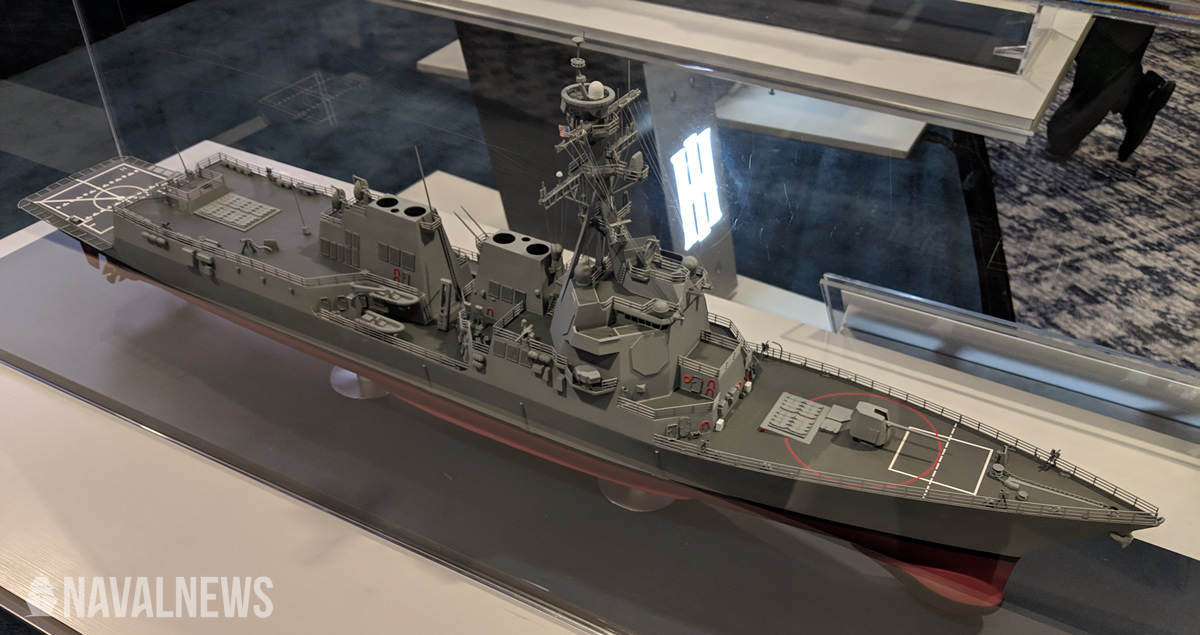
Galinis said PEO Ships has been planning to build more destroyers beyond the current multiyear contract, which covers as many as 15 ships from FY 2018 through 2022. With so much uncertainty in the timing of Large Surface Combatant, he said, “how many more and for how long, that’s what’s part of the discussion.”
“We’re looking at all options on the table right now. We’ve kind of notionally put a target date of sometime in 2026 or so, give or take, for the Large Surface Combatant, but I would tell you that’s not set in stone,” the admiral continued.
“The current force structure assessment that’s ongoing is going to also play into those conversations, and we won’t get that until this fall.”
The Navy needs some sort of a large combatant for a couple reasons: to replace the capability the cruisers bring to host an air defense commander staff within the carrier strike group, to host the capability to launch a large number of large weapons, and to haul a very large radar into theater. Beyond that, the surface warfare directorate at the Pentagon has made clear it is much more interested in fielding more small surface combatants and fewer large surface combatants, compared to a fleet today that has dozens of large combatants at sea at any given time but only one small combatant – a single Littoral Combat Ship deployed to Singapore – operating at sea right now. What this flip-flopped balance of roles between large and small combatants means for Large Surface Combatant and guided-missile frigate (FFG(X)) acquisition is still mostly unclear.
Last month, new Director of Surface Warfare (OPNAV N96) Rear Adm. Gene Black said he and his staff “haven’t closed the book” on LSC requirements or the acquisition process for the new ship program.
“It’s a question of how much speed do you need, how much speed can you afford, how much do you want. How much signature are you willing to pay for? What payloads are you going to put in in?” he said while speaking at a local Surface Navy Association chapter event.
“The things I know: I want a big sensor, I need big computing power, and I want some big magazines. Beyond that, we’re not entirely sure.”
“We’ve got Flight III DDG coming, it’s going to be a fantastically capable ship, and that gives us a little bit of room to think through some of these challenges, because this is going to be an expensive ship and we want to be sure we’re coming in with a capability and cost that are a good balance,” he concluded.