Sweden is looking for a ship to enable and support development of and experimentation with maritime uncrewed systems. Such a ship would help change and accelerate not only Sweden’s process for acquiring capability but the Royal Swedish Navy’s (RSwN’s) ability to deliver operational effect, a senior Swedish defence acquisition official told Naval News.
In an interview conducted at the DSEI UK exposition in London in early September, Rear Admiral Fredrik Lindén – Director Naval Systems at FMV (Försvarets materielverk: the Swedish Defence Materiel Administration) said
“There is an ongoing discussion – with no conclusion as yet – about if there is a possibility the navy could provide us with a testbed platform for uncrewed vehicles on the surface and under the surface.“
The requirement to find such a vessel for this purpose is coming from FMV and the RSwN collectively. “We are in it together,” said Rear Adm Lindén.
The conversations also reflect a wider effort within the RSwN and FMV to accelerate processes for delivering capability and operational effects, including through tailoring procurement processes depending on the programme, requirement, and capability in question, the admiral explained.
With increasing underwater challenges to NATO members, their national interests, and their navies, maritime uncrewed systems provide more affordable, scalable, and available means of addressing such challenges compared to acquiring large, high-end, high-value crewed platforms.
A platform for conducting development and experimentation with uncrewed systems would help accelerate the process of acquiring and delivering new capability almost by turning this process around, Rear Adm Lindén explained. Principally, this would be because the new ship would provide available testing space for the wide range of different uncrewed surface and underwater systems that already exist.
“Instead of conducting a concept acquisition process, then producing a system, and then undertaking test and evaluation (T&E), we would be doing T&E much earlier with existing products,”
Rear Admiral Fredrik Lindén – Director Naval Systems at FMV
“When we’re doing the T&E, it’s part of the concept development in an operational environment: so, we would be turning things around and doing everything in the beginning, instead of in sequence.”
Currently, Rear Adm Lindén has no specific requirement for what the ship should be, other than being a platform from which testing with current systems could begin quickly.
“Since the matter is time critical, it would preferably be an existing vessel, manned with navy personnel,” the admiral explained.
Moreover, he continued, “Right now, I would be happy with whatever I got. As soon as I get it, I can start testing things.”
Setting out requirements to be met, or sending out invitations to contribute, are ways to involve industry – but the important point is getting a testing process going, the admiral added.
As regards testing constructs for uncrewed capabilities, Rear Adm Lindén noted some of the approaches used in other countries. “We have seen concepts that work. We have seen the tool of using industrial challenges, which works very well.”
The RSwN’s major challenge to solve, he underlined, is the underwater domain. Given the wide-ranging nature of sub-surface threats, navies today are looking for industry to harness innovation that can meet operational problems, and to be able to partner in the capability development process for the longer term. Alignment with the mission will be crucial, said Rear Adm Lindén. The mission, in this context, is accelerating development of capability and effects across the underwater domain.
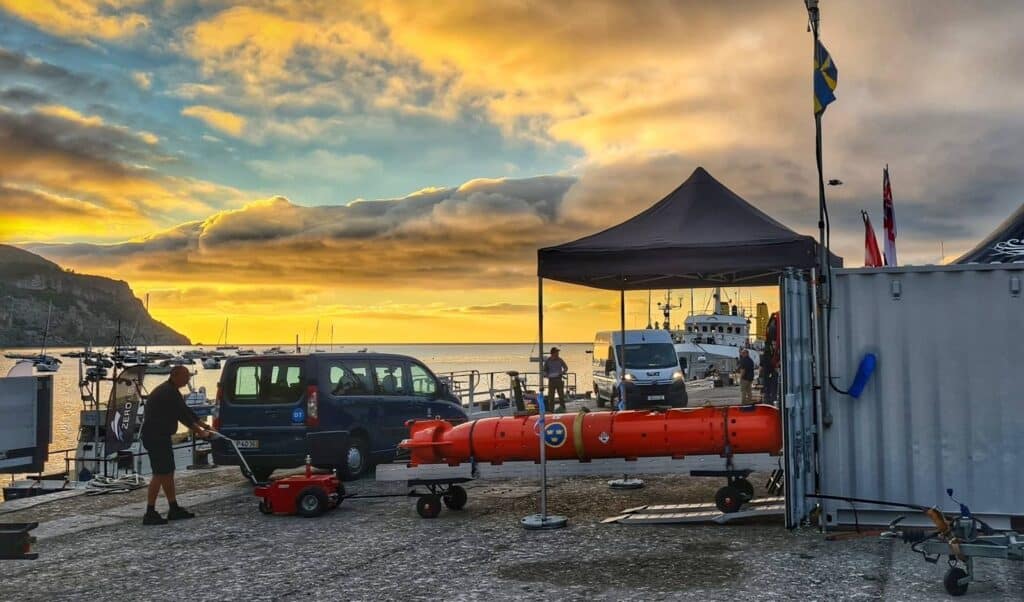
“If we can get the same operational speed underwater as we can on the surface, everything will be transparent, and we can move equally as fast in all domains. If you can fight in the underwater domain at the same speed you can on the surface, or in the air, or on the ground, that would create a big problem for the adversary,” Rear Adm Lindén explained. “By doing that, including by complementing the military effort with uncrewed systems, the amount of problems you present to the adversary will become complex by the number of them, and not just by the complexity of each one.”
“We need to find an ‘add-on capability’ in numbers – in terms of effects, and not just in numbers of steel platforms in the water,” he added. Uncrewed systems can provide this ‘add-on’.
The speed itself is also a combination, the admiral continued. It encompasses speed of equipment, speed of communications, speed of sensor to decision, and speed of effect.
“If we can find a way with all these systems to enhance all the temporal aspects of warfighting, that’s when we really pick up the pace,” said Rear Adm Lindén. “We can do that with other things than just numbers.”
Naval News Comment
Sweden’s thinking regarding purchasing a bespoke T&E platform for uncrewed systems reflects trends elsewhere across NATO navies.
The French Navy uses several in-service naval support vessels to conduct both underwater operations and new capability T&E from the same platforms, under its ‘Calliope’ mission.
The UK purchased an offshore support vessel from the commercial market in a short space of time. The vessel, RFA Proteus, is used for both trials and operations to support UK Royal Navy underwater warfare mission requirements, including critical undersea infrastructure (CUI) security and mine counter-measures activities.
In the Netherlands, Damen and Fugro have been contracted to provide a ship and crew to generate a capability to support Royal Netherlands Navy sub-surface surveillance requirements, including using uncrewed systems for tasks like CUI protection.
The Portuguese Navy is building a bespoke platform for testing and using maritime uncrewed systems in all domains. Referred to as ‘the drone carrier’, known formally as a maritime uncrewed systems carrier, and named formally Dom Joao II, the ship – scheduled for delivery in 2026 – will conduct T&E/operational experimentation and scientific research with uncrewed systems.
One example of an uncrewed system capability ‘challenge’ process is the six-country Seabed Security Experimentation Centre (SeaSEC) construct. Sweden is a member, along with Denmark, Finland, Germany, the Netherlands, and Norway. SeaSEC conducted its first ‘Challenge Weeks’ process in May 2025, with industry invited to demonstrate different capability against different underwater tasks.