The US Naval Sea Systems Command (NAVSEA) has issued a competitive Request for Proposal (RFP) for a Vessel Construction Manager (VCM) to manage the production and delivery of the US Navy’s new Landing Ship Medium (LSM) vessels.
Released on 17 February, the solicitation calls for single VCM to take responsibility for contracting, oversight and delivery of LSM Block 1 ships based on a non-developmental Damen landing ship design. The navy has directed that initial production will be split between Bollinger Shipyards in Mississippi and Fincantieri Marinette Marine in Wisconsin.
Forming a key component of the US Navy and Marine Corps’ effort to address readiness in the Indo-Pacific, the LSM vessels are intended to provide the US Marine Corps with a capability to maneuver and sustain littoral expeditionary forces (including supplies and equipment) across intra-theater distances in contested open ocean and littoral conditions to enable distributed maneuver and logistics. Designed to fill the capability gap between smaller surface connectors and the navy’s larger multipurpose amphibious warfare ships, LSMs will be able embark and disembark littoral expeditionary forces directly on to beach areas, or into and austere/degraded ports.
Having abandoned plans for an all-new bespoke LSM design in late 2024 on cost grounds, the US Navy announced last December that Damen Naval’s LST-100 design had been serve as a mature ‘build to print’ baseline to support rapid fielding of the LSM capability. Current procurement plans call for the acquisition of between 18 and 35 LSMs.
The idea of outsourcing management of the LSM acquisition was first publicly mooted in August 2025. According to NAVSEA, the decision to appoint a VCM as a ‘prime contractor’ is intended to leverage established commercial ship acquisition practices in order to accelerate delivery, improve cost discipline, and expand the US shipbuilding enterprise. VCM responsibilities will include the selection and award of shipbuilding subcontracts; configuration management of the LST-100 design across multiple shipyards; oversight of shipyard construction; negotiation and/or purchase of class standard equipment to be used by all shipbuilders; and provisioning, crew training, and turnover to a government crew.
The VCM will hold the prime contract with the navy and, in turn, issue and manage its own subcontracts with shipyards. This places the VCM in direct contractual control of shipyard performance and creates a buffer that, along with a proven design, is expected to reduce cost and schedule risks. Outsourcing to a VCM will also significantly reduce the number of naval personnel required to manage the programme.
Damen Naval will be retained as the Design Agent and Configuration Manager to coordinate configuration management integration across production efforts.
“The VCM approach not only accelerates construction timelines but also strengthens our industrial base by engaging multiple shipyards,” said Rear Admiral Brian Metcalf, Program Executive Officer, Ships, in a 18 February statement. “By providing a mature, ‘build-to-print’ design and empowering a VCM to manage production, we are streamlining oversight for this acquisition. This approach accelerates the timeline and strengthens our industrial base, ensuring we have the capacity and expertise needed for sustained maritime advantage.”
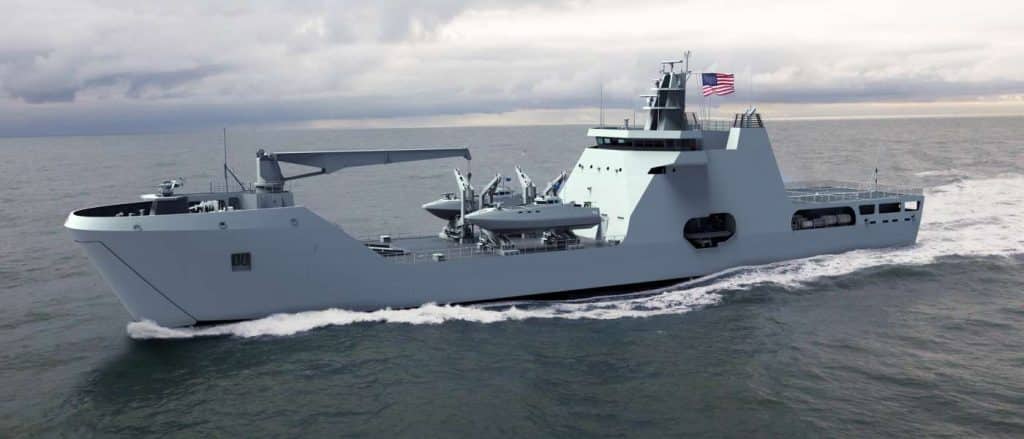
LSM construction
The RFP calls for VCM services for an initial eight LSMs. The navy will direct the VCM to manage first-of-class build at Bollinger Shipyards, which was awarded a contract in September 2025 to support LSM long lead time procurement and lead ship engineering design activities.
The VCM has also been directed to contract Fincantieri Marinette Marine for the build of four LSMs. The VCM will then decide the best strategy for awarding contracts for up to three additional ships authorized under the base contract.
Responses to the VCM RFP are due to be submitted to NAVSEA no later than 2 April. A contract award is anticipated in mid-2026. NAVSEA has previously indicated that it expects each LSM to take 32-36 months to build. It has also suggested that delivery should be completed within six years of the VCM selection.