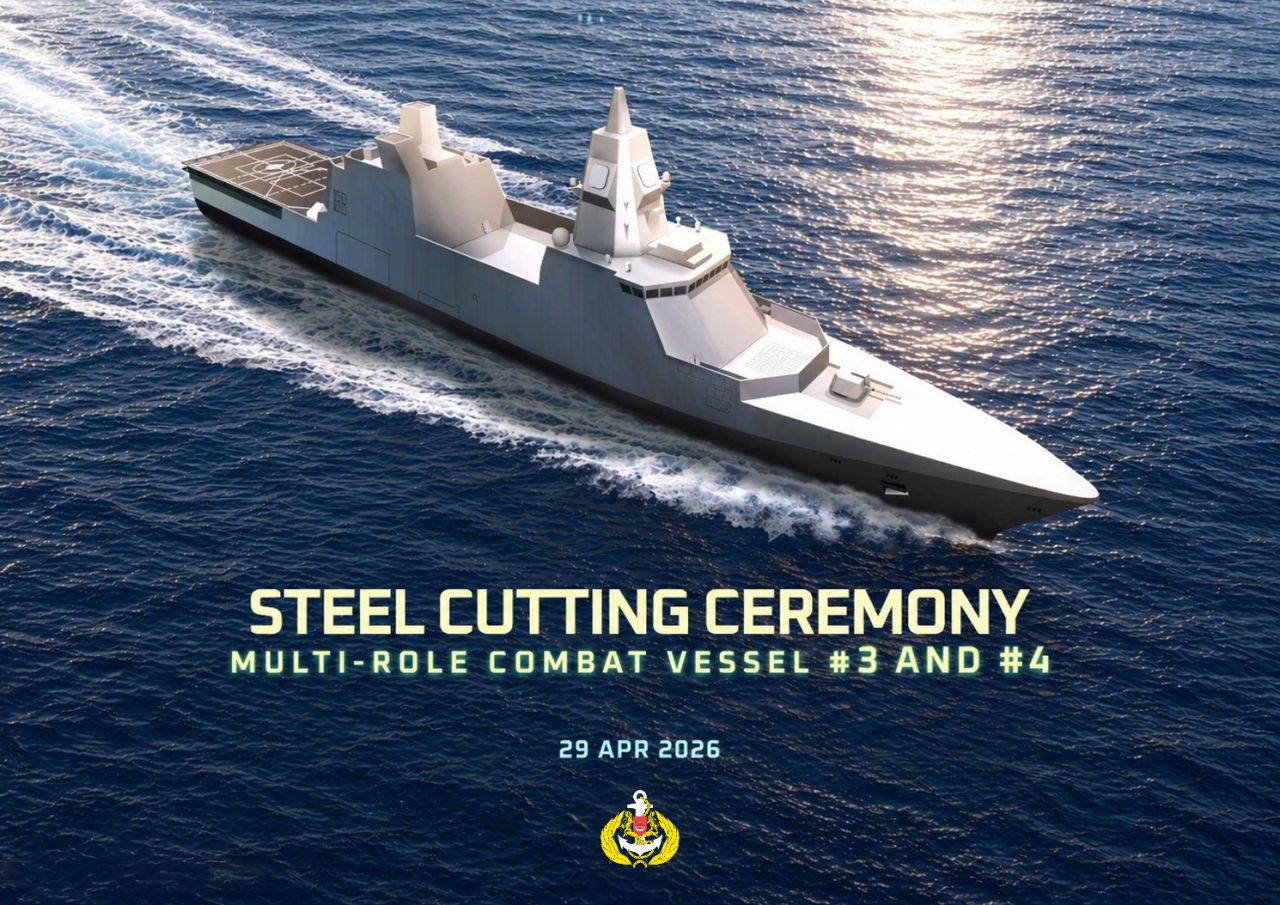
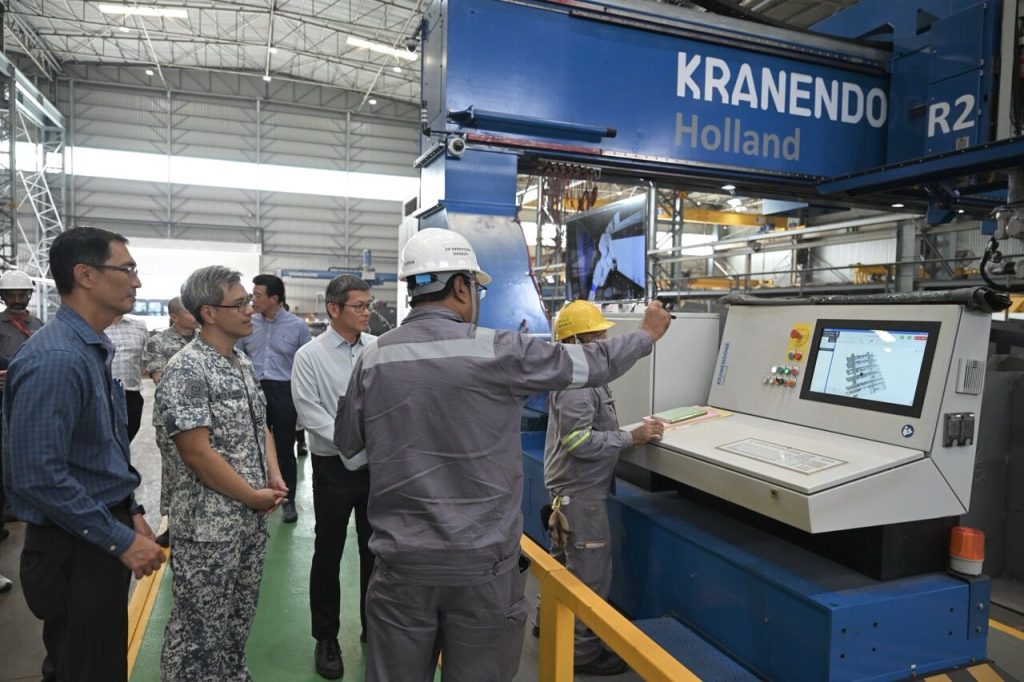
On April 29, 2026, the Republic of Singapore Navy held the steel cutting ceremony of the third and fourth Multi-Role Combat Vessels (MRCV) at a ST Engineering shipyard in Singapore.
The Republic of Singapore Navy made shared the announcement on its social media account. The post reads:
Earlier today, Head of Naval Engineering and Logistics (HNEL) ME7 Khoo Koh Giok officiated the Steel Cutting Ceremony for our third and fourth Multi-Role Combat Vessels (MRCVs). The ceremony was attended by senior officials and representatives from the RSN and DSTA at ST Engineering Marine Ltd.
MRCV Victory, the first of class, was launched in October 2025, and we look forward to the launch of MRCV #2 in the second half of this year.
The MRCV is designed to function as a “mothership” for unmanned aerial, surface and underwater systems for the conduct of naval operations.
The third vessel of the Victory-class is set to be named RSS Vigilance and while the fourth ship-in-class will be named RSS Valiant. A total of six MRCV are being produced at ST Engineering’s Benoi shipyard.
ST Engineering launched the first of six Victory-class Multi-Role Combat Vessel (MRCV), Victory, at its Benoi Yard in October 2025. The company started the construction of the second vessel with a steel-cutting ceremony for the second Multi-Role Combat Vessel (MRCV) in April 2025. The keel for this second MRCV was laid in early 2026.
About MRCV

The Republic of Singapore Navy (RSN) ensures the seaward defence of Singapore and protects vital Sea Lines of Communication (SLOCs) by keeping them open and ensuring the unimpeded flow of goods, services, and energy. This requires a strong Navy to conduct operations both near and afar. The MRCVs, alongside the RSN’s existing assets, will enhance Singapore’s ability to safeguard our SLOCs, and contribute to regional security architecture and international efforts to ensure that our access to the sea remains unimpeded.
The MRCV combines the combat capabilities of a modern frigate with the carriage and control capacity needed to be a Mothership for a wide range of unmanned systems. Developed to meet the RSN’s unique operational requirements, it is the largest and most complex warship built to date in Singapore. Developed through a joint effort led by the Defence Science and Technology Agency (DSTA), as well as DSO, ST Engineering and international partners, the MRCV demonstrates the deep expertise of Singapore’s Defence Technology Community and its strong partnership with the Singapore Armed Forces (SAF).
Advanced Combatant and Mothership for Unmanned Capabilities
At 150m in length and with a displacement of 8,000 tonnes, the MRCVs are designed to function as Motherships for a range of unmanned systems. With an operational range exceeding 7,000nm – twice that of the Formidable-class frigates – and an endurance of over 21 days, the MRCVs enable the RSN to deploy a range of unmanned systems to protect Singapore’s SLOCs.
Unmanned Surface Vehicles (USVs), Unmanned Aerial Vehicles (UAVs), and Autonomous Underwater Vehicles (AUVs) deployed from the MRCVs will work together to expand the surveillance and operational reach of the ship across air, surface, and underwater domains. This enables one MRCV, with its fleet of unmanned technologies, to execute missions which would require multiple manned warships today.
The MRCVs will be equipped with advanced sensors and weapons to conduct high-end warfare, and perform the role of Command ship in support of SAF missions. It will also feature the latest Combat Management System (CMS), indigenously developed by DSTA, which incorporates advanced sense-making and decision-support capabilities.
Mission Modularity
Designed to host eight containerised modules in its mission bay, the MRCV can be re-configured for a wide range of missions within short periods of time. This provides increased operational flexibility as it allows the MRCV to also be deployed for missions such as humanitarian assistance and disaster relief (HADR). For example, if the onboard medical capabilities (i.e., Operating Theatre (OT), Intensive Care Unit (ICU), High Dependency Beds, Consultation Room, General Ward, and Pharmacy) are insufficient, the MRCV’s mission bays can accommodate Rapidly Deployable Maritime Containers (i.e. “clinic in a shipping container”) to increase its capabilities for HADR missions.
The capability to handle standardised shipping containers also streamlines logistics for the ship. Food, stores and maintenance equipment can be loaded and unloaded safely and efficiently.
The MRCVs will replace the existing Victory-class Missile Corvettes (MCVs), and will be delivered progressively from 2028 onwards. To honour the legacy of the Victory-class MCVs, the MRCVs will retain the names of the Victory-class MCVs. The first MRCV will be named Victory.
Future Ready Design
Beyond the flexibility that modular capabilities provide, the MRCVs are also built with significant growth margins:
- The high-voltage electrical distribution system – the MRCV’s “grid” – needed to power its Integrated Full Electric propulsion (IFEP) system – is designed to accommodate future systems which may have higher energy demands
- The superstructure is made from lightweight Composite material. This enhances ship stability by lowering the centre of gravity and provides additional weight margins to accommodate the insertion of new equipment.
The MRCV is also designed with advanced automation to enhance crew effectiveness and safety:
- The MRCV’s Bridge – the “cockpit” of ships – can be operated by two crew instead of five, and the Engineering Control Centre only requires one crew instead of four to monitor ship systems.
- Onboard cranes streamline the process of loading/unloading of supplies, weapons, equipment. The Mission Bays are also fitted with a cargo elevator as well as equipment for efficient internal movement of containers.
Ship Naming and Pennant Numbers
The MRCVs will retain the name and pennant numbers of the Victory-class MCVs. This upholds the proud heritage and history of those ships which similarly represented a quantum leap in the RSN’s capability when they entered service in the 1990s.
| Name of MRCV | Pennant Number |
| Victory | 88 |
| Valour | 89 |
| Vigilance | 90 |
| Valiant | 91 |
| Vigour | 92 |
| Vengeance | 93 |
Characteristics
Length: 150m
Beam: 21m
Displacement: 8000 tones
Speed: In excess of 22 knots
Endurance: Over 7000nm
Baseline Complement Crew Size: <100 crew members
Sensors
- Thales Multi-Function Radar
- Thales Fire Control Radar
- SAFRAN Electro-Optical System
- Hull Mounted Sonar
- Cyber Security Capabilities
Weapons
- STRALES 76mm Guided Gun
- MK30-C 30mm Remotely-Controlled Weapon System
- MICA and ASTER Surface to Air Missile System
- Surface-to-Surface Missile System*
*To be confirmed subsequently
Check out our video coverage for the launch of the first vessel of the MRCV programme: