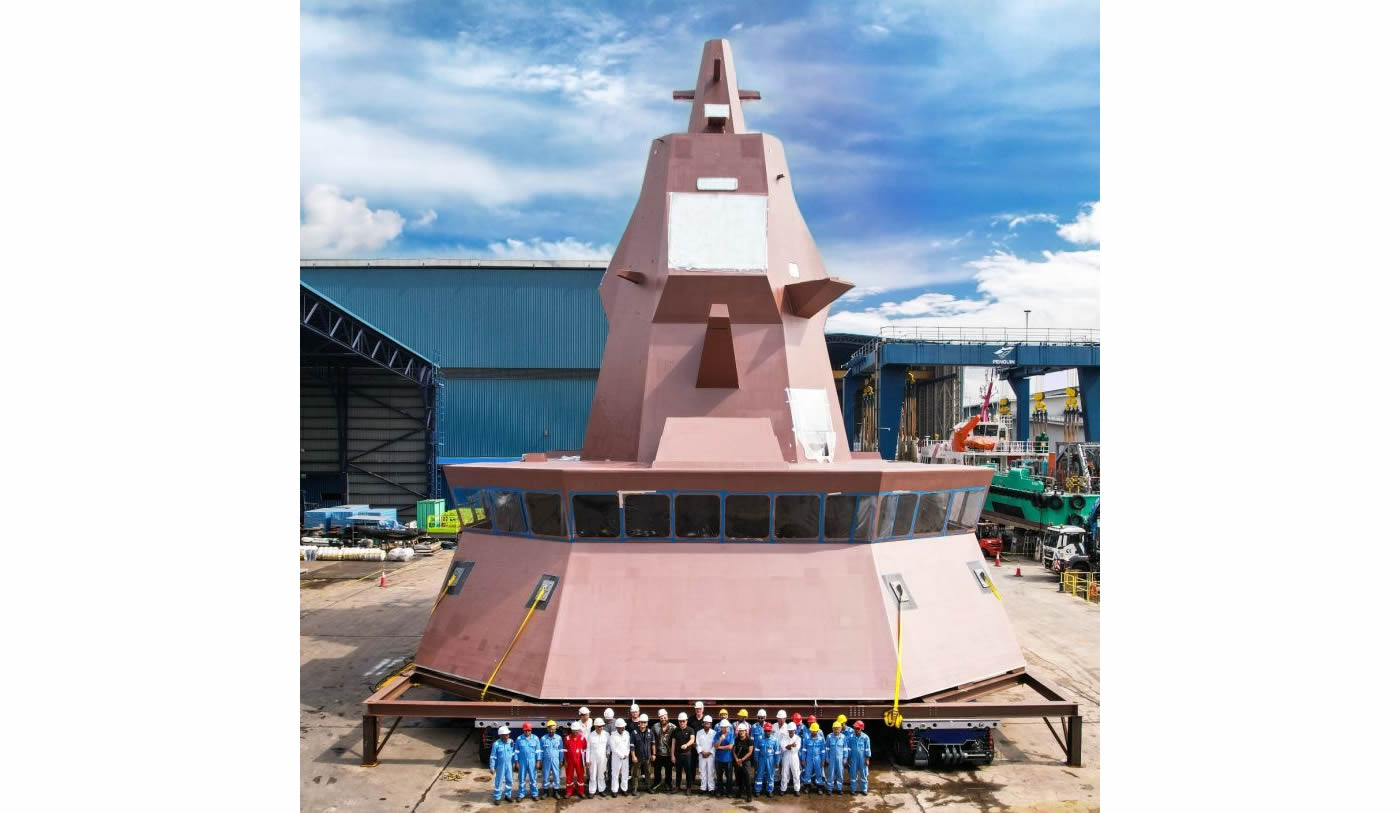
PENGUIN Shipyard International has completed and delivered a composite superstructure (CSS) using Saab’s unique technology for the Republic of Singapore Navy’s new Multi Role Combat Vessel (MRCV).
PENGUIN International press release
“This milestone marks the successful completion of Penguin’s first composite shipbuilding project and our first naval defence project,” said Penguin’s Managing Director James Tham.
“The capabilities developed through this project will be integrated across our broader shipbuilding operations, strengthening our ability to undertake more advanced programmes in the future.”
On 27 June 2026, Penguin handed over to Saab the first of six composite superstructures and masts for this new class of naval vessels.
Daniel Oscarsson, Head of Saab Business Unit Surface Ships, said, “By integrating composite superstructures into naval ships, our customers benefit from advantages such as low weight, decreased radar cross-section and reduced life-cycle costs.”
Commenting on the milestone, Fredrik Martinsson, Head of Project Management, Saab Business Unit Surface Ships, said, “We are seeing a growing number of customers entrust Saab with addressing their operational needs.”
“To better serve these customers locally, we continue to strengthen our strategic partnership with Penguin Shipyard International. With its long-standing heritage and deep expertise in shipbuilding in Singapore, Penguin shares Saab’s strong commitment to understand and meet customer requirements. This makes Penguin a valued and trusted partner for Saab.”
-End-

Naval News comments:
Naval News understand the composite sheets were produced by Saab in Sweden and shipped to Singapore for local assembly into the bridge and mast superstructure by PENGUIN shipyard. The macro block will then be fitted on the MRCV’s hull by ST Engineering.
ST Engineering launched the first of six Victory-class MRCVs, Victory, at its Benoi Yard in October 2025. The company started the construction of the second vessel in April 2025. The keel for this second MRCV was laid in early 2026. On April 29, 2026, the Republic of Singapore Navy (RSN) held the steel cutting ceremony of the third and fourth MRCVs.
The MRCV combines the combat capabilities of a modern frigate with the carriage and control capacity needed to be a Mothership for a wide range of unmanned systems. Developed to meet the RSN’s unique operational requirements, it is the largest and most complex warship built to date in Singapore.
At 150m in length and with a displacement of 8,000 tonnes, the MRCVs are designed to function as Motherships for a range of unmanned systems. With an operational range exceeding 7,000nm – twice that of the Formidable-class frigates – and an endurance of over 21 days, the MRCVs enable the RSN to deploy a range of unmanned systems to protect Singapore’s SLOCs.