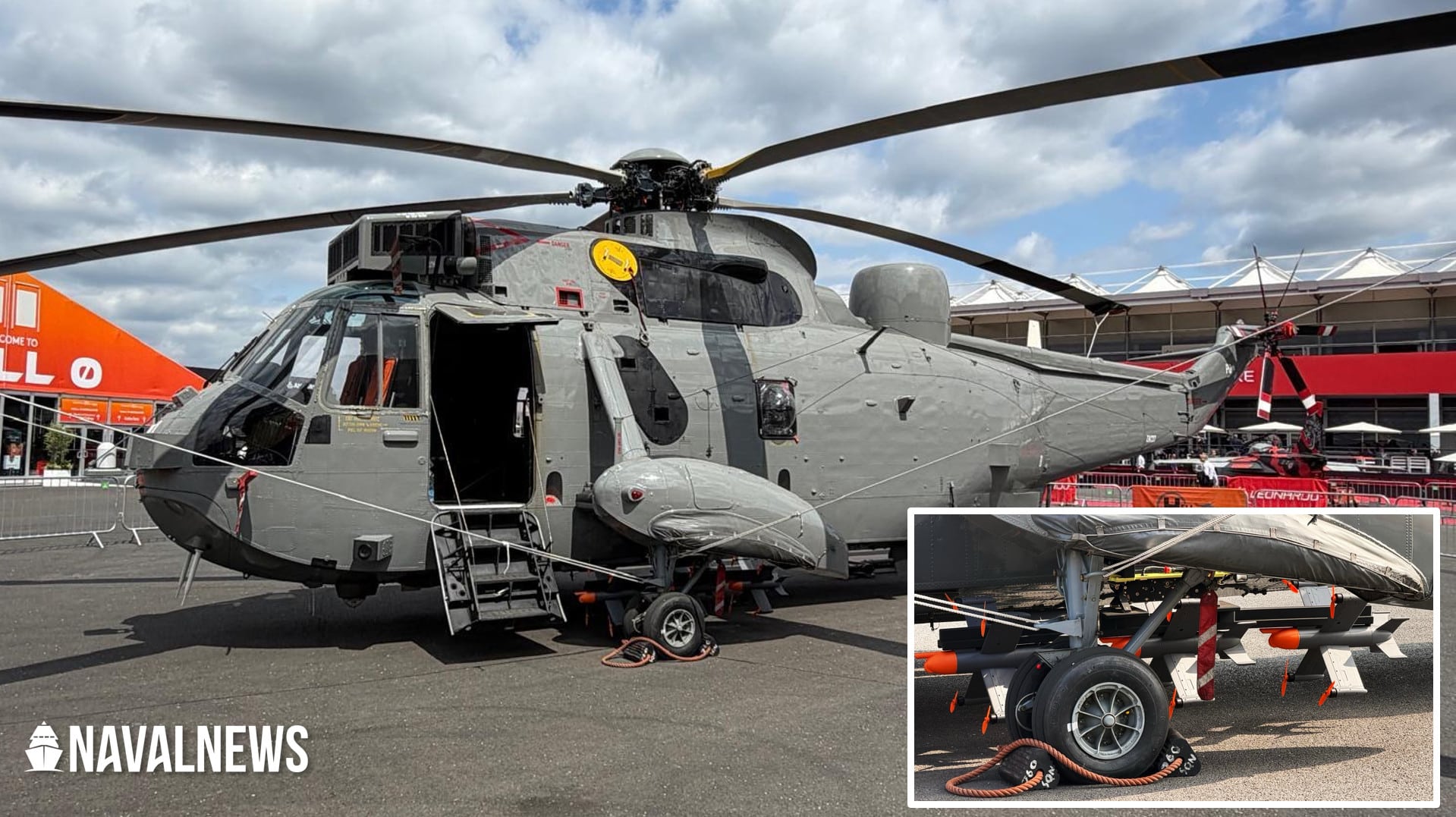
A Sea King helicopter on static display at Farnborough Airshow in the United Kingdom reveals a new weapon concept in Ukrainian Navy’s arsenal. Although the aircraft does not carry Ukrainian markings, it is understood by Naval News to be representitive of equipment levels expected for the six Mk.41 Sea Kings supplied to Ukraine by Germany.
The Cold War era helicopter is fitted with new launch rails between the fuselage and the sponsons. This is a position previously associated with Sea Skua or Exocet anti-ship missiles. Each rail can accommodate three of the latest generation interceptor drones.
Interceptor drones are a new development, born from necessity from the Russo-Ukraine War. First generation systems were agile quadcopters which could engage other battlefield UAVs (uncrewed air vehicles). These gave way to purpose designed bullet-shaped drones with four propellers facing forwards. These more missile-like systems remain relatively low cost, especially compared to traditional missiles. Yet they can catch higher and faster targets, not least Russia’s Shahed (Geran-II) deep strike drones.
Ukraine’s Sea King Helicopters
The aircraft is being displayed by HeliOperatons Ltd (‘HeliOps’) from Portland. The company has been involved in the overhaul, modification and transfer of Sea Kings to the Ukrainian Navy (VMS ZSU). In 2022 three HeliOps Sea King HAS.5U / HU.5 were donated by the UK to Ukraine. The ex-Royal Navy aircraft has been sold to HeliOps in 2018-19 but were bought back for donation.
Then earlier this year it was reported that several Mk.41 Sea Kings donated to Ukraine were being prepared by HeliOps. The company has a long-standing relationship with Germany for supporting its Mk.41 Sea King fleet. The transferred Sea Kings are likely to be operated by the Ukrainian Navy.
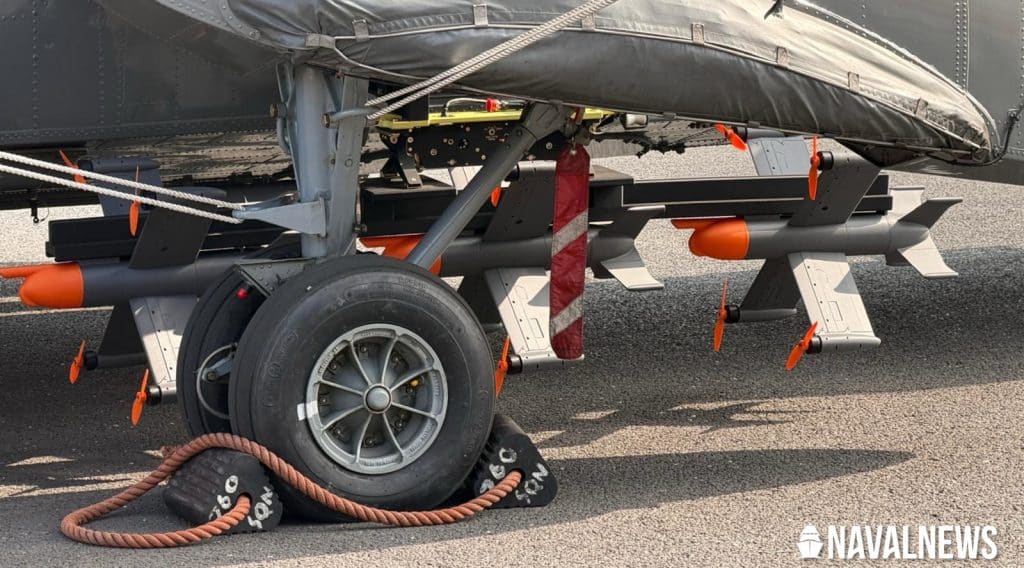
The exact model of interceptor drone carried by the Sea King has not been revealed. The ones attached at Farnborough are understood to be models and are representative only. It is possible that the interceptors to be carried may be of a previously unreported type.
Naval Weapon System
It is a logical step to mount interceptor drones on aircraft. Ukraine has already equipped an Antonov An-28 (NATO reporting name Cash) twin turboprop transport aircraft with rails under the wings. And Russia has recently revealed a vintage Yakovlev Yak-52 training aircraft with them. Air launch increases the airspace which can be covered and likely increases the range of the interceptors.
Operating over sea represents fresh challenges for interceptor drones. The harsh weather, often with high winds, saps their power. And, particularly when defending a coast like near Odesa in Ukraine, you have to be able to make head-on engagements. Many drone interceptions over land are tail-chase situations which can simplify guidance. At sea the threat is coming straight at you much of the time.
It seems natural that Navies will arm their helicopters with interceptor drones. If nothing else they are much cheaper than missiles, while still able to engage slower air targets. But they will come into their own providing air defense to coastal bases and cities.