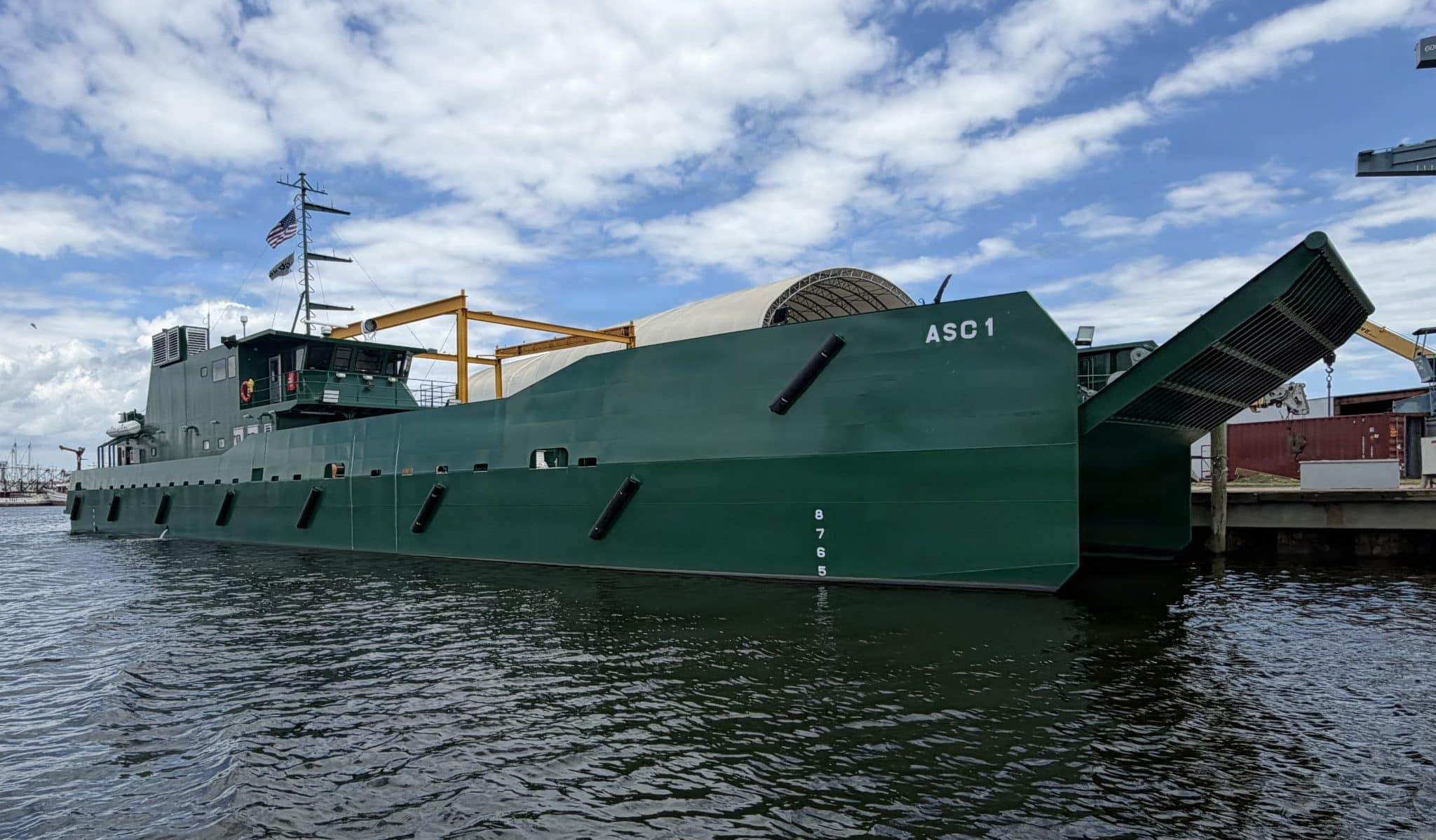
The U.S. Marine Corps Warfighting Laboratory has officially marked a critical milestone in Force Design modernization efforts with the technical acceptance of the first Ancillary Surface Craft (ASC) prototype. Designed to navigate challenging maritime geography and bridge logistical gaps, the ASC represents a major leap forward in the Corps’ ability to sustain Stand-in Forces within contested littoral environments, particularly in the Pacific.
USMC press release
By using a partnership intermediary contracting strategy, the ASC program moved rapidly from concept to construction, placing work with a non-traditional shipbuilder to shorten the path to a fielded prototype. Contracted to Birdon America in 2024, the first prototype’s delivery initiates a new phase of rigorous testing and tactical experimentation led by the MCWL.
The technical acceptance of the ASC underscores the Marine Corps’ commitment to solving the complex challenges of contested logistics during Expeditionary Advanced Base Operations (EABO). The roughly 150-foot roll-on/roll-off (RO-RO) craft was purpose-built to deliver personnel, equipment, and fuel over the “last tactical mile,” beaching directly on unimproved shores.
Technical specifications validated during the acceptance process highlight the craft’s exceptional ruggedness and operational utility. Engineered for demanding ocean transits, the ASC is fully operational in Sea State 5 and designed to survive extreme conditions up to Sea State 7. To ensure safe navigation through uncharted, very shallow littoral waters, the craft is equipped with advanced forward-looking sonar that enables maneuverability across the battlespace. Furthermore, it can transport up to 46 tons of cargo and 40 combat-loaded Marines while executing vital shore-to-shore maneuver, mobility, and sustainment.
“Achieving technical acceptance is a crucial first step in our rigorous testing regimen,” said Aaron Hatfield, Maritime Program Manager, Science and Technology Division, U.S. Marine Corps Warfighting Laboratory. “This validation assures that the craft’s advanced systems and robust design are ready for MCWL to begin hands-on technical experimentation, ensuring we can meet the extreme operational demands of the Indo-Pacific theater.”
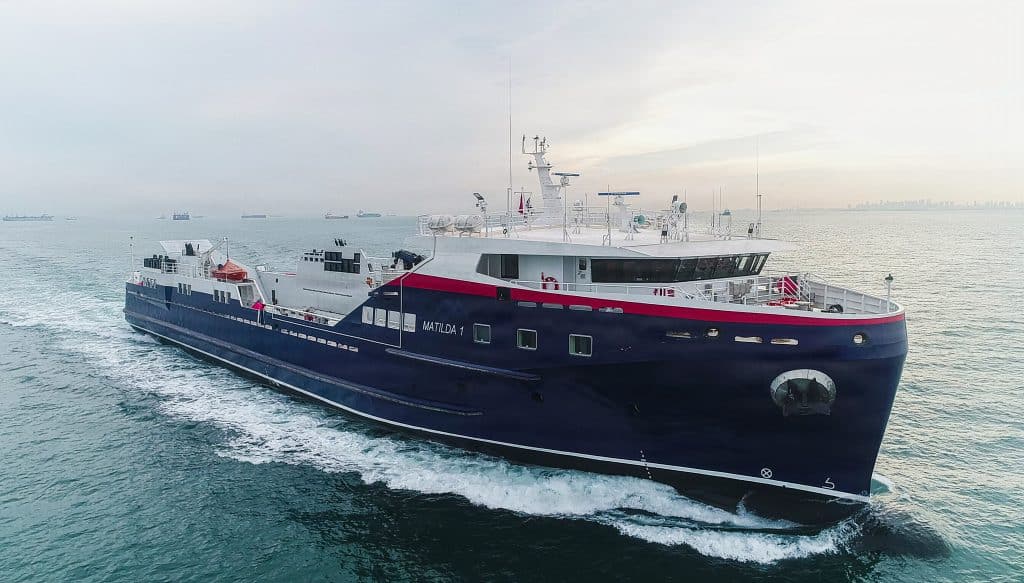
Following the technical acceptance of the ASC, the craft now moves into limited technical assessments (LTA) with Birdon America craft masters and engineers partnered with Australian Army crewing support and Marine Corps Warfighting Laboratory oversight and assessments. This partnership demonstrates the close relationship between the Marine Corps and the Australian Army as both services execute their respective Force Design.
The ASC is designed to be organic to the Marine Corps, employed by the units it supports and at the echelon that needs it. It is intended to complement rather than duplicate the Medium Landing Ship. The LSM is a larger amphibious vessel that moves a force between islands. The ASC is sized and configured with a very shallow draft to deliver logistical support to the “last tactical mile” into landing sites beyond the reach of larger vessels, including shallow-gradient, unimproved, and unsurveyed shorelines where standoff would otherwise leave cargo stranded offshore. Taken together, the two give a Stand-in Force a route from an intermediate staging base to the beach without dependence on a port, a pier, or a causeway.
“To support Expeditionary Advanced Base Operations (EABO), our forces must remain highly mobile and sustained without relying on fixed, vulnerable ports,” said Col. Kenny Jones, Science and Technology Division Director at the Marine Corps Warfighting Laboratory. “This prototype allows MCWL to immediately execute hands-on experimentation, test tactical concepts, and put real hardware in the hands of Marines. By exploring the ASC’s traditional bow-first beaching physics alongside other experimental platforms, we are actively reducing programmatic risk and perfecting the requirements for the future naval fleet.”
With the technical acceptance complete, the ASC will now transition into an operational testing phase. Initially, the craft will be operated by a hybrid crew pairing Marines with seasoned contracted mariners This approach ensures that American service members are thoroughly trained as the Marine Corps prepares for an expanded role in the independent operation of small surface craft.
While the primary mission of the ASC is logistics and maneuver rather than direct combat, upcoming testing phases will also evaluate various force protection and self-defense configurations, ensuring the craft can survive in highly contested maritime environments.
As the U.S. and Australia continue to build combined forces optimized for naval expeditionary warfare and littoral maneuver, the involvement of the Australian Army in the upcoming ASC limited technical assessments is a strong show of allied cooperation and demonstrates an effective way to drive innovation, reduce costs, and secure a free and open Indo-Pacific.
– End –