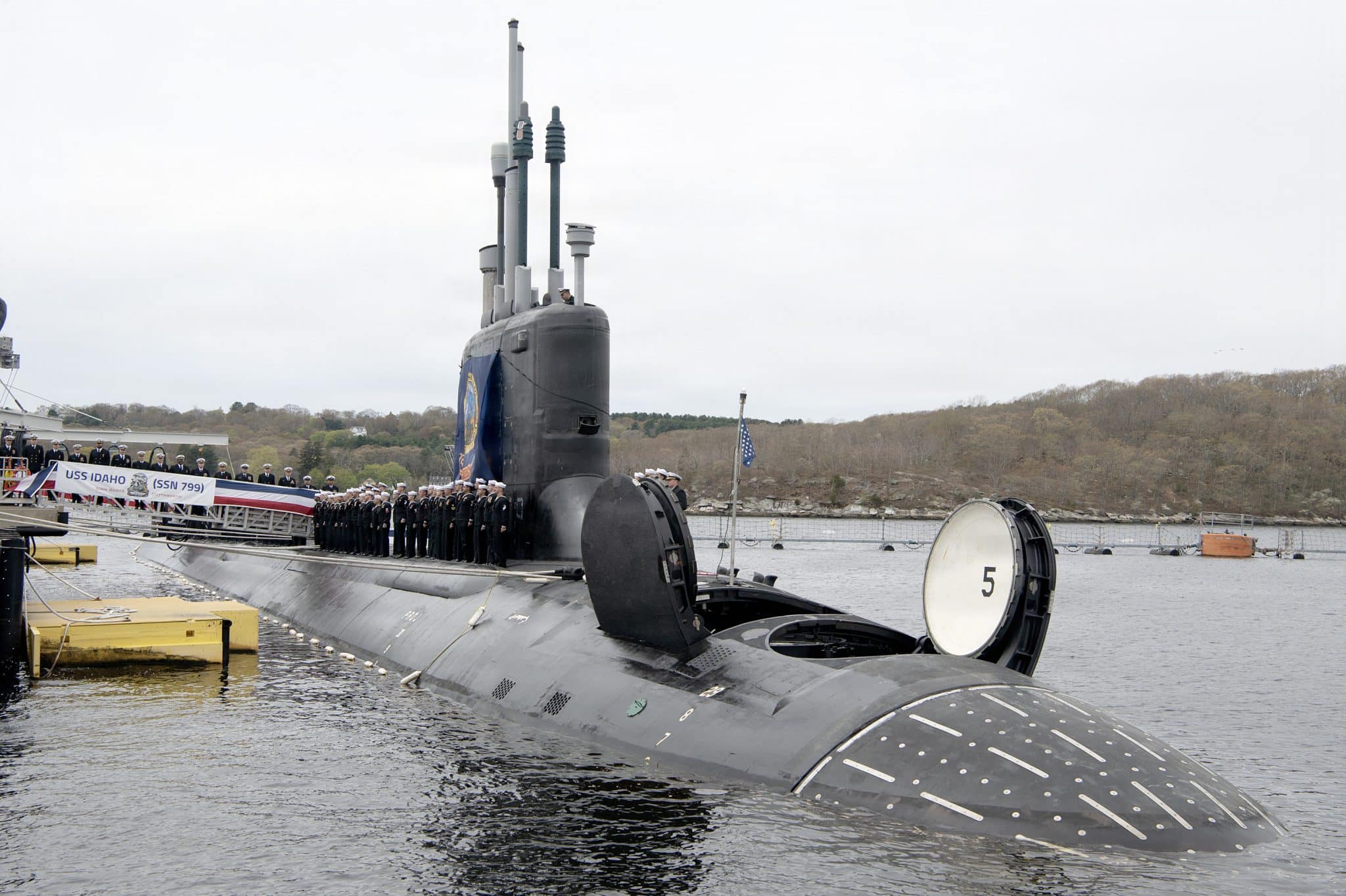
Vice Adm Rob Gaucher – the US Navy’s (USN’s) Director, Submarine Programs – has set out a four-pillar strategy for accelerating the navy’s submarine-building output. This process is designed to reflect and underpin the USN’s Chief of Naval Operations’ (CNO’s) testimony that a raised production rate will be in place by 2032.
The raised rate would deliver two Virginia-class nuclear-powered attack submarines (SSNs) and one Columbia-class nuclear-powered ballistic missile submarine (SSBN) off the production line each year.
That production line encompasses the navy’s two ‘prime’ submarine-building shipyards: General Dynamics Electric Boat, at Groton, Connecticut; and Huntington Ingalls Industries – Newport News, at Newport News, Virginia.
During 12 May testimony before the United States House of Representatives Appropriations Committee Sub-Committee on Defense, USN CNO Admiral Daryl Caudle said that, based on plans and processes the navy now has in place, the submarine-building output should “be up on step with that [raised rate] around 2032.”
The USN’s latest shipbuilding plan, released on 11 May, said “The navy’s requirement to increase the submarine production rate to at least one Columbia-class and two Virginia-class submarines per year remains the top industrial base priority.”
Speaking at the Combined Naval Event 2026 (CNE26) conference in the UK in mid-May, Vice Adm Gaucher – dual-titled as Direct Reporting Portfolio Manager (DRPM) Submarines and Program Acquisition Executive (PAE) Undersea Warfare, but widely known as the navy’s ‘sub tsar’ – said his own plan aims to meet CNO Caudle’s drumbeat by 2031 or earlier.
There are also some closer-in, more specific delivery targets that are part of meeting this requirement, Vice Adm Gaucher explained. These include delivering the lead Columbia SSBN in 2028, and then establishing the rhythm of delivering one Columbia boat per year by 2030 and two Virginias per year by 2031.
12 Columbias are to be built, and 44 more Virginias are in build or planned within in total class of 70 boats. Thus, an integrated construction programme is critical. “You can’t look at Virginia and Columbia in a vacuum because you’re sharing workforce, it’s the same shipyard, you’re sharing footprint,” Vice Adm Gaucher told the CNE26 audience.

US Navy submarine production: The Four-Pillar Strategy
To meet the overall aim and the milestones therein, Vice Adm Gaucher has drawn up the four-pillar strategy to deliver the change needed in the submarine construction approach:
1. Locking in submarine design: “We’re done with engineering churn,” Vice Adm. Gaucher stated. For the Virginia class, he has ordered “pencils down” on design changes unless mandated by safety or critical operational necessities (such as a sudden, severe acoustic signature increase). Any such modifications require the admiral’s personal sign-off, as do additions of new equipment not tied directly to safe and effective operation. Day-to-day minor adjustments on the deck plates—such as moving a pipe hanger to ensure fit—remain delegated to the appropriate operational levels. Looking toward the transition between the final two Virginia variants (Blocks VII and VIII), minimizing design churn will be critical to maintaining build pace.
2. Optimizing prime shipyard focus: Step two refocuses prime shipyards strictly on what they do best: module outfitting, hull assembly, and final testing. The goal is to shift component assembly outside the prime yards so that major modules arrive fully outfitted. In a “perfect world,” modules arrive ready for immediate integration, testing, and launch.
3. Integrating and scaling the broader industrial base: Closely tied to step two, this pillar focuses on enhancing the capacity, readiness, and resilience of the wider supply chain. Highlighting strategic outsourcers such as Rhoads (Pennsylvania), Austal (Alabama), and BAE Systems (Jacksonville), Vice Adm. Gaucher emphasized the need to scale component manufacturing across a wider geographic footprint to relieve bottleneck pressures on the prime yards.
4. Designing for producibility (SSN-X): Looking ahead to the next-generation SSN-X attack submarine, the guiding philosophy is “producibility.” The navy is closely evaluating operators’ requirements to strike a practical balance between ultimate capability and manufacturing scale. As the admiral noted: “At some point, if I could have two submarines instead of one submarine, that might be better than paying an exorbitant cost with money and time for the added capability.”
While steps one and four anchor the bookends of current production and future design, Vice Adm. Gaucher stressed that his day-to-day focus remains locked on executing steps two and three to gain better visibility into industrial bottlenecks before they impact schedules.
Naval News Comment
Vice Adm Gaucher’s strategy suggests some small but significant prospective shifts in the navy’s submarine-building philosophy, including keeping greater continuity and commonality in boat design across a class, introducing incremental capability upgrades, and perhaps edging away from Block builds (as evidenced in the aim to minimise design changes between the last two Virginia Blocks). USN submarine design and capability has always been focused on delivering the ‘best of the best’: however, the strategic need for more submarines indicates the navy could accept a minor degree of reduced capability if it could get more boats more quickly.