Japan plans to field the supersonic ASM-3ER anti-ship missile in FY2027 with a new dual-role capability to target enemy AWACS and tankers at long range.
On August 31, 2026, Japan’s Ministry of Defense (MOD) released its budget request for fiscal year 2027. Among the programs included in the request, the MOD announced that it would begin mass production and procurement of the ASM-3ER, a new air-launched anti-ship missile, from the next fiscal year. At the same time, however, the ministry also revealed plans to employ the missile in an air-to-air role.
The ASM-3ER is a long-range supersonic anti-ship missile whose research and development has been conducted by Japan’s Acquisition, Technology & Logistics Agency (ATLA) since FY2020. The missile has a range of more than 400 km.
It employs an integral rocket ramjet (IRR) propulsion system, in which a solid-fuel rocket booster is integrated into the rear section of the ramjet engine. During propulsion, the solid rocket booster initially accelerates the missile to a speed at which the ramjet can operate. Once the solid propellant has been consumed, the rocket section subsequently functions as the ramjet combustion chamber. This configuration allows the ASM-3ER to fly at supersonic speeds exceeding Mach 3, significantly reducing the time available for enemy forces to detect, react to, and intercept the incoming missile.
The ASM-3ER is manufactured by Mitsubishi Heavy Industries (MHI). For target acquisition and terminal guidance, the missile is equipped with an active/passive radar seeker. Its passive capability enables it to detect radio-frequency emissions from hostile radar and other emitters and use those emissions to engage the target.
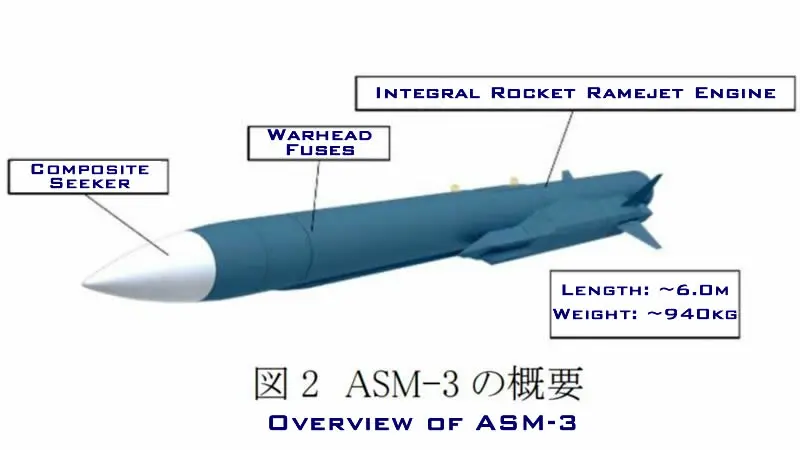
The ASM-3ER is based on the earlier ASM-3. Research into the underlying technologies for the ASM-3 began in FY1992, while full-scale development was conducted between FY2010 and FY2017 as a replacement for the aging ASM-1 and ASM-2 air-launched anti-ship missiles.
By the time development of the ASM-3 had been completed, however, the Chinese Navy’s air-defense systems had become increasingly sophisticated and capable of engaging targets at considerably greater ranges. As a result, the original concept of allowing the launch aircraft to attack hostile warships safely from outside their air-defense engagement envelope had become increasingly difficult to realize. Japan therefore decided not to field the original ASM-3 and instead proceeded with the development of the longer-range ASM-3ER.
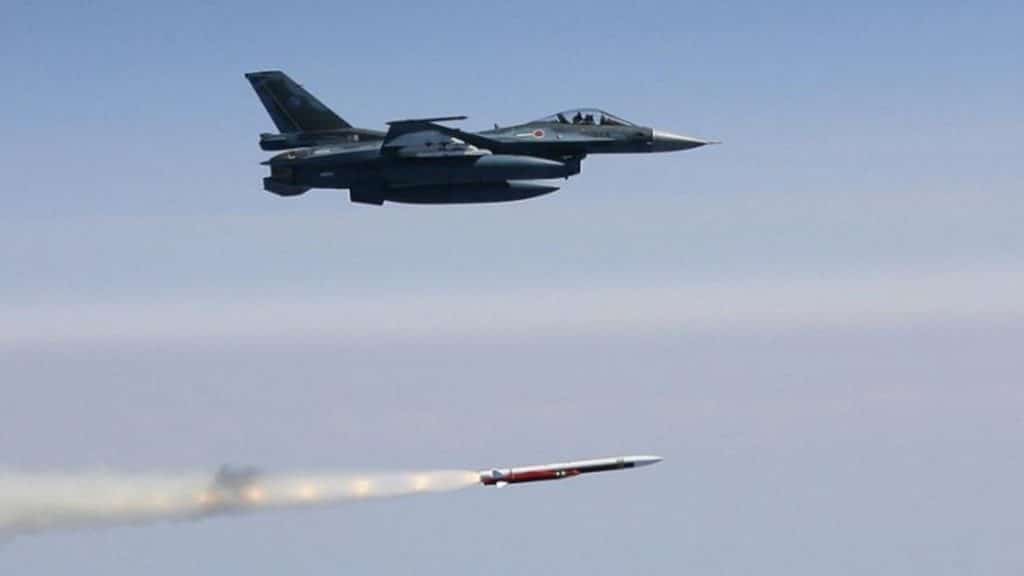
The ASM-3ER essentially retains the overall dimensions of the ASM-3, while improvements such as weight reduction have been incorporated to extend its engagement range. In FY2025, deployment of the ASM-3A, an interim variant incorporating some of the technologies and improvements developed for the ASM-3ER, began with the Japan Air Self-Defense Force (JASDF) which will be carried and operated by the JASDF’s F-2 fighter aircraft.
Adapting the ASM-3ER for the Air-to-Air Role
The announcement that the ASM-3ER would be adapted for an air-to-air role came as something of a surprise. According to the MOD, no hardware modifications will be required to give the ASM-3ER an air-to-air capability, with the necessary changes instead being implemented through software modifications. As originally planned, mass production and procurement are therefore scheduled to begin in FY2027, with the missile expected to enter operational service in FY2030.
The ASM-3ER has traditionally been described as having a range of more than 400 km, although this figure applies to anti-ship engagements. When used against airborne targets, the missile would presumably remain at high altitude for much of its flight. At such altitudes, the lower air density results in less aerodynamic drag than at low altitude close to the sea surface, meaning that, in theory, its effective range could be even greater.
This, however, raises the issue of how target-location data can be continuously updated throughout the missile’s flight, particularly when engaging targets beyond the radar detection range of the launch aircraft. To address this requirement, the ASM-3ER is equipped with the capability to receive updated target information via satellite. This capability is not available on either the ASM-3 or ASM-3A.
During the development phase, tests were also conducted to link the ASM-3ER with the Japan Aerospace Defense Ground Environment (JADGE), the JASDF’s core command-and-control and communications system. This could potentially allow an ASM-3ER-armed fighter to engage targets detected by other platforms, such as the JASDF’s E-767 Airborne Warning and Control System (AWACS) aircraft.
However, the ASM-3ER is likely to be considerably more expensive than conventional air-to-air missiles. Moreover, because the missile will also be required for its primary anti-ship mission, available stocks are unlikely to be sufficient for it to be employed against every type of airborne target. It is therefore likely to be reserved for engaging enemy high value airborne assets (HVAAs), such as airborne early warning and control (AEW&C) aircraft and aerial refueling tankers, whose loss would have a disproportionately significant operational impact.
This reflects an emerging doctrine also seen in Europe with MBDA’s STRATUS RS (Rapid Strike) missile under the FC/ASW program, which similarly leverages a supersonic ramjet airframe for anti-HVAA missions while the primary roles are anti-ship and anti-surface.
Like the ASM-3A, the ASM-3ER will be carried and operated by the F-2 fighter aircraft. From FY2027, the JASDF is also scheduled to begin fielding upgraded F-2s capable of employing the air-launched variant of the improved Type 12 Surface-to-Ship Missile, an anti-ship missile with a range of approximately 1,000 km. As a result, the F-2 will eventually be capable of employing both a supersonic missile with a range exceeding 400 km and a 1,000-km-class anti-ship missile, giving the aircraft one of the most formidable anti-ship strike capabilities of any fighter in the world.