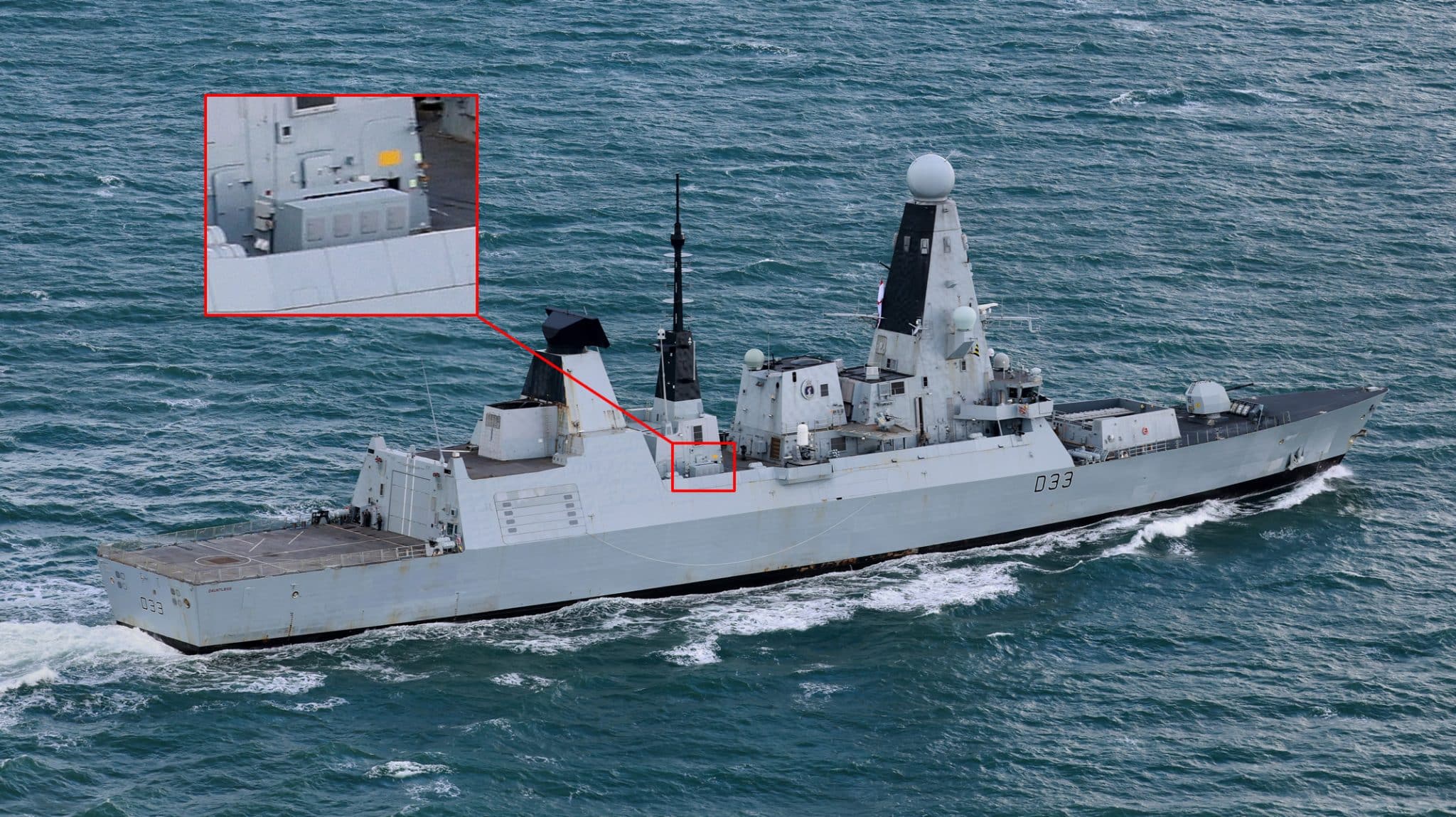
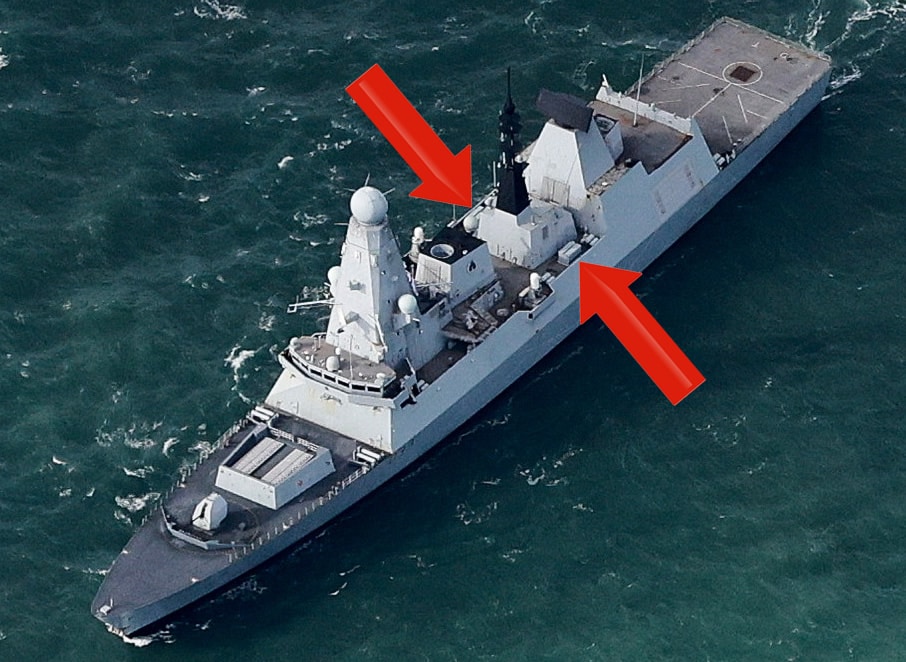
The Royal Navy Type 45 Destroyers appear to have received a new C-UAS system for self protection against drones. Images released recently by the UK MoD show HMS Dauntless (D33) sporting two mystery containers that are likely acting as interceptor drone launchers.
The pictures, dated 10 October 2026, show HMS Dauntless conducting a passing exercise (PASSEX) with five Ukrainian Minehunters off the Isle of Wight. The Ukrainian Navy ships were closing out Exercise Lion Protector, demonstrating their ability to safely manoeuvre as a small task group in company with a major warship, played by Dauntless. Lion Protector started in August. The exercise’s goal is to refine the military response of Joint Expeditionary Force nations to protect Europe’s northern flank.
According to the Royal Navy, HMS Dauntless is gearing up to escort UK flagship HMS Prince of Wales when she resumes her Firecrest 2026 deployment to the High North.
The images show two containers or boxes (as these do not look like standard ISO containers) positioned on the port and starboard sides of the destroyer’s main communication mast (painted black). Visual analysis suggests these house multi-cell vertical launch systems (VLS) for interceptor drones. Their size appears to be approximately 2 meters x 1 meter (using the nearby SOLAS canister as reference). Interceptor drones typically require large boxes so they can fly out with rotors spinning. The apparent lack of new, organic sensors indicate that the interceptors must be receiving targeting data from the Type 45’s existing suite, i.e. the Sampson multi-function radar, the S1850M long-range radar on the aft mast and/or the electro optic systems. If this is confirmed, it would mean the new system is a deeply integrated, mature C-UAS capability rather than a standalone, quick-fix system.
Contacted by Naval News, a Royal Navy spokesperson said “Due to operational sensitivities, we are not going to discuss this equipment fit”.
Adapting to new threats
The presence of this new system on a Type 45 destroyer shows how navies are adapting to the new challenges posed by affordable drones. The Royal Navy learned from real-life operations, like the conditions faced by HMS Diamond in the Red Sea as the Houthis fired drones and missiles from Yemen at merchant shipping in 2024. HMS Dragon returned just last week from a seven-month deployment in the Mediterranean and Red Sea but the new system has not been spotted. This suggests HMS Dauntless could be the first Type 45 ship to trial the capability ahead of her High North deployment.
Drone attack and swarming tactics—extensively practiced by the Royal Navy and French Navy in dedicated exercises like Sharpshooter and WildFire and based on their experience from Red Sea deployments—highlighted a critical limitation in European navies’ VLS magazine depth (48 cells for Type 45 and Horizon destroyers, 32 cells for French Air Defence FREMMs). To address this issue, the Royal Navy started transitioning toward DragonFire lasers and C-UAS helicopter (Martlet / LMM aboard Wildcat). The new C-UAS system spotted on Dauntless shows that the Royal Navy continues to transform the Type 45 from a conventional air-defence vessel into a highly resilient platform capable of surviving drone saturation. The French Navy is also adapting with the adoption of new sensors, jammers, gun systems, FPV drones and interceptor drones.
Interceptor drones provide an extra layer of defence and allow the ship’s crew to better match the counter to the threat. They offer much cheaper options than always launching an expensive missile against every enemy drone.