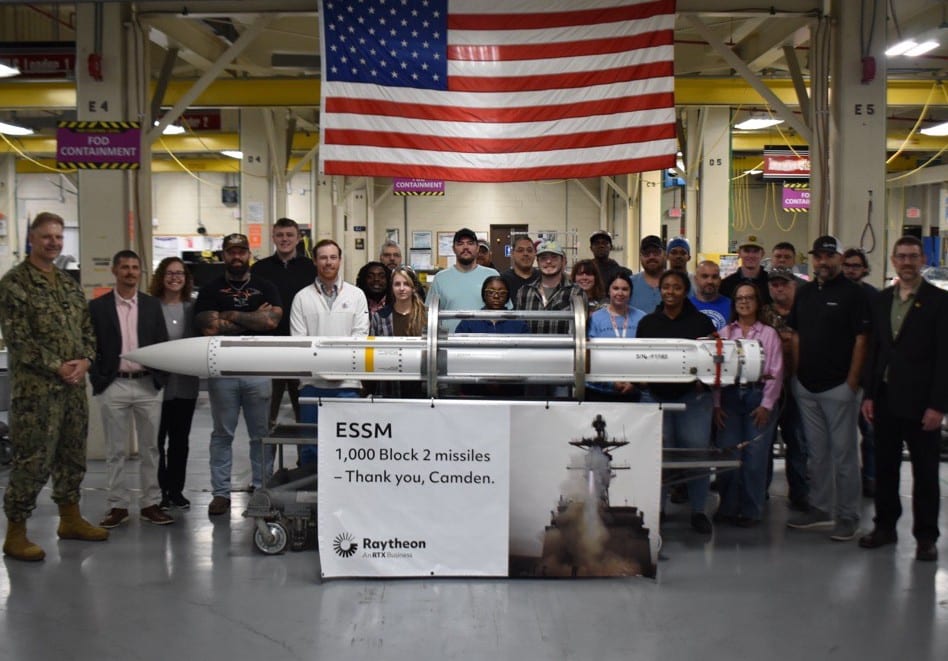
A Raytheon-led industry team has completed the handover of the 1,000th Evolved SeaSparrow Missile (ESSM) Block 2 all-up-round, the US Navy announced on 2 November.
“Delivery of the 1,000th ESSM Block 2 missile is a significant achievement for the NATO SeaSparrow Consortium, PMX-312 [the US Navy’s NATO SEASPARROW Program], our industry partners, and, most importantly, the Sailors who rely on these weapons as a critical layer of defense,” said Captain John Bowman, PMX-312 program manager. “This milestone demonstrates the enduring value of international cooperation and a resilient industrial base in delivering proven maritime defense capability at the scale our nations require.”
This delivery milestone, celebrated at Raytheon’s Camden, Arkansas, plant on 28 October, occurred just 16 months after the 500th missile was handed over. Moreover, it comes as Raytheon and its international industry partners are preparing to grow the ESSM Block 2 production rate to over 700 all-up-rounds per year to meet growing customer demand. “We delivered over 350 missiles last year,” said Misty Holmes, the company’s vice president of Naval Shipboard Missiles. “The programme is on a good path from a production standpoint, and while we are delivering on time on schedule to meet customer commitments, we’re also consistently ramping in a steady state rate because the demand for this capability is higher than our current production capacity.
ESSM is a ship self-defence missile developed under a cooperative effort between the US Navy and its 11 NATO SeaSparrow Consortium partners (Australia, Belgium, Canada, Denmark, Germany, Greece, the Netherlands, Norway, Portugal, Spain and Türkiye). The Block 2 variant achieved initial operational capability in 2021.
An evolution from ESSM Block 1, the Block 2 missile was developed to counter future threat capabilities — including reduced signatures, increased raid sizes, and electronic countermeasures — within the existing kinematic envelope. Block 2 replaces the legacy guidance section and introduces a new dual mode active/semi-active X-band radar seeker (increasing the diameter of the missile front end section from 8 inches to 10 inches). The introduction of an active seeker channel supports terminal engagement without the requirement for target illumination by the launch ship.
ESSM Block 2 additionally features a new Dual Band Transceiver (S- and X-band) for in-flight data communications to enable control and management of the missile during flight. Warhead improvements and an updated guidance and control section are also embodied.
Raytheon leads the multinational industry consortium responsible for the manufacture and delivery of ESSM Block 2. “The unique thing about ESSM is that it’s run by a consortium,” said Holmes. “We don’t just have a supply chain, we have industrial partners all over the globe. That provides a robustness and a resilience unlike a typical supply chain arrangement. And we see the fruits of that in the workshare arrangements that we steward with our industrial partners.
“We’re achieving steady-state throughput on our production line, but also maintaining the critical deliveries based on the allocation of the consortium.”
Moves to increase rate production have been informed by early engagement with customers through the NATO SeaSparrow Project Office (NSPO). “This is not coming as a surprise,” Holmes told Naval News. “We’re able to collaborate across all the nations in the consortium so we can plan ahead into our production contracts, and see what that ramp-up needs to look like across the industry partners.”
Raytheon will wrap up its current contract in early 2027, and then segue into the next Fiscal Year of production. “My target ramp for the next three years is 65 missiles per month, coming from roughly 45 per month,” Holmes said. “We’ve been able to demonstrate the ability to consistently and proactively ramp and rate on ESSM.”
She continued: “Understanding the demand signal early has enabled us to invest in capital earlier this year that’s going to help us get to a rate of 65 [missiles] per month. We’re also able to bundle several years of procurement together, via Raytheon investment, and then deliver those savings on an economic order quantity basis back to the US Navy and its allies.”
Looking beyond ESSM Block 2, the NSPO is now advancing plans for the ESSM Next Significant Variant (NSV). Intended to offer an improved capability to pace current and future air and missile threats, while retaining a 10-inch diameter to fit into a MK 41 quad-pack canister, the NSV project is exploring an NSPO releasable missile design adopting an open, modular, and standards-driven architecture and incorporating open-source principles and deliverables wherever feasible.
Key drivers for ESSM NSV development include stressing simultaneous engagement scenarios, the need to develop fully releasable technologies using open architecture standards for all consortium partners to openly share, and the need to maintain capability with current consortium systems to the greatest extent possible while limiting ship support. The NSPO is encouraging participation from both existing and new industry partners.
NSPO held an industry day for NSV in early 2026, with a formal sources sought notice released in the third quarter of this year. Respondents have been asked to outline their capability to provide a complete missile system, including, but not limited to airframe; propulsion; guidance, navigation and control; seeker; kill mechanism; control actuation; datalink/communications; and software architecture. A Milestone B acquisition decision is planned by September 2029.
NSPO is pursuing a competitive acquisition approach. “We’re fully supportive of this [acquisition strategy and] completely embrace the competition,” Holmes said. “We’re looking forward to being an active participant. “I think we’re uniquely suited to provide all of these attributes that the [customer] is looking for,” she added. “We’re working right now on our delivery roadmap with the NSPO team on the Next Significant Variant.”