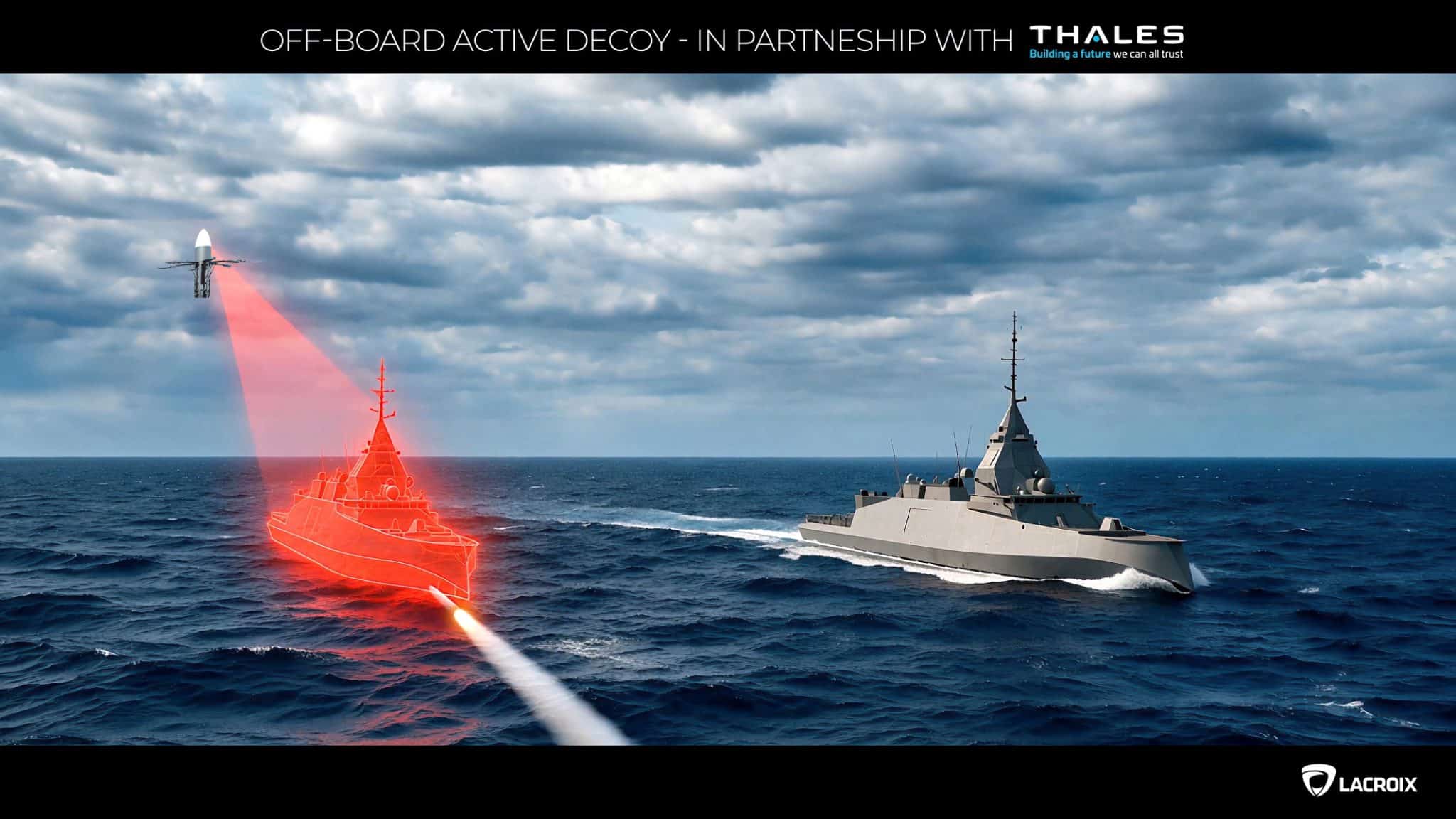
The French Defense Procurement Agency (DGA) is partnering with Thales and Lacroix to equip French Navy warships with a new Off-Board Active Decoy (OBAD).
The French Defense Procurement Agency (DGA) is advancing a new Off-Board Active Decoy (OBAD) program designed to protect surface vessels from modern anti-ship missiles. Highlighted ahead of Euronaval, the program is named DAUPHIN, an acronym for Drone d’Autoprotection Projeté et Héliporté d’Interception Navale (which translates to Projected and Heliborne Self-Protection Drone for Naval Interception). Led by the DGA and driven by French Navy requirements, the collaborative project partners Thales, which is responsible for the electronic warfare payload, with Lacroix, which is developing the aerial vector.
DAUPHIN OBAD: A New Layer of Softkill Protection
Initiated in late 2024, the DAUPHIN project aims to reinforce traditional hardkill and softkill ship defenses for high-intensity conflicts. The system deploys a drone equipped with an electromagnetic jammer to lure incoming missile seekers away from the targeted ship. Lacroix is responsible for the vector carrying the payload, which consists of a pyrotechnic ejector and a multicopter UAV. Thales is developing the compact, embedded jamming payload.
Operating as a reactive measure, the OBAD functions autonomously without a datalink back to the host ship once deployed. The system relies on new, ITAR-free, in-house technology, representing a sovereign electronic warfare capability for the French industry. It features a specialized antenna that computes the threat’s direction of arrival, allowing the drone’s stabilization algorithms to maintain its position directly in front of the missile’s radar seeker beam.
At the core of the payload is a Digital Radio Frequency Memory (DRFM) system that captures, records, and alters the incoming radar signal to generate a fake return, deceiving the incoming missile about the target’s actual location. This is driven by an innovative, solid-state High Power Amplifier (HPA). According to Thales, a single DAUPHIN drone is capable of simulating the Radar Cross Section (RCS) of an FDI frigate or a larger vessel.
International OBAD Developments
The development of DAUPHIN aligns with a broader international push toward advanced Off-Board Active Decoy capabilities as allied navies seek to save expensive hardkill interceptors. During the press briefing, Thales officials confirmed they are coordinating with Thales UK, given their shared business domains. France and the United Kingdom previously collaborated on the Accolade Technology Demonstration Programme (TDP), a joint effort exploring advanced off-board active decoys. However, the DAUPHIN architecture remains fully new and distinct from the Accolade effort.
Across the Atlantic, the United States Navy is pursuing similar capabilities with the Long Endurance Electronic Decoy (LEED) program. Developed in partnership with Lockheed Martin, LEED seeks to provide a ship-launched, long-endurance radio frequency decoy alternative to existing hovering rocket systems like the MK 234 Nulka. The program aims to marry a modular RF payload with autonomous flight, strengthening the non-kinetic shield of U.S. Navy warships against incoming anti-ship missile barrages.
In the Middle East, Israel’s Rafael Advanced Defense Systems has fielded the C-GEM off-board active RF decoy. Currently operational on Israeli Navy Sa’ar 6-class corvettes, C-GEM is a rocket-launched, expendable system that deploys an autonomous micro-ECM payload suspended beneath a parachute. Like DAUPHIN, C-GEM utilizes advanced DRFM technology and a solid-state active array to generate sophisticated deception techniques. However, while DAUPHIN utilizes a rotary-wing drone to maintain its position, C-GEM relies on electronic beam steering to direct its jamming signals toward incoming threats as it descends. C-GEM is designed to be fired from standard 110 mm to 150 mm decoy launching systems, such as NATO 130mm SRBOC launchers.
Tactical Advantages and Timeline of DAUPHIN OBAD
By introducing this OBAD capability, navies gain an optimized defensive layer that can operate alongside shipboard jammers to achieve a significantly higher probability of kill (PK) against incoming threats. Crucially, successfully luring missiles away with active decoys reduces the need to expend a ship’s limited and expensive hardkill interceptors such as Aster missiles.
The project is advancing rapidly, utilizing the expertise of five DGA centers to mitigate technological risks. The high power transmission block has already been successfully demonstrated, and the first prototype of the Lacroix vector will be produced and flight-tested throughout 2027. While a specific launcher has not yet been selected, the design focuses on remaining as compact as possible. Following the completion of the current development phase, a separate contract will govern the system’s integration on board naval vessels. Decisions regarding whether the drone can be recovered and reused after deployment—requiring parts like the pyrotechnic propellant to be replaced—remain pending, and it is currently too early for the system to be marketed for export.