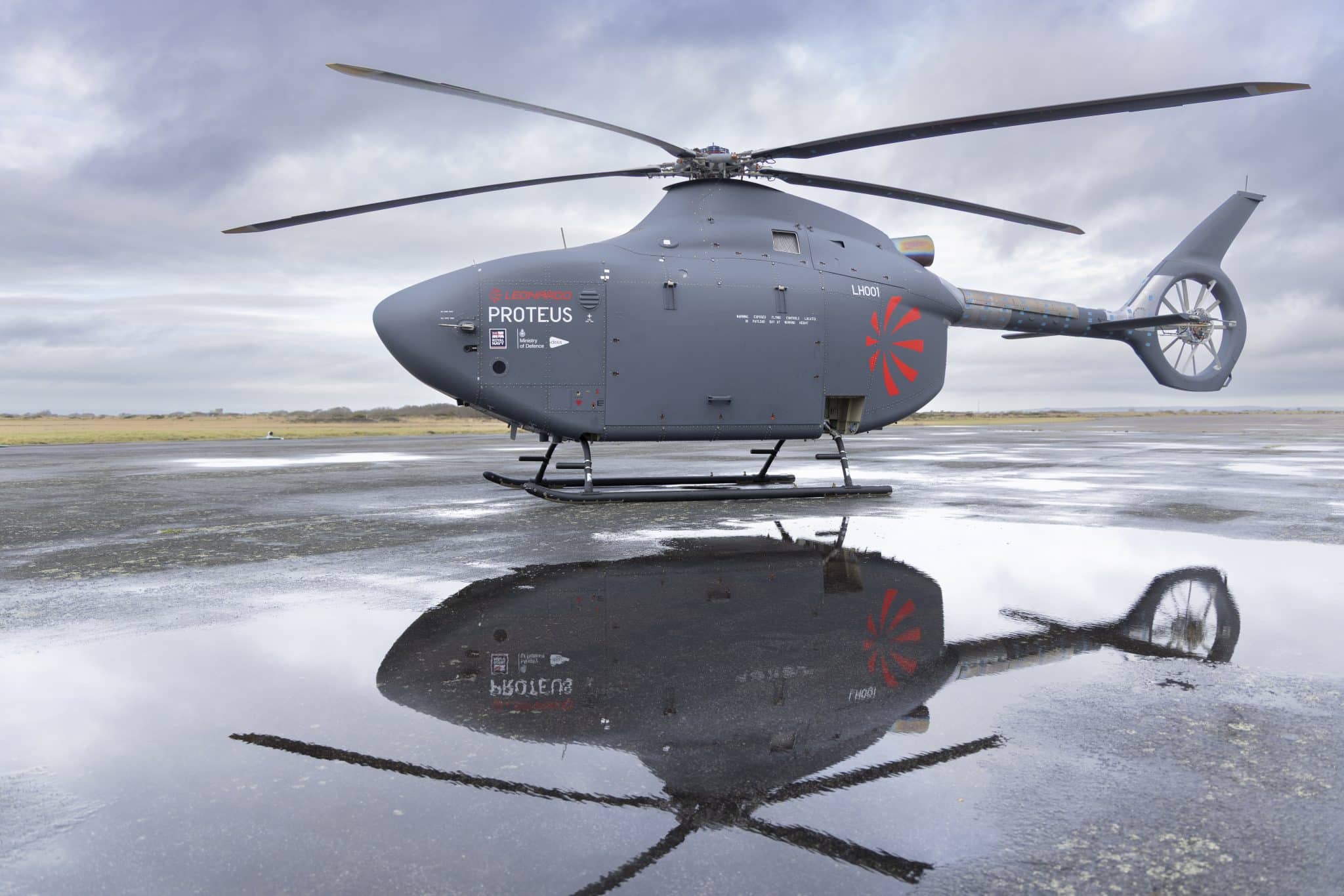
Leonardo’s focus on uncrewed and autonomous systems is increasingly covering a range of air and surface solutions, and rotorcraft make no exception, particularly with the 200 kg-class AWHero and 3-ton-class Proteus rotorcraft uncrewed systems.
Sponsored by

The two systems have been designed to meet evolving defence UAS requirements rapidly, ideally suited in particular for naval applications including ISTAR (Intelligence, Surveillance, Target Acquisition and Reconnaissance) and support to counter surface and submarine threats, integrated with vessels’ CMS (Combat Management System). AWHero and Proteus leverage highly integrated capabilities across Leonardo, from platform to systems and sensors, and are conceived with a strong focus on modern multi-domain operations, also acting as nodes in a network of data gathering and exchange to guarantee a high degree of situational awareness and support decision-making in the battlefield. Both systems have CUC-T (Crewed-Uncrewed Teaming) capabilities embedded that are being tested and demonstrated.
The AWHero’s production configuration featuring a heavy fuel powerplant, which is nearing certification in Italy, is optimized to support a range of assets involved in a range of naval and multi-domain operations such as ISTAR (Intelligence, Surveillance, Target Acquisition and Reconnaissance), ASW (Anti-Submarine Warfare), Electronic Warfare, Communication Relay, Border Protection, Combat support, and Force Protection, and can be integrated with the naval combat management system. Since 2019 and through to 2026, AWHero has been conducting maritime surveillance capability demonstrations on ships and other exercises, benefitting from a range of capability demonstration initiatives in the RUAS domain in Italy, UK and Europe.


Proteus is a technology demonstrator developed under a UK MoD and Royal Navy initiative sustaining their ambition of a Hybrid Navy and their Maritime Aviation Transformation strategy (MATx), which includes developing Vertical and Short Take-Off and Landing (VSTOL) autonomous collaborative platforms (ACPs). First flown at the beginning of this year, Proteus has been designed and developed extensively, relying upon advanced digital twin capabilities and has successfully demonstrated fully autonomous mission accomplishment for a large-size, heavier rotary UAS platform in a virtual environment. An autonomous, uncrewed platform such as Proteus is designed to operate from ships, in challenging conditions such as high sea states. Its size is a reflection of the plethora of payloads it can carry – such as sensors and sonobuoys – as well as enabling it to operate at sea where aircraft are battered by the elements. Proteus has been thoroughly illustrated also to other nations.
AWHero and Proteus are part of a forward-looking roadmap that Leonardo is implementing to maintain its leadership in vertical flight applications in the frame of current and future technological evolutions, which will extensively reshape this industry. Within this roadmap, uncrewed systems and relevant enabling technologies (i.e. automation/autonomy, communications, sensors integration and fusion) are key elements in which the company has been significantly investing, while leveraging a fruitful collaboration with the Italian and UK Military Authorities, respectively. The systems reflect, at various levels, the incremental yet firm move from design to CONOPS (Concept of Operations) and market-focused configuration.