Naval Group unveiled the design of its new 37-meter Seaquest M Medium Unmanned Surface Vessel (MUSV), an autonomous platform featuring a fully containerized combat system and Steeris mission management, ahead of Euronaval 2026.
Naval Group recently unveiled details and the first rendering of the Seaquest M, its new Medium Unmanned Surface Vessel (MUSV) design, during the Euronaval press trip. The Seaquest M is a 37-meter, multi-role, reconfigurable platform featuring a steel hull and a straight bow. It is designed for both standalone operations and as a “loyal wingman” to complement existing naval assets.
Derived from a civilian design to facilitate rapid scalability and production across various shipyards, the Seaquest M features a fully containerized combat system for quick mission turnaround and versatile configurations. Naval Group emphasized three primary focus areas for the MUSV: mission and platform autonomy (aiming for 10-day increments without human intervention), scalability, and the fully containerized combat system. While designed as fully unmanned, Naval Group is also exploring optionally manned configurations due to market interest.
The vessel will be equipped with Steeris, Naval Group’s drone-agnostic mission management system, allowing for integration with existing combat management systems and enabling mission autonomy through the “Steeris on board” kit. This system facilitates high-level command intentions and can manage payloads autonomously.
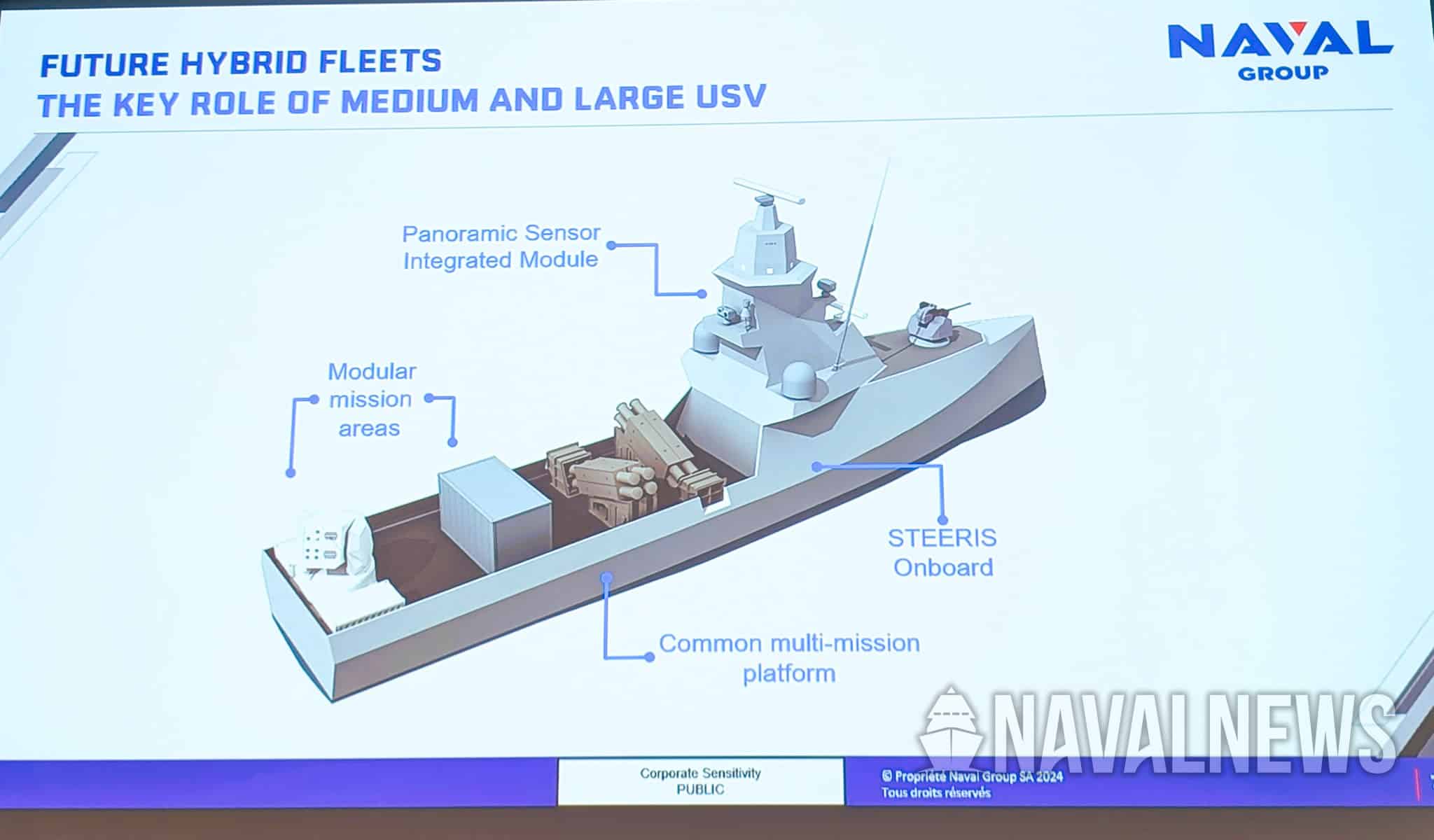
The provided rendering illustrates the Seaquest M’s modular design, highlighting features like a Panoramic Sensor Integrated Module (SPIM). This integrated mast concept, which consolidates sensors, bays, and calculators into a single module, has been successfully matured and proven as a strong game changer through Naval Group’s Gowind and FDI frigate programs. The rendering also shows modular mission areas capable of accommodating standard containers and effectors such as the Rampart launcher, alongside a common multi-mission platform.
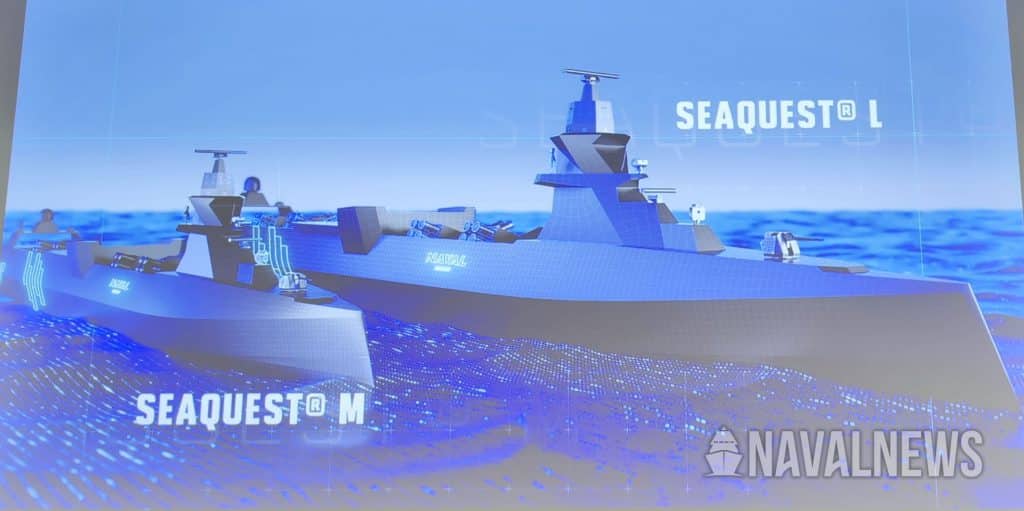

While a larger “Seaquest L” Large Unmanned Surface Vessel (LUSV) was briefly brought up during the press briefing, Naval Group representatives clarified that they are not actively developing the LUSV variant at this time. Their current efforts remain entirely focused on bringing the 37-meter Seaquest M to market.
Regarding the French Navy’s perspective, the officer in charge of drones at the planning and programs office told Naval News that armed MUSVs are on the roadmap but remain categorized as “later increments.” The service’s immediate operational focus is on maturing core fundamentals, including endurance, secure connectivity, and hull durability in harsh maritime environments. Despite this longer timeline for medium-sized platforms, the French Navy is rapidly advancing its smaller uncrewed capabilities; the Direction Générale de l’Armement (DGA) recently launched a formal tender for embarked, long-endurance surface drones for ISR missions, and the Ministry of Armed Forces has selected the top industrial contenders for the DANAE project, an accelerated initiative to field a fleet of armed autonomous surface vessels.
Naval Group plans to begin sea trials for the Seaquest M’s initial capabilities within the next couple of months, focusing on a minimum viable product approach for rapid iteration.