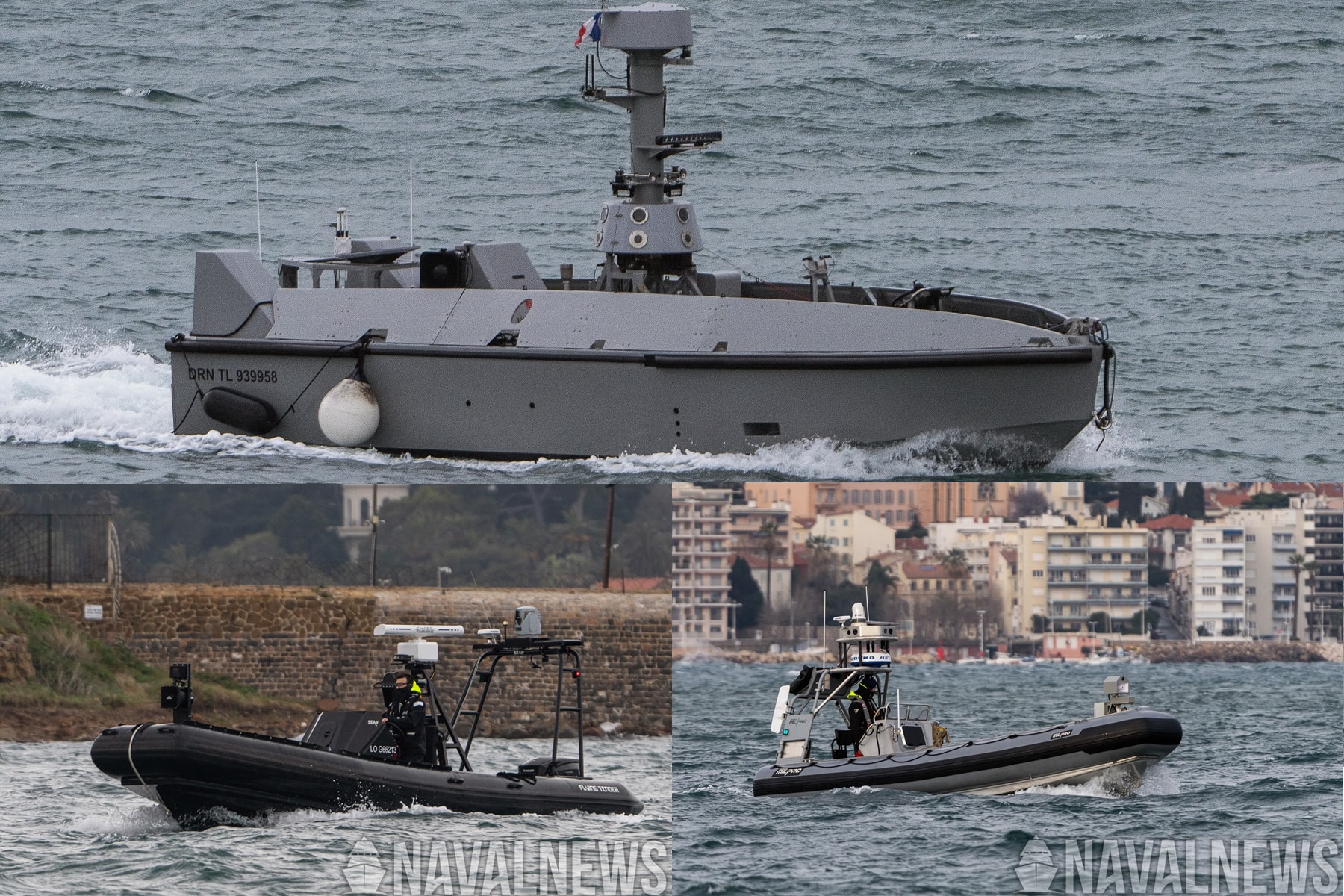
The French Defence Innovation Agency (Agence de l’innovation de défense — AID) and the French Navy (Marine nationale) have officially selected the three industrial partners moving forward in the DANAE armed USV program.
Launched in January 2026 under the guidance of the French Directorate General of Armaments (DGA), as reported by Naval News, the DANAE (Drone de surface Autonome Naval avec capacité d’Armement Embarqué) program aims to rapidly field a fleet of armed autonomous surface vehicles (USVs) capable of conducting port protection (for both military and civilian infrastructure) and high-value unit or warship escort duties. Following an initial evaluation phase held in January 2026 off Saint-Mandrier near Toulon—where seven existing drone solutions were put through rigorous trials assessing navigation, endurance, and decision-making autonomy—the DGA and AID have narrowed the field to three teams.
The Three Selected Partners
As part of the second phase of the program, which kicked off in September 2026 and will run through late 2027, the three selected industrial partners will each receive funding to produce and test a larger prototype over the next 12 months. The three down-selected team for DANAE are:
SEAir & The ORCAS Group: Centered around SEAir as the platformist and integrator, this solution proposes a unique “Flying USV” multi-mission platform. Operating on hydrofoils, it distinguishes itself by offering superior speed, stealth, endurance, and sensor/weapon stability even in heavy seas, while remaining compact enough to be deployed directly from frigates.
SeaOwl: Offering the NEMEZIS system, SeaOwl brings an innovative dual-mode (manned and autonomous) architecture that expands the operational versatility of the EDO 4G MN boat. Equipped with an advanced sensor suite and a non-lethal dissuasion turret, NEMEZIS enables round-the-clock patrol, surveillance, and escort operations optimized for control by a single operator utilizing high levels of payload integration and autonomous decision-making.
SIREHNA, Couach & Naval Group: This group presents the Seaquest S, a modular and versatile 9-meter intermediate-format USV designed natively as a drone. Built to integrate seamlessly into existing naval combat systems and operate in degraded sea states, the Seaquest S can be rapidly deployed from navy vessels either independently or in cooperative swarms.
At the end of this second phase, which will last 12 to 18 months, a single winner will be awarded a contract to equip the French Navy with a “mass produced” USV. The final choice is expected by the end of 2027. Prior to this, a longer sea trial phase than the one conducted in January 2026 will take place.
Driving Operational Superiority
The technical pillars of the DANAE project focus heavily on autonomous navigation, energy management for extended mission endurance, autonomous threat classification, and decision-making autonomy—ensuring that the ultimate firing authority and control over weapon systems remain strictly with human operators.
As noted by Jean-François Thomas, innovation acceleration manager at the AID and DANAE project lead, these three partners demonstrated the most mature solutions aligned with the Navy’s rigorous operational requirements. With the 12-month prototype development window now underway backed by DGA Technical Naval expertise, the DANAE initiative represents a cornerstone of France’s push toward technological sovereignty and operational supremacy against emerging asymmetric maritime threats.
This initiative also runs parallel to broader French naval autonomous milestones, such as the DGA’s procurement tender launched for embarked, long-endurance surface drones dedicated to intelligence, surveillance, and reconnaissance (ISR) missions, indicating the French Navy is taking a step by step approach toward a “hybrid navy” model.