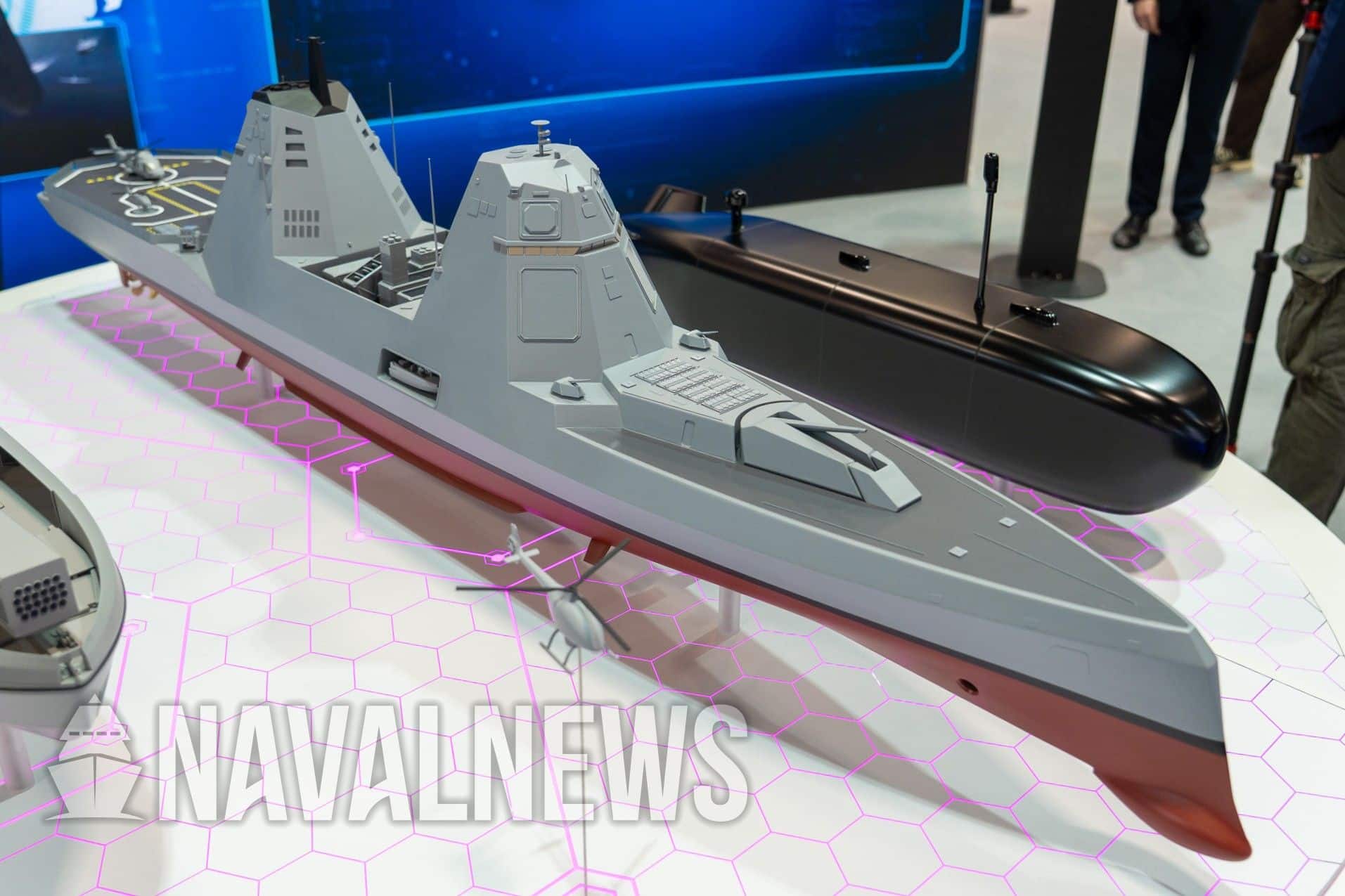
French shipbuilder Naval Group unveiled a new conceptual surface warship design at Euronaval 2026 dubbed “SCX 26.” Naval News provides an overview covering the key technical characteristics and wider operational concept, explaining how SCX 26 fits into the company’s vision for the future of naval warfare.
Standing for “Surface Combatant Xperimental,” Naval Group’s SCX 26 does not represent a fully formalized, production-ready design. Like previous concepts such as the SMX-31 unveiled in 2020 the new design envisions broad characteristics of a future surface combatant for navies worldwide. The key operational assumptions for SCX 26 center on the provision of large and versatile firepower, based on drones, missiles, energy and projectile weapons, a flexible payload arrangement, a VLS with reloadability at sea and high power reserves for sensors, weapons and operational support of deployed drones.
“Hybrid Fleet” grouped around a well armed, crewed warship
Hybrid fleet concepts are gaining prominence among several navies. The United Kingdom in particular emphasises a “Hybrid Navy”-concept as key for affordable naval operations heavily relying on drones complementing crewed vessels. The British approach outlines a variety of USV and UUV equipped with sensors and weapons performing a wide range of missions. More modestly equipped crewed “Common Combat Vessels” serve as affordable command and control-hubs at sea. In contrast, Naval Group envisions the SCX 26 as a heavily armed surface combatant, akin to a large guided missile destroyer or cruiser. Rather than trading off weapons and sensor capability the concept adds space, power and logistical support to embark and deploy a variety of drones at sea.
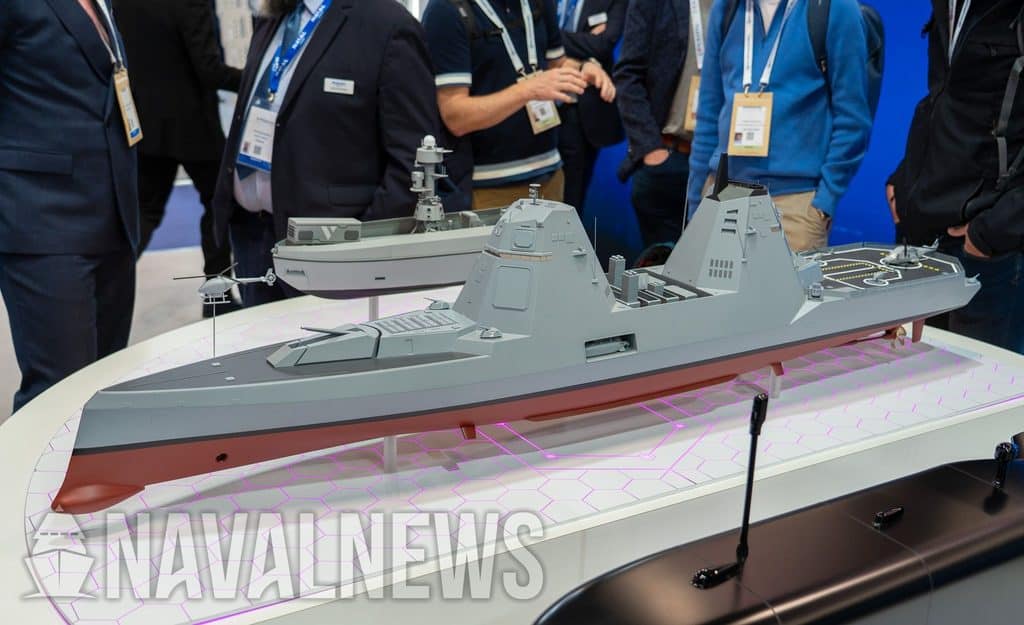
Despite the prominent radar panels and heavy missile armament, the concept is not specifically aimed at a future French anti-air warfare (AAW) combatant succeeding the Horizon-class destroyers. Rather, SCX 26 envisions what a true multirole combatant covering a wide range of sea-control mission requirements may look like. As such, its general size and configuration more broadly match the operational requirements currently met by various FREMM frigate variants.
Design features and specifications
As presented at Euronaval 2026 the SCX 26 is a large, destroyer-like warship measuring 170 metres in overall length, with a beam of 24 metres. Naval Group specifies displacement as 8,000 tons, a strikingly low figure considering overall dimensions of the hull. The vessel provides acommodation for a core crew of 150 sailors and can embark an additional 100 mission specialists. The propulsion is based on a CODLAG-arrangement, with diesel engines providing power to electric motors connected to two screws. At higher speeds including the designed for top speed of 30 knots a gearbox mechanically connects gas turbine propulsion directly to the screws.
The general arrangement of SCX 26 emphasizes a highly stealthy hull featuring an inverted bow and supporting a two-island superstructure that integrates distributed sensor panels, communications gear, and propulsion exhausts. Weapon systems, including gun turrets, are integrated as much as possible into the shaping of the superstructure and feature retractable barrels for the larger guns. The model also includes a hull-mounted sonar and a bow thruster.
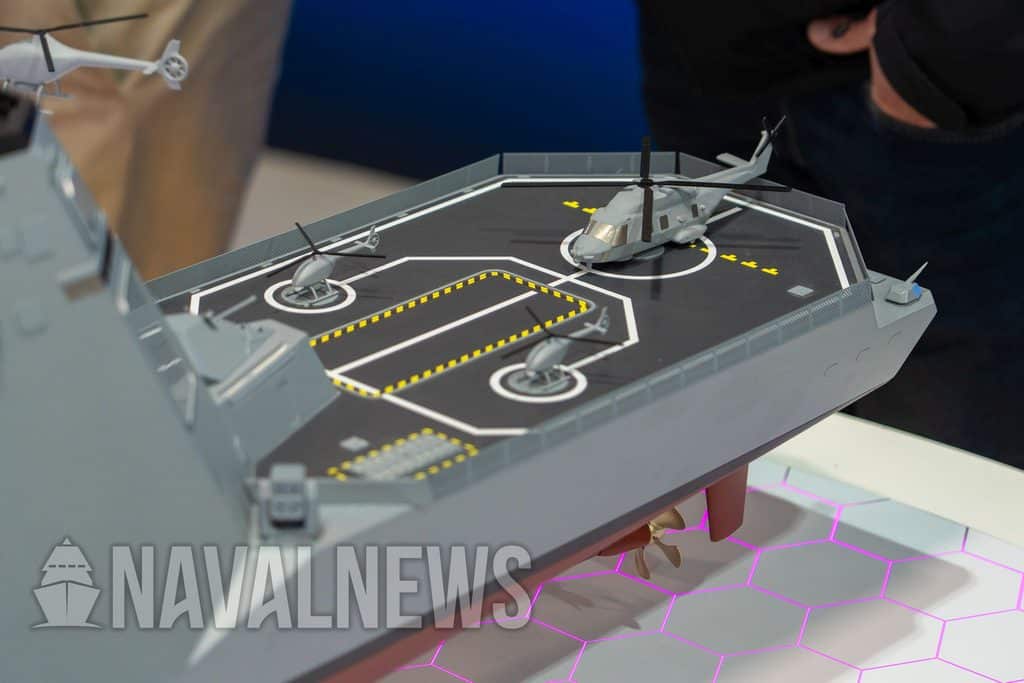
A more unusual feature of the superstructure is a large bridge-like level at the rear, acting as an aviation and drone control space.
Heavy armament emphasising magazine depth and energy weapons
Principal armament for SCX 26 comprises 96 cells for the Sylver NG VLS, with 64 cells ahead of the bridge and a further 32 cells arranged in two banks of 16 at the stern. The Sylver NG is an evolution of the established Sylver vertical launch system supporting a wider range of missiles in a uniform packaging format, including quad-packing for compact, shorter-range munitions.
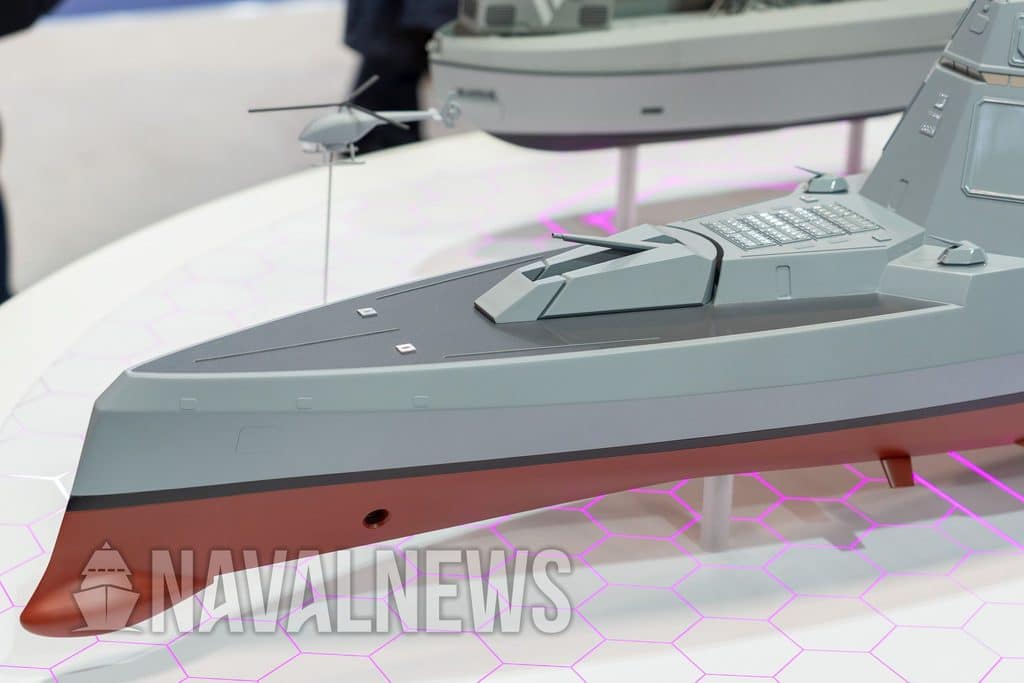
Gun armament is notably diverse. Weapons include a prominent large railgun on the bow (reflecting Naval Group’s work with the Franco-German Institut Saint-Louis or ISL under the European THEMA project) flanked by smaller-calibre conventional guns for close-range defence. At the stern one medium calibre gun sits ahead of the flight deck. Two further, smaller guns provide additional defence at both corners of the stern. All guns feature turrets heavily optimised for signature reduction. Two Rampart-launchers sit port and starboard at the rear superstructure. Rampart is a multi-ammunition trainable launcher accommodating flexible payloads including missiles, rockets and decoys for self-defence at close range.
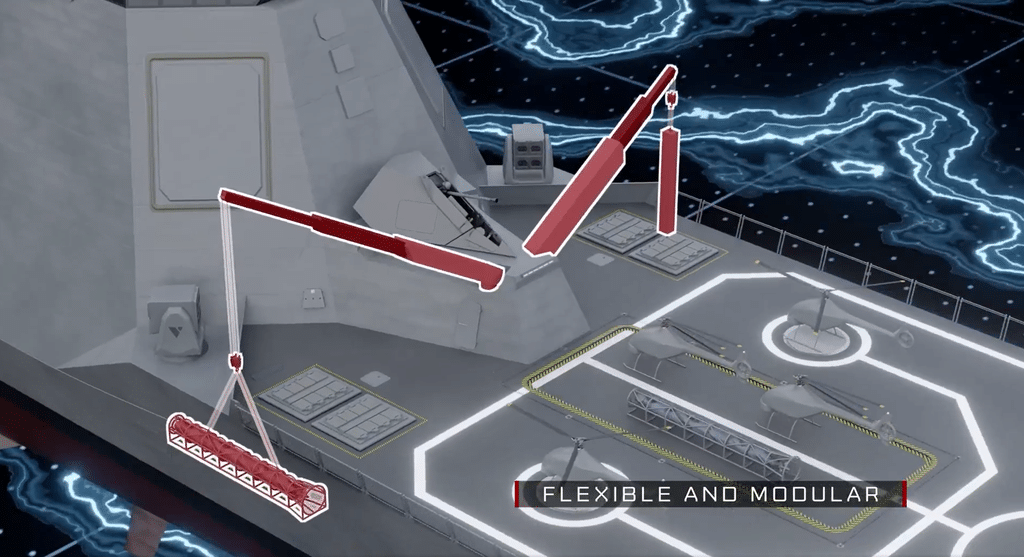
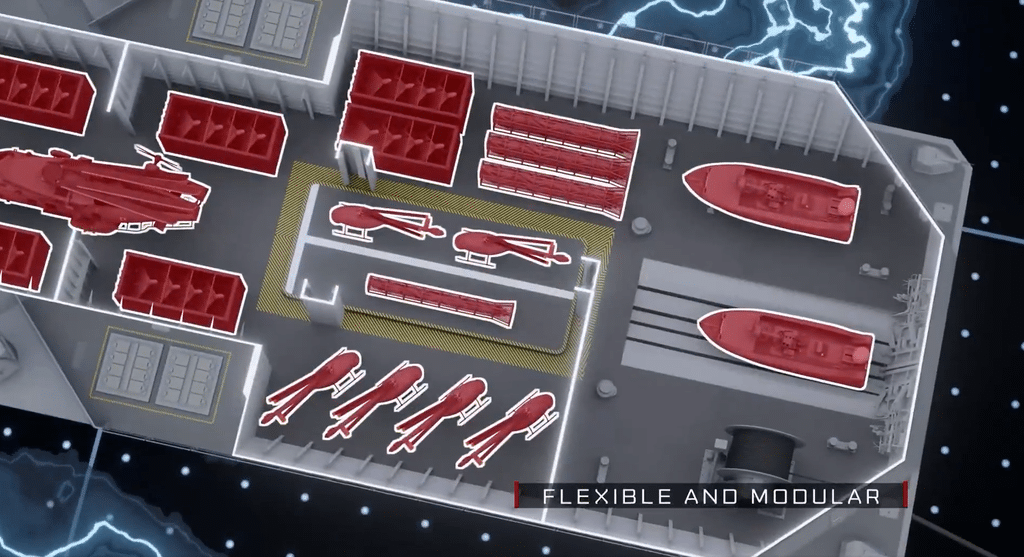
Containerised mission space and VLS-reloading at sea
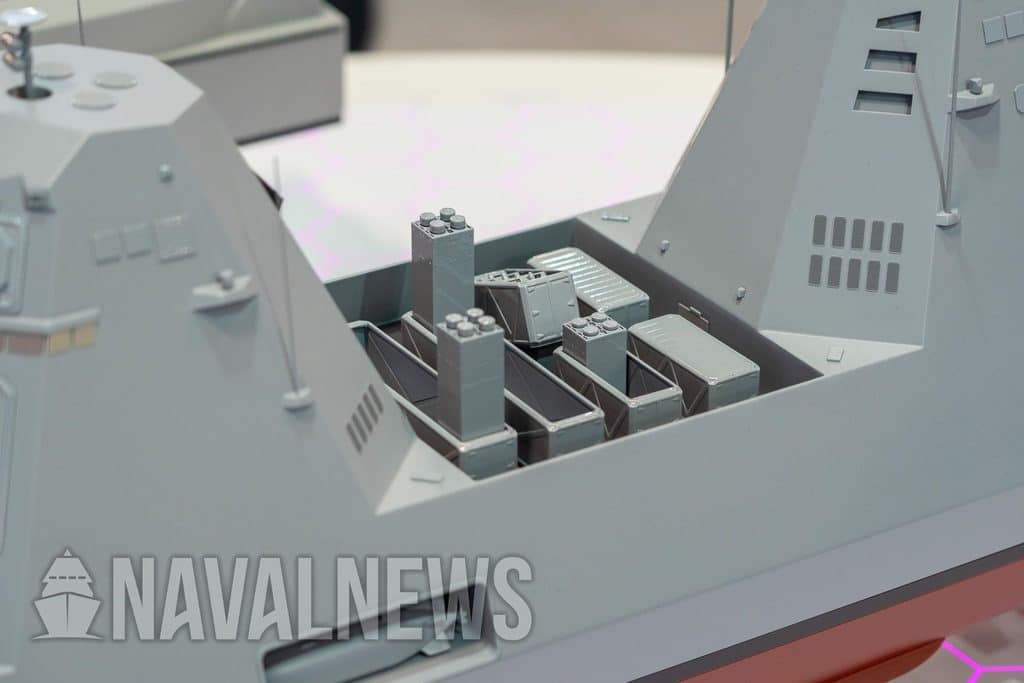
A key armament feature of SCX 26 is the central multi-mission space, which accommodates payloads equivalent to four 40-foot or eight 20-foot ISO containers. The model carries a mix of containerized munitions in this space, including loitering munitions and erector launchers for ballistic or cruise missiles, including hypersonic weaponry. Finally, SCX 26 carries a laser-based directed energy weapon with an output of 100 kW in a retractable projector atop the forward integrated mast.
One notable detail of the Sylver NG VLS as presented on SCX 26 is the ability to reload ordnance at sea. For this purpose, the model features two conformal cranes integrated into the superstructure next to the two rear 16-cell VLS banks. The larger 64-cell forward bank appears to lack this feature.
Strong command and control-capability paired with expansive drone storage
The sensor-arrangement relies four panels for the Sea Fire S-band AESA supporting a conceptual L-band radar with four very large panels on the forward and rear superstructure islands. Additional apertures for EO/IR sensors and EW are distributed around the entire superstructure.
The rear section of the SCX 26 accommodates a large flight deck incorporating an aircraft elevator for moving crewed and uncrewed aircraft into the expansive hangar below. The hangar allocates space for one medium-sized helicopter, two RHIBs or similarly sized USVs, storage and maintenance facilities for multiple rotary UAVs [cite: 4], and transport containers for drones and loitering munitions.
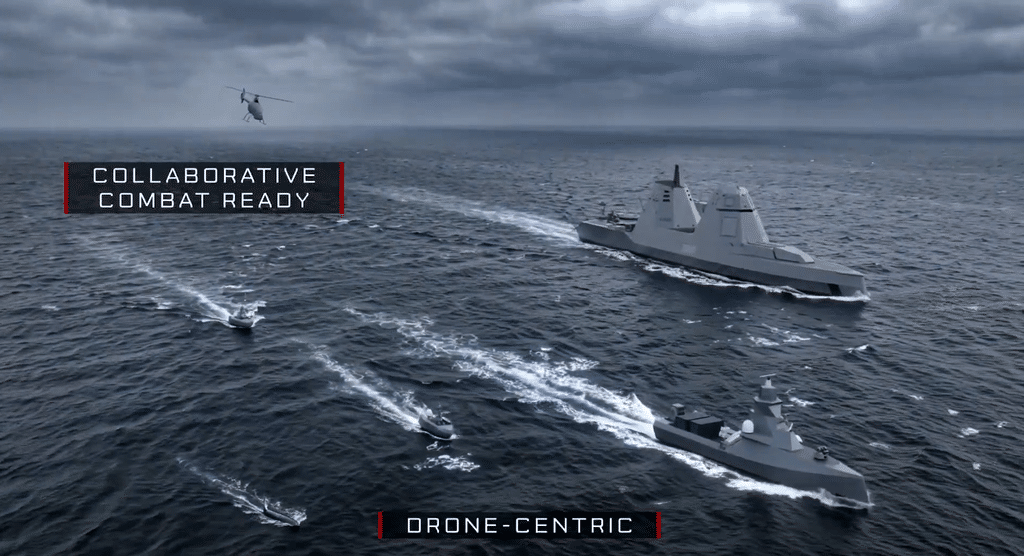
SCX 26 as drone control hub of the “hybrid fleet”
Naval Group envisions SCX 26 not just as a carrier platform for compact drones including UUV, UAV and USV. Additionally, the concept serves as the operational hub for larger submerged and surface drones operating alongside this 8,000 ton combatant. In conversation with Naval News NG-officials emphasise the operational flexiblity of SCX 26, resulting from its size, power reserves and payload capacity.
While a more distributed fleet of small drones lends itself to sea denial-tasking, the demanding C2 and endurance-aspects of sea control missions in the view of Naval Group call for a robustly armed and well equipped crewed surface combatant serving as operational hub for uncrewed systems.
At Euronaval 2026 the SCX 26-presentation included the display of an armed USV and an “extra-large” UUV dubbed the “Seagent XL”, which Naval News has covered separately.
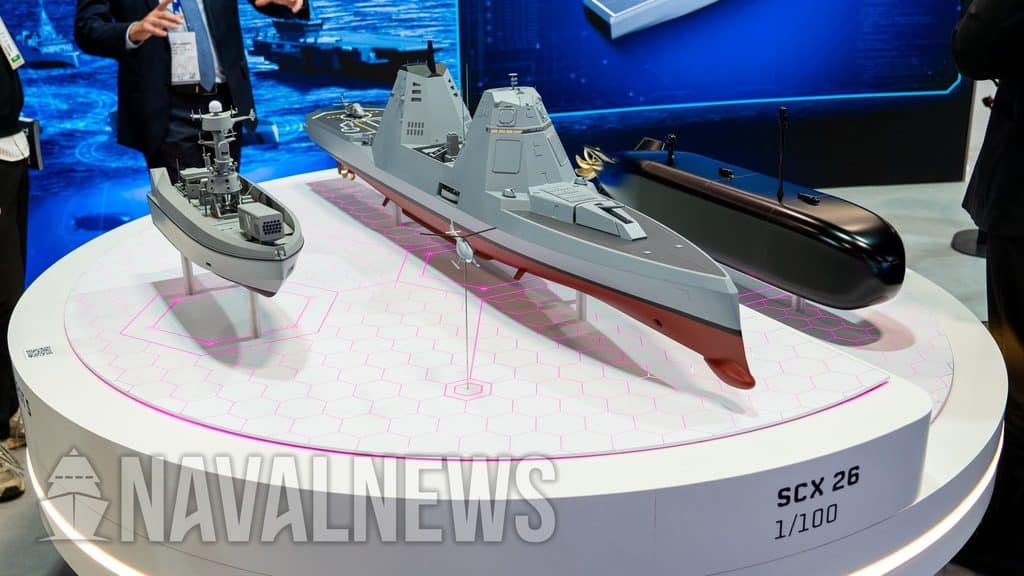
The SCX 26-proposal underscores a dynamic industrial landscape targeting ambiguous, but ambitious government efforts integrating drones into naval force structures. The vision outlined by SCX 26 appears to cater well to Marine Nationale’s measured approach developing and operating a variety of naval drones over the next decade. The concept acknowledges the potential of fielding uncrewed platforms complementing and in some aspects replacing crewed vessels. Simultaneously, the configuration of this future combatant also emphasises a perceived need for well armed and equipped crewed combatants acting as the backbone for naval operations of the future.