The US Navy’s newest carrier strike group (CSG) has conducted operations in the High North alongside NATO allies, in a deployment underlining the deterrent impact CSG presence can bring in the region. The CSG also integrated into NATO operational command structures.
The USS Gerald R Ford CSG (GRF CSG) is on a routine, scheduled deployment to the US 6th Fleet area of operations. As part of this deployment, between late August and early September the CSG, alongside French, German, and Norwegian ships, sailed into the northern Norwegian Sea up as far as Norway’s Svalbard Island – the northern point of the strategically critical Bear (or Bear Island) Gap.
The Gap – which runs from Svalbard south to Bear Island and to the northern tip of Norway’s mainland – divides the Barents Sea from the deeper waters of the Norwegian Sea, and provides a barrier behind which NATO has strategic and operational interests in keeping Russian naval assets including submarines, ensuring they remain at distance from central Europe.
“The High North is a critical region for the US and NATO alliance to stand together in support of a safe, stable, and secure Euro-Atlantic region by enhancing military capabilities, readiness, and interoperability,” US 6th Fleet said, in a statement.
During the deployment, a surface action group (SAG) drawn from the CSG, from NATO Allied Maritime Command’s (MARCOM’s) Standing NATO Maritime Group 1 (SNMG1), and from NATO allies conducted an operational transit southeast of Svalbard. The group consisted of the USN’s Arleigh Burke-class destroyers USS Bainbridge and USS Mahan from the CSG; the German Navy’s Sachsen-class frigate FGS Hamburg, operating under SNMG1; and the French Navy FREMM frigate FS Aquitaine and Royal Norwegian Navy (RNoN) Fridtjof Nansen-class frigate HNoMS Thor Heyerdahl, both operating under national command.
Elsewhere in the Norwegian Sea, USS Gerald R Ford and the Arleigh Burke-class destroyer USS Winston S Churchill conducted flight operations and strike exercises with the Royal Norwegian Air Force.
“What we’re doing is a building block on [top of] the last three years of our US CSGs’ work off the coast of Norway and in High North with the RNoN,” said Rear Admiral Paul Lanzilotta, Commander CSG 12, in the US 6th Fleet statement.
The GRF CSG’s operational activity in the region reflects the requirements of the US Department of Defense’s (DoD’s) 2024 Arctic Strategy. The US 6th Fleet statement said the CSG-led operations reinforced the strategy’s commitment to maintaining security and stability in the Arctic, and “[advanced] the strategy’s lines of effort to enhance maritime domain awareness [MDA] and the ability to campaign [there]”.
Deploying up into the Norwegian Sea, Gerald R Ford was operating further north than any US Navy carrier had done in recent years, a Commander Sixth Fleet (C6F) spokesperson told Naval News.
Back in 2020 and 2022, SAGs from other CSGs deployed into the Barents Sea itself.
“The ability to operate in the High North and Arctic is critical to the warfighting readiness of CSGs,” the C6F spokesperson noted.
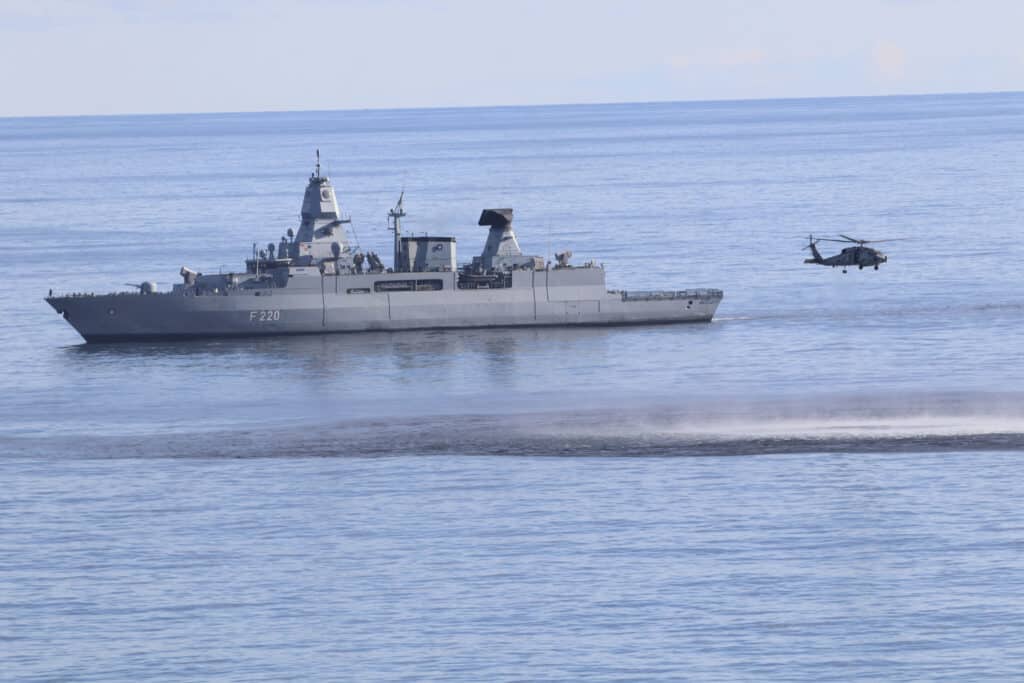
The German Navy frigate FGS Sachsen, operating under NATO’s SNMG1, was able to enhance the air-defence and anti-submarine screens of the USN CSG. (Credit: US Navy)
Supporting US and NATO maritime strategies for the High North, and contributing to the capacity to conduct maritime campaigns in the region, a CSG can have significant effect. “A CSG brings flexible, credible sea-based airpower, command and control (C2), and anti-submarine warfare (ASW) to the High North,” the C6F spokesperson said, adding that the CSG also brings air and missile defence, strike, sea control, and sustainment capabilities. “Working with NATO allies, a CSG expands maritime domain awareness, protects critical sea lines of communication (SLOCs), and can rapidly defend the North Atlantic and Arctic approaches.” “Conducting continuous maritime operations as an allied maritime force in the High North enhances NATO operational and tactical interoperability,” the spokesperson continued.
“Operating with NATO allies demonstrates NATO capability and will to deter aggression,” the spokesperson explained.
Such deterrence presence brings significant strategic effect in the context of the Bear Gap. “Operating in the Arctic and in the vicinity of the Bear Gap enables the US and allies to maintain maritime awareness in a maritime choke point. This in turn enables the US and allies to maintain freedom of navigation and defence of critical SLOCs,” the C6F spokesperson said.
As regards the operational benefits of integrating CSG and SNMG assets, the CSG integrated into NATO’s C2 architecture, expanded the common operating picture, and stitched together air, surface, and sub-surface forces to build layered defence of the Arctic approaches. In turn, Hamburg was able to extend the CSG’s air and missile defence and ASW screens. “That visible, seamless integration strengthens deterrence, protects trans-Atlantic SLOCs, and ensures NATO can respond quickly and lawfully to any contingency,” said the C6F spokesperson.
From NATO’s perspective,Commander Arlo Abrahamson, MARCOM chief spokesperson, told Naval News: “The employment of NATO ships enhances the integration of allied ships into CSG operations, and ultimately strengthens alliance cohesion and interoperability. The operations demonstrate our versatility to bring together capabilities to achieve effects.”
Naval News Comment
From the US Navy’s perspective, alongside supporting the strategic requirements of the 2022 National Security Strategy, the 2022 National Defense Strategy, the 2022 National Strategy for the Arctic Region, and the DoD’s 2024 Artic Strategy, training CSG ships, equipment, and people in the region will also have helped meet the operational requirements to build experience, capability, and readiness to operate in the High North and its challenging environmental conditions. So doing will ultimately enhance warfighting readiness, and thus deterrence.