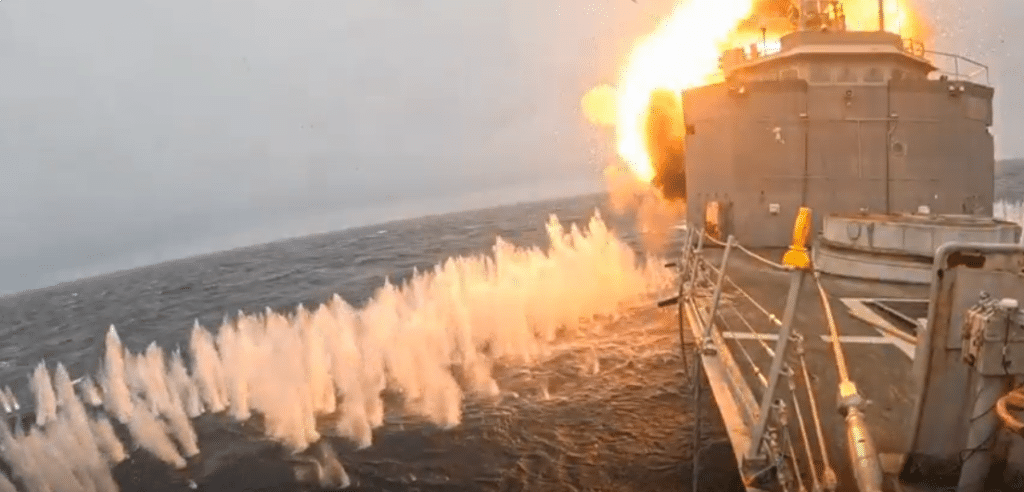
WASHINGTON, D.C.- General Atomics is pitching previously developed railgun technologies amid Washington’s push for a nation-wide air and missile defense network and the reinforcement of its Indo-Pacific outpost at Guam, Naval News has learned.
General Atomics displayed its railgun graphics at its booth during last week’s Association of the United States Army annual meeting in D.C. When inquired about the inclusion of the long-canceled program efforts, Mike Rucker, Head of GA-EMS Weapons, stated that the company has pitched its railgun for the Golden Dome initiative.
“Just the idea of the muzzle velocity and the standoff capability, and particularly from our perspective, from a terminal defense for air [and] missile defense. Just this with the tungsten pellets as the warhead,” Rucker told Naval News regarding railgun air defense potential.
A General Atomics Electromagnetic Systems’ infographic states that the company’s multi-mission railgun system can fire projectiles up to Mach 6 speeds. Three variants of the railgun were listed, ranging between three to 32 megajoules of energy capacity. The company also claims that these systems are capable of intercepting ballistic and cruise missiles.
Rucker, who was previously a program manager on General Atomics’ railgun effort with the U.S. Navy, also stated that the company’s efforts gained international attention. While none of these foreign parties were named, Rucker noted that Washington was “cooperating” with these nations regarding their interest in General Atomics’ railgun products.

While American programs have stopped, foreign initiatives from Japan, China, France and Germany demonstrate interest and development on the technology. Tokyo and Beijing have unveiled experimental ship-mounted railguns. France, Germany and Japan are also collaborating on the technology.
Despite the cancellation of U.S. Navy and Army railgun programs in 2021, the California-based defense contractor has maintained its research and development of the experimental technology and is pitching its air defense applications. Since then, Rucker claimed that the cited operational deficiencies of railgun technologies, such as barrel wear and other technical challenges, have been solved.
“The system works. It stopped because it wasn’t, you know, fieldable in an operational environment. The reliability aspects of it, right? But in terms of the technical challenges, the technical challenges have been solved. It’s pulling it all together and making it so soldiers and sailors can operate it,” said Rucker.
Aside from Golden Dome, Rucker also noted that the railgun’s terminal defense potential could prove useful for U.S. forces defending Guam. The second island chain outpost’s lack of defense against massed Chinese long-range fires, including Dong Feng series ballistic missiles and submarine-launched cruise missiles, has driven a major initiative to bolster the territory’s air defense capabilities.
In the event of a conflict with Beijing, Washington can expect the island to be targeted by numerous Chinese munitions—a threat that Guam’s current defense architecture, geared against North Korean capabilities, would struggle against.