DRDO showcased a dummy LR-AShM with the 12×12 launcher during India’s Republic Day parade on January 26. Several other systems were showcased in the parade including operational Astra and Meteor AAMs.
DRDO is developing a Long-Range Anti-Ship Missile (LR-AShM), “designed to meet the coastal battery requirements of the Indian Navy.” Two known flight tests of LR-AShM have been conducted, with a 2023 test briefly mentioned in an annual report while a 2024 test was announced in a press release. A press release announcing the parade appearance provided the first detailed official overview of the 1500 km rangedLRAShM:
The LR-AShM is a Hypersonic Glide Missile capable of engaging static and moving targets and is designed to carry various payloads. The missile is a first-of-its-kind with indigenous avionics systems and high accuracy sensor packages. This hypersonic missile follows a quasi-ballistic trajectory with hypersonic speeds starting at Mach 10 and maintaining average Mach 5.0 with multiple skips. Indigenously developed sensors are provided for engaging the moving targets in the terminal phase. As this missile flies in low altitude with high speed and manoeuvrability, enemy ground and ship based radars cannot detect this missile during most of its trajectory. The LR-AShM is configured with a two stage solid propulsion rocket motor system. These propulsion systems boost the missile to the required hypersonic velocities. Stage-1 of the vehicle is separated after it is spent. After Stage-II burnout, the vehicle performs an unpowered glide with required manoeuvres in the atmosphere before engaging the target.
While the missile nomenclature highlights the primacy of the naval role, the Indian Air Force and Indian Army are also likely to explore employing the missile. It is also expected to have a ship-launched variant in the future. The missile is alluded to be capable of carrying various types of conventional warheads within its glide vehicle, with the current focus being on the anti-ship version.
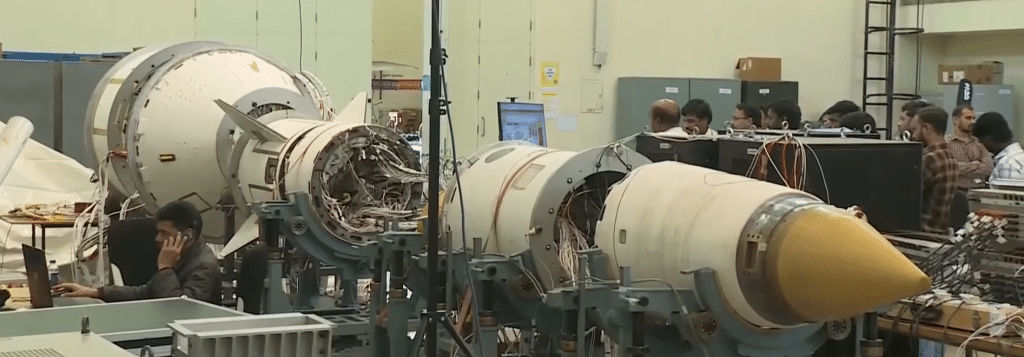
Naval News had previously reported based on open source information, that the missile is likely 1.4 metres in diameter with a length of about 14 metres and weighs less than 20 tons. A recent video report by India TV quoted DRDO officials stating the length to be 13 metres and weight to be about 12 tons. The third known test of the system is likely to occur this year with footage showing sections of LR-AShM on an assembly jig / test stand at a DRDO facility. This revealed a radome for the RF seeker. The radome is typically hidden by a carbon-silicon carbide heat shield which protects the radome during hypersonic flight. At the terminal phase, the shield is ejected and the seeker, with a range of over 50 km, is activated.
LR-AShM is being developed with the rapidly expanding PLAN in mind. DRDO is also working on scramjet powered hypersonic cruise missiles under Project Vishnu and HGVs with winged glide body design under Project Dhvani. Missiles to defeat hypersonic missiles are also being developed. All of these are expected to have derivatives with naval applications.
During the Republic Day parade DRDO also showcased a tableau with the theme Naval Technologies for Combat Submarines, featuring three indigenously developed systems: Integrated Combat Suite (ICS), Wire Guided Heavy Weight Torpedo (WGHWT) & Air Independent Propulsion (AIP). ICS is a new generation submarine-based defence system vital for underwater warfare and anti-submarine operations focused on situational awareness by providing the threat picture to make tactical decisions and actions like weapon selection, launch and guidance.

WGHWT is a submarine-launched torpedo with high speed and endurance to counter contemporary ship and submarine threats. It must be noted that the MoD had signed a contract in December 2024 with Naval Group to integrate DRDO’s Electronic Heavy Weight Torpedo (EHWT) onboard the Project 75 Kalvari class Scorpene submarines. However, a contract was signed in December 2025 with WASS Submarine Systems for 48HWTs for the same class. With deliveries scheduled between April 2028 and 2030, this is likely a stopgap until the DRDO system is operationalized. Currently it is unconfirmed if WGHWT and EHWT are different torpedoes.
The Indian Navy currently operates dozens of Varunastra HWTs and Torpedo Advanced Light (TAL) Shyena Light Weight Torpedoes (LWTs) from its surface combatants. A follow-on order reported to be in the works for the Varunastra, while Shyena will be succeeded by the Advanced LWT (ALWT).
DRDO’s AIP uses locally developed phosphoric acid fuel cell with an onboard hydrogen generator. The project has faced several delays and an AIP plug is currently expected to be fitted onboard INS Khanderi during its refit.
Meanwhile, the IAF also displayed the operational Astra Mk1 AAMs on its Su-30 MKI along with Rampage missiles, both of which are also intended for the Navy’s MiG-29K fleet. IAF Rafale F3R fighters were spotted for the first time in public with Meteor AAMs, which will also feature on the Indian Navy Rafale M fleet. India is likely to place a massive order for 114 Rafale for IAF.