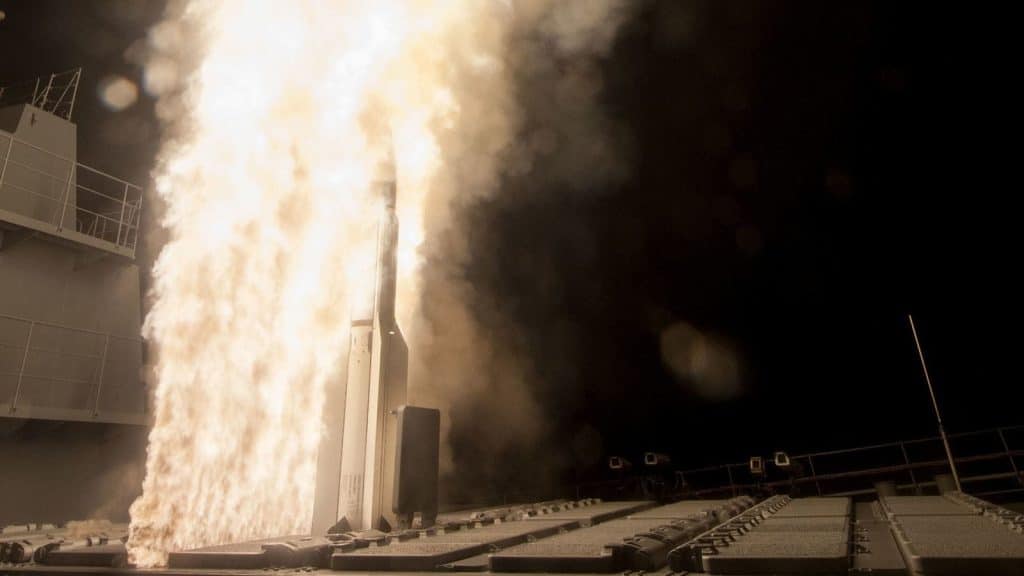
SAN DIEGO — Boeing highlighted the anti-ship and mining payloads of its upcoming Joint Direct Attack Munition Long Range (JDAM LR) aboard U.S. B-52H and B-1B strategic bombers.
Derived from the company’s widespread guided-bomb kit, the JDAM LR will be able to strike targets or deliver minefields out to 300 nautical miles, effectively converting the Mark 82 warhead into a long-range cruise missile. The variant was previously known as the Powered JDAM in 2023, with Boeing updating its information pamphlet to the new designation this year and at WEST 2026.
Maritime strike, Quickstrike aerial-launched mines and baseline strike variants are planned. A decoy variant without the warhead extends the range to 700 nautical miles. The inclusion of the fuel tank, engine and spaces for optional attachments has greatly increased the length of JDAM LR.
While specifications, ranges and variants of JDAM LR remain as previously listed, the company revealed the large payloads of anti-ship and mining munitions that can be deployed via American strategic bombers. A video highlighting the system’s integration onto legacy platforms showcased up to 20 JDAM LRs being deployed by a B-52, with eight via the conventional rotary launcher and 12 mounted on external pylons. The B-1 concept was also shown to be carrying up to 30 munitions via three conventional rotary launchers and external pylons. These payloads configurations are similar to those used by larger air-launched cruise missiles, such as the AGM-86 and AGM-158 Joint Air-to-Surface Standoff Missile.
Implications for Long-Range Offensive Mining Capabilities

A Boeing fact sheet highlighted the affordable mass that can be achieved with the upcoming munition due to its design being based upon cheap dumb bombs and a conversion kit, which could prove crucial in a conflict in the Indo-Pacific. While Washington has made efforts to step up the production of long-range precision strike munitions via its defense industrial base, concerns over Taiwan and ongoing conflicts in Ukraine and the Middle East has increased the need for production at speed and scale.
Aside from maritime strike, the development of the Quickstrike variant follows continued U.S. efforts to develop conventional bombs as conventional mines for sea denial missions. However, compared to existing non-powered Quickstrike and aerial mine deployment ranges of a few dozen kilometers, the JDAM LR can enable American platforms to deploy mines at scale well outside of enemy surface-to-air missile range.
300 nautical mile standoff mine-laying capabilities from U.S. aircraft operating from aircraft carriers, regional airfields or even continental American bases have the potential to lay large minefields at key maritime areas across the Indo-Pacific. This mine-laying capability could help deny or disrupt certain chokepoints across the first island chain or amphibious assault operations.