The Philippine Navy debuted its first non-lethal effector, a system that combines long-range acoustic device (LRAD) and laser dazzling roles, aboard the service’s new first-in-class offshore patrol vessel (OPV) BRP Rajah Sulayman (PS-20), according to recent images.
Two Multirole Acoustic Stabilized System (MASS) SX-424(V)122 from the Sitep Italia were highlighted during BRP Rajah Sulayman‘s commissioning ceremony on Tuesday. According to a fact sheet from the Italian defense electronics firm, the system is capable of producing “extremely loud disturbing sound, high-intensity light, and a laser dazzler.” Aside from projecting uncomfortable noise and light disruptions, the system is also capable of alerting subjects at extended ranges.

This is the first time these systems – and capabilities – will be available to Philippine Navy warships, and opens up a new tool for commanders in the South China Sea to deploy their own non-kinetic effects against Chinese maritime militia vessels operating in the country’s waters.
Beijing has previously deployed similar LRAD and laser devices against Philippine forces in recent years during incidents between the two nations over disputed maritime features. China’s deployment of these systems aimed to disrupt Philippine sailors in the operation of their vessels via high-pitched sounds and laser blinding.
LRAD and laser dazzlers belong to a category of systems known as non-lethal effectors, also referred to as intermediate force capabilities. A U.S. Defense Department brief claims that these systems “are designed to provide military and security forces with options that can de-escalate tensions, control crowds, or disable threats without causing permanent harm.”

The installation of these devices across Manila’s future frontline South China Sea patrol fleet come as the Southeast Asian nations deliberates how to push back against Beijing’s forces without escalation. Last summer, the National Maritime Council voiced concerns regarding the deployment of Philippine Navy warships to Scarborough Shoal, citing the presence of a military asset as being seen as escalatory by China.
“It signals that the Philippine Navy regards the MASS as a meaningful tool for deterrence while avoiding escalatory or kinetic measures: It is primarily a defensive instrument. The symbolism is evident and ties into Manila’s broader strategy of showcasing that it is not an aggressor,” Georgi Engelbrecht, a Manila-based Senior Analyst with International Crisis Group, told Naval News.
Engelbrecht stated that while there are tactical advantages to the LRAD system, primarily in “disrupting smaller adversary boats during tactical confrontations or standoffs in the South China Sea,” it is unlikely for its deployment to deter larger China Coast Guard cutters and People’s Liberation Army Navy warships from operating near and within disputed maritime zones. He further added that its introduction into Philippine Navy service raises the question of if the country’s Coast Guard, which has taken the brunt of confrontation with Chinese forces, might acquire a similar non-lethal effects system.
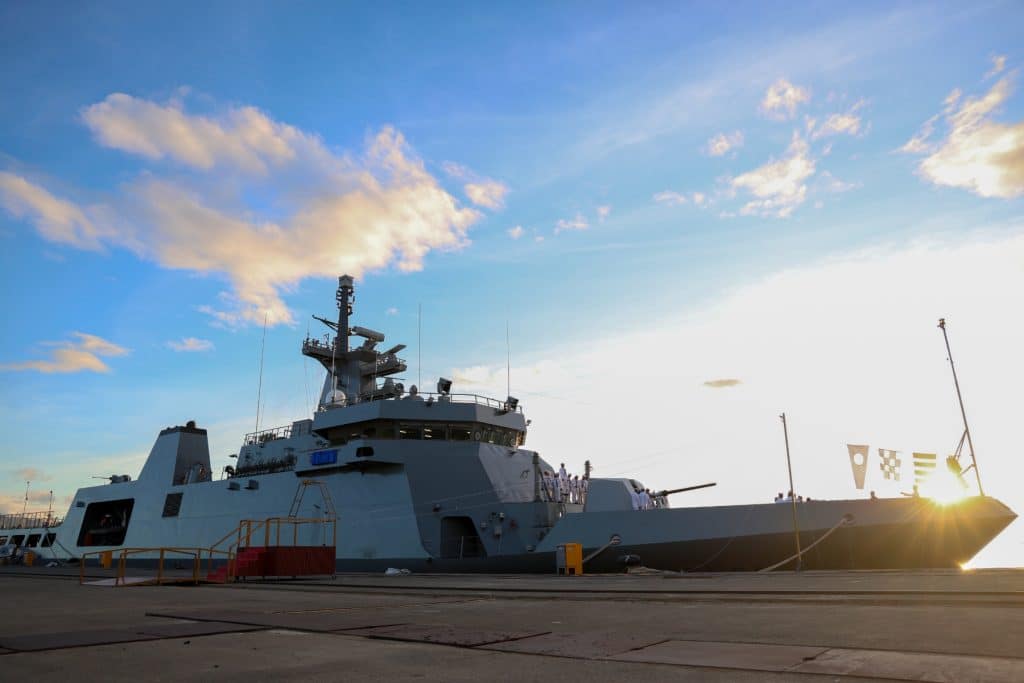
Joining the fleet from Naval Operating Base Subic Bay, the 2,400-ton vessel is the first of six ordered from Hyundai Heavy Industries to meet the service’s demands for sustained offshore patrol missions amid a series of South China Sea spats with China. A service fact sheet stated that the patrol ships can operate 20 days at a time and sail up to 3,500 nautical miles at 15 knots.
The commissioning ceremony noted the embarkation of two unmanned aerial systems, confirming a previous report by Naval News. However, the manufacturer and class of drone has yet to be disclosed. Previous imagery indicates a VTOL unmanned system with an estimated range of 180 kilometers. Rajah Sulayman‘s mission versatility via installed mission modules was also highlighted on informational graphics displayed at the event. Danish firm SH Defence pitched its Cube System of containerized modules to the Philippine Navy’s OPV program in recent years, with notable packages including mine-laying and anti-submarine warfare payloads.