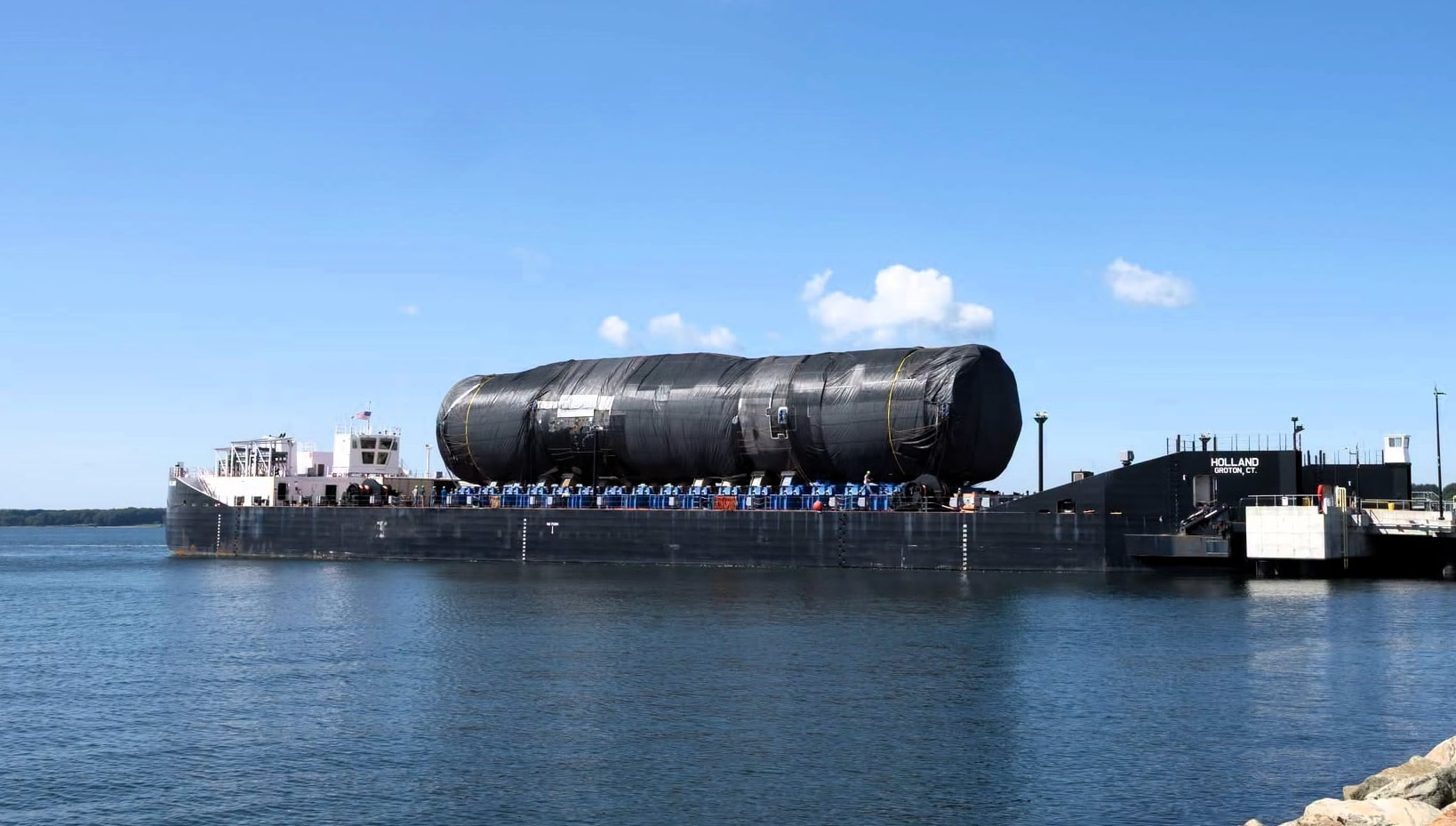
General Dynamics Electric Boat has shared a photo showing the first completed Virginia Payload Module (VPM) for the U.S. Navy’s Block V submarines, expanding strike capacity.
General Dynamics Electric Boat posted the first view of the future USS Arizona’s (SSGN-803) Virginia Payload Module (VPM) on Monday, September 14. The completed section is seen floating on a barge, presumably beginning transport towards final assembly at GD Electric Boat’s facility in Groton, Connecticut.
The USS Arizona will represent the first submarine in U.S. Navy inventory equipped with the VPM, despite being the second Block V boat to enter service, following the USS Oklahoma (SSN-802). She represents the first of 19 total hulls fitted with the VPM, with a total of 12 Block Vs and 7 Block VI hulls receiving the upgrade over the course of the next two decades. The sighting of the first fully constructed VPM marks a key milestone in returning and ensuring critical strike capabilities across the undersea fleet.
The VPM will give the USS Arizona a more than 3x increase in Vertical Launch Cell capacity over previous hulls, with up to 28 additional Tomahawk-sized missiles carried in four larger canisters housing seven missiles apiece. This increases the VLS missile allotment to 40 when accounting for the two Virginia Payload tubes carried in the bow with six missiles apiece. Alternatively, each canister can carry three Conventional Prompt Strike (CPS) hypersonic boost-glide weapons, with the Navy utilizing the same mounting systems for CPS present on the Zumwalt-class destroyers following their conversions.
Each of the 19 VPM-equipped submarines will be 83 feet longer than their sisters, with a completed VPM constituting roughly 184 out of 460 feet of total length. Each of these 19 submarines will retain upgrades administered to earlier blocks, including a new side-mounted sonar array first found with the construction of the Block V boats.

Modernizing Missile Capacity
Currently, the first four Ohio-class submarines make up most of the U.S. submarine fleet’s conventional VLS capacity, with each submarine converted to carry 154 Tomahawk land-attack cruise missiles in lieu of a complement of 16 Trident Submarine-Launched Ballistic Missiles in the early 2000s, letting the four boats dodge an early retirement. Consequently, a massive gap in conventional VLS capacity looms over the U.S. submarine fleet as each of the 40+ year-old converted Ohios begin to depart service.
The VPM-equipped Virginias will thus backfill the capacity left behind by the Ohios, distributing missile capacity better across an increased number of modern platforms, with the U.S. Navy receiving an overall increase in VLS cells available once all of the VPM-equipped submarines are in service. Despite this, it remains unclear when the USS Arizona and the rest of her larger sisters will begin to reach U.S. Navy hands, as only the first VPM module is complete and awaits assembly alongside the rest of the submarine’s key compartments.
VPM might also increase the flexibility of U.S. Navy attack submarines in the future, as the Navy increasingly seeks different types of munitions employed from submarine-mounted VLS tubes. In particular, Naval News has previously covered efforts to mount a submarine-launched variant of the AARGM-ER anti-radiation missile, bringing an explicit radar-hunting capability to U.S. submarines. Additionally, The War Zone reported on an effort to bring anti-air capabilities to submarines via a specific variant of the Navy Modular Missile (the Navy’s prospective next-generation interceptor), presumably meant to be utilized from undersea vertical launch systems.