By TASS Russian news agency
The fate of the Black Sea’s flagship was not easy. In 1990s, its overhaul dragged for over eight years because of debts. The warship has not sailed out of late because of technical problems, the Izvestia daily writes.
The Moskva was scheduled to sail out after an overhaul in mid-May, Defense Ministry sources said and specified the warship is likely to return back into service on May 9.
The flagship has been overhauled since 2018. In 2019, it has sailed out for a brief time to test the mechanisms. At present, the power plant is tuned up to completely restore the operability of the cruiser.
The Moskva is the most powerful warship of the Black Sea fleet, expert Dmitry Boltenkov said:
“It will serve for several more years. Its anti-ship missiles can sink any vessel. It is armed with long-range S-300 Fort antiaircraft launchers to create zonal air defense and protect a whole area or squadron from adversary attacks. The qualities were useful in Syria where the cruiser defended Humaymin and Tartus bases from sea attacks,”
The Moskva missiles can destroy the adversary at the entrance to the Black Sea yet in Bosporus, former Navy Chief-of-Staff Admiral Valentin Selivanov said. “At present, the Moskva is the only big warship in the Black Sea fleet and one of the few in the Navy. The main mission is to preserve the traditions of operating big ships until new cruisers arrive,” he said.
The Soviet and Russian Navy built three missile cruisers of project 1164 which are still operated. Besides the Moskva, they are the Varyag flagship of the Pacific fleet and the Marshal Ustinov in the Northern fleet. The latter has been upgraded. Another Soviet-era cruiser, the Ukraina, which was 95 percent ready remained in Ukraine. Russia wanted to buy it, but the deal failed. In 2017, Ukraine decided to scrap the cruiser.
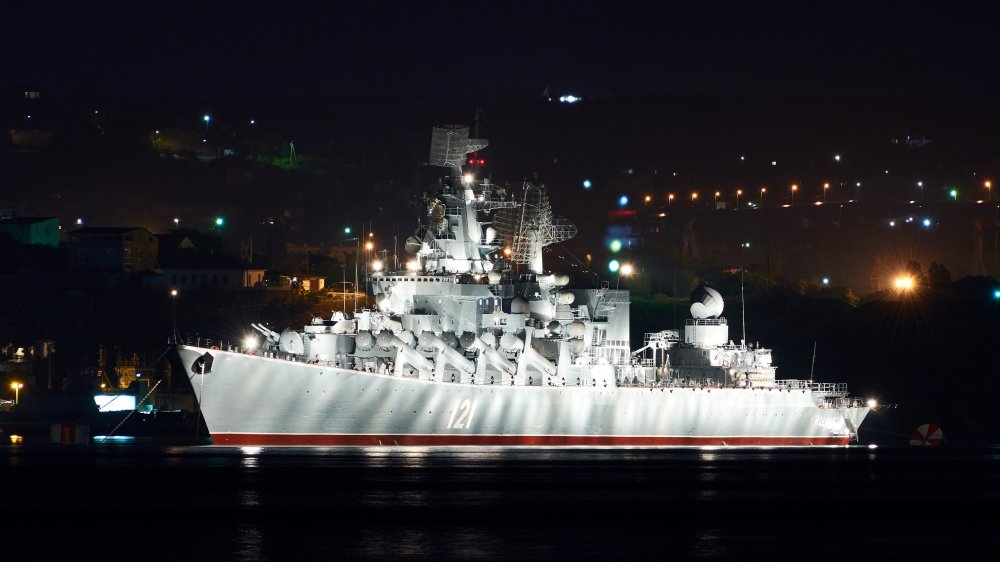
In March 1991, the Slava cruiser (now the Moskva) began a capital overhaul in Nikolaev Shipyard in Ukraine. It found itself in another country after the Soviet collapse. The overhaul dragged for over eight years and debts constantly grew because of a financial plight. The Russian capital city took the cruiser under its patronage and thus saved the warship which was renamed the Moskva.
The overhaul was completely financed in 1999 and the warship retuned to Sevastopol to become the flagship of the Black Sea fleet. It has actively operated. In 2013, the Moskva called at seaports of Portugal, Cuba, Nicaragua and Venezuela. In 2014, the cruiser with other warships blockaded the Ukrainian Navy in Donuzlav Bay. From September 2015 to January 2016, it headed the permanent Russian force in the eastern Mediterranean.
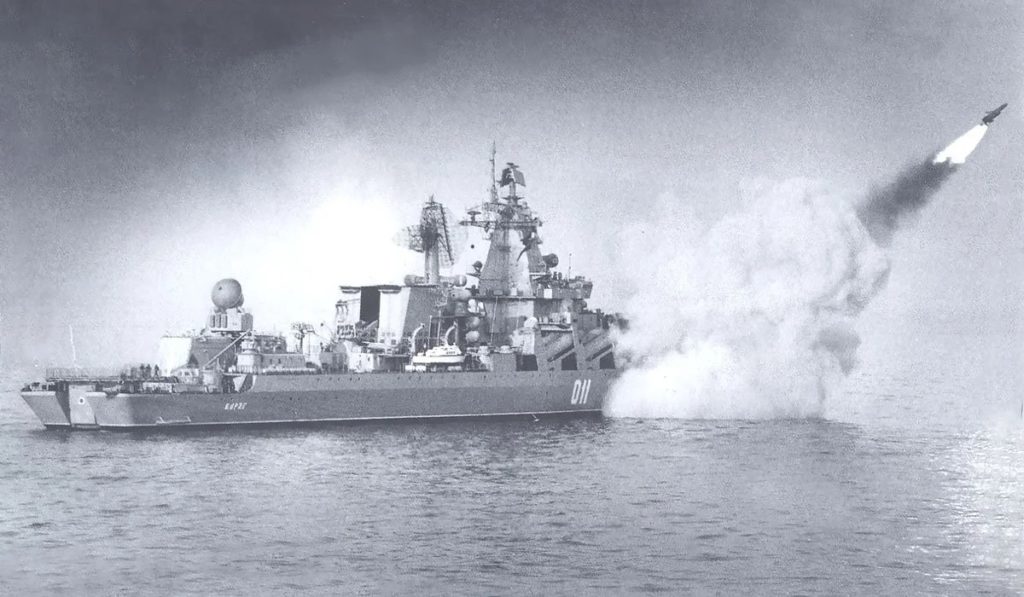
The Moskva carries 16 antiship P-1000 Vulcan missiles with a radius of at least 700 km. They use a combined flight scheme: a part of the trajectory is covered at a major altitude. The missile then descends to the target and flies at 15-20 meters.
Project 1164 cruisers are protected from jets, helicopters and missiles by S-300 °F Fort and Osa-M antiaircraft launchers, as well as six-barrel 30mm artillery AK-630 guns. The warships have a pair of five-pipe 533mm torpedo launchers, two rocket-assisted bomb throwers to fight adversary submarines, and a helicopter. There is also AK-130 artillery weapon with 130mm rapid-fire guns and a range of 23 km, the Izvestia said.