NAVSEA press release
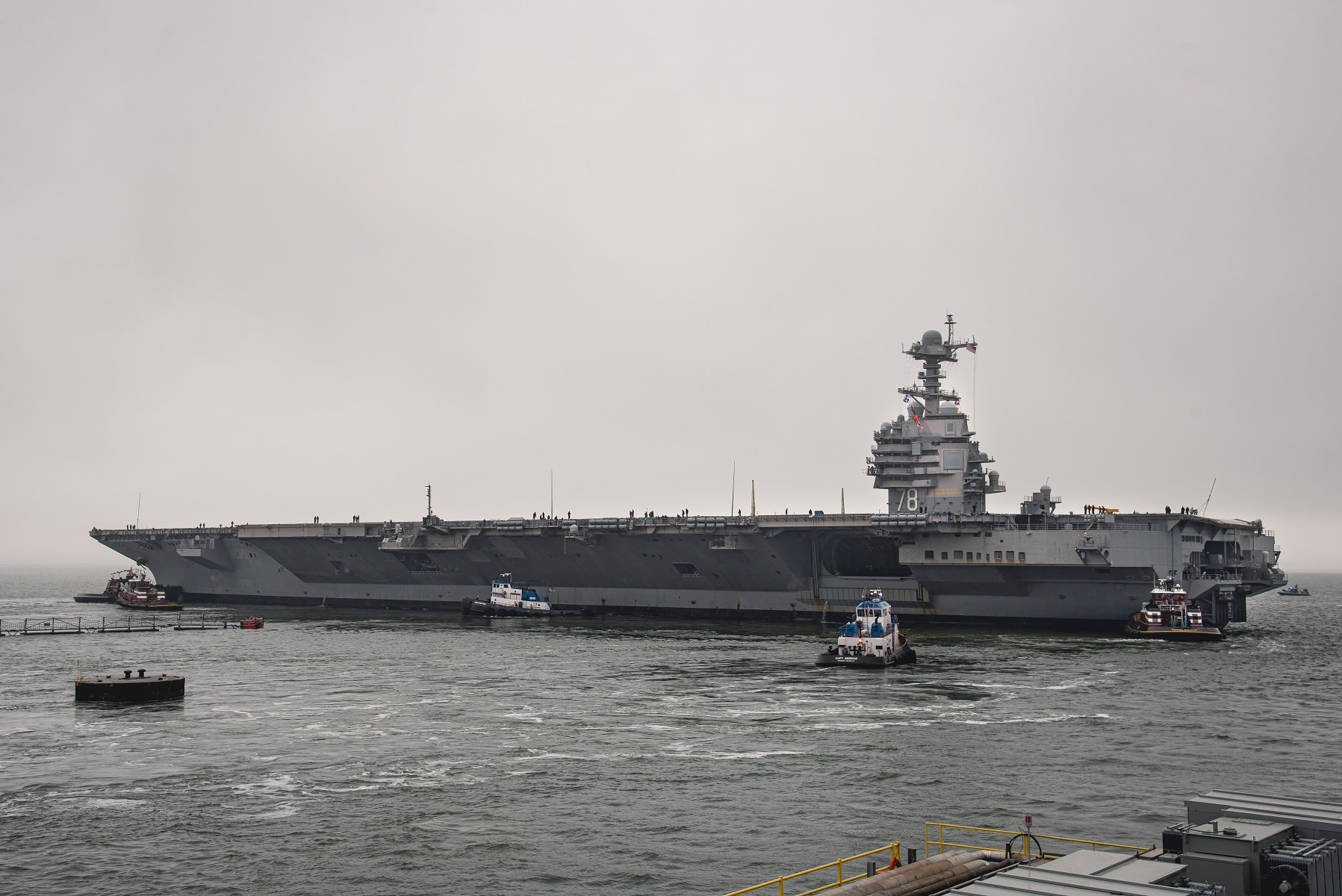
USS Gerald R. Ford (CVN 78) successfully completed sea trials off the coast of Virginia this week, marking the successful conclusion of its inaugural Planned Incremental Availability (PIA).
The milestone follows six months of modernization and maintenance work at Huntington Ingalls Industries-Newport News Shipbuilding in Newport News, Virginia. On February 28, the ship sailed to its home at Naval Station Norfolk, where CVN 78’s crew will begin several months of training and certification in preparation for the ship’s first deployment in Fall 2022.
The first-of-class aircraft carrier entered PIA in September 2021, after completing Full Ship Shock Trials (FSST) off the coast of Mayport, FL. Gerald R. Ford and her crew performed exceptionally well during shock trials, conducting three explosive events using live ordnance on 18 June, 16 July, and 8 August.
The Navy collects data from shock trials to validate a ship’s shock hardness and ability to sustain operations in a simulated combat environment under extreme conditions.
At the start of CVN 78’s PIA, teams conducted detailed inspections, assessing potential damage sustained during FSST. The Navy had conducted shock trials on the Nimitz-class carrier USS Theodore Roosevelt (CVN 71) in 1987 and used those results plus other modeling and simulation to estimate the potential impact from the explosive events on the overall PIA workload. FSST-related repairs during Gerald R. Ford’s PIA proved fewer than anticipated.
“Ford required only 20 percent of the repair work we saw with TR,” said Rear Adm. James P. Downey, program executive officer for aircraft carriers. He added that of the required FSST-related repairs, about 85 percent were completed by ship’s force, as opposed to work that needed to be completed by the shipyard.
“That’s an impressive testament to the design of the ship and the resiliency of her crew,” said Downey, who rode the ship during the first and third shock evolutions. Downey added that the Navy will continue to incorporate lessons learned from CVN 78’s FSST to further harden follow-on ships in the Ford class, the future USS John F. Kennedy (CVN 79), Enterprise (CVN 80), and Doris Miller (CVN 81).
While completing these repairs during the PIA, the Navy-Industry team also performed required modernization and maintenance on CVN 78. The work ranged from updating Gerald R. Ford’s galley to modernizing the ship’s Consolidated Afloat Networks and Enterprise Services (CANES) system—a program the Navy has implemented across the Fleet to enhance shipboard computing systems and to consolidate multiple legacy networks.
Modernization work on the Navy’s newest class of aircraft carrier has been streamlined, when compared to work on Nimitz-class ships. Ford’s reconfigured command and control spaces, for example, accommodate new technologies without the need for cutting into decks and overheads.
“Historically, about 40% of modernization work on Nimitz-class carriers goes into rip out, which involves cutting and welding. The Navy specifically designed Ford with a flexible infrastructure, so you can build in new capabilities to enhance system integration that facilitates immediate operational gains for the warfighter.”
Rear Adm. James P. Downey, Program Executive Officer
Advanced Weapons Elevators Completed

Four months into the PIA, the Navy-Industry team turned over to CVN 78’s crew the ship’s 11th and final Advanced Weapons Elevator (AWE), marking a significant milestone for one of the ship’s most complex new technologies. Gerald R. Ford-class AWEs employ electromagnetic motors as opposed to more labor-intensive, hydraulic systems, which enables fewer sailors to move ordnance safely from weapons magazines to the flight deck with unparalleled speed and agility.
Downey praised the Navy-Industry AWE team for working tirelessly both in port and at sea to complete the elevators last year.
“The Navy-Industry teaming provided opportunities for hundreds of craftsmen, technicians, and engineers, working around the clock—through multiple underway periods—to get these advanced systems online and operational,” said Downey. He added that multiple vendors delivered a steady stream of needed materials and engineering expertise, which enabled the ship’s force to foster a seamless integration of multi-shift, on-board production efforts.
“The end game is always operational readiness,” Downey said, adding that CVN 78 is on track to commence workups and move on to follow-on tasking.
Workups and Deployment

In the coming months, USS Gerald R. Ford will prepare for its upcoming deployment. The ship will embark on its air wing, CVW-8, and will begin rounds of system qualification tests, flight deck certification, three phases of air warfare training, and a Combat Systems Operational Readiness Evaluation.
Ford’s Commanding Officer, Capt. Paul Lanzilotta, says the crew is ready to resume their accelerated pace of training and operations, critical in bringing the ship to operational readiness.
“The crew of this mighty warship had a buzz of excitement, even when pier-side and performing drills overnight during Fast Cruise. Gerald R. Ford’s Sailors were ready to return to the sea. They know their jobs and are committed to a continuous cycle of learning and improving. Sea Trials demonstrated, without a doubt, that the PIA was successful, enabling live interaction on the high seas with hundreds of upgraded systems and processes. We also increased our confidence in our training, which builds on the inherent lethality of this extremely capable warfighting platform.”
Capt. Paul Lanzilotta, Ford’s Commanding Officer
The PIA also represented the transition of CVN 78 from the Navy’s Gerald R. Ford Class program office (PMS 378), which oversees the construction of Gerald R. Ford Class ships, to the In-Service Aircraft Carriers program office (PMS 312) responsible for the sustainment, maintenance, and modernization of in-service aircraft carriers for the bulk of their 50-year service lives. Capt. Charles Ehnes, PMS 312 program manager, agrees that the crew’s efforts and growing expertise of shipboard systems helped fuel the ship’s momentum during PIA.
“For the past six months, the Navy-Industry team has been focused on an on-time delivery of Ford out of the CNO’s availability,” explained Ehnes. “Granted, Ford is unique among the nation’s carriers, so some of the maintenance requirements offer unique challenges. But the approach to this PIA—as it is with all PIAs across the carrier fleet—has one commonality at its core. The mission is delivering readiness. It’s what we do.”