This story was originally published by Sam LaGrone, USNI News on November 3, 2022.
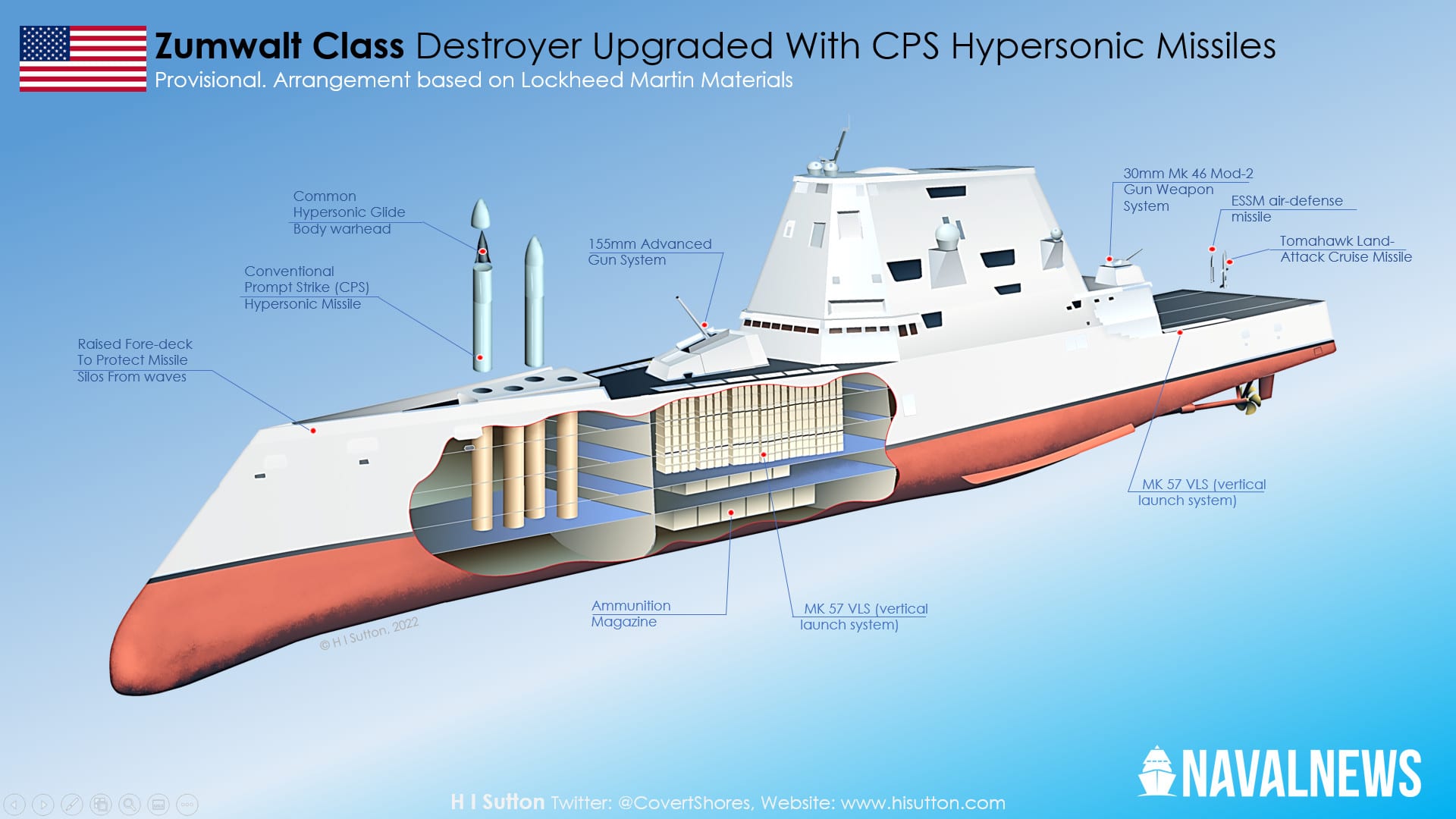
The service has determined that the hull can accommodate four 87-inch missile tubes that can each hold multiple missiles, Vice Adm. Johnny Wolfe the head of the Navy’s strategic systems programs, told reporters on Tuesday at the Naval Submarine League’s annual symposium.
“We’re talking about deploying this system on DDG-1000 in 2025, that’s three years from now.
We got to get on with getting all of the design for the Zumwalt, getting all of those tubes in there, as we pulled out the forward gun mounts. We’ve gotten to put these large diameter tubes in there, and then finish the integration work into the combat system.”
Vice Adm. Johnny Wolfe
USS Zumwalt (DDG-1000) is set to arrive at Ingalls Shipbuilding in Pascagoula, Miss., late next year to start a modernization period to install the missile tubes that will replace the two existing 155mm gun mounts on the 16,000-ton guided-missile destroyer, USNI News first reported in August.

USNI News understands the Navy has determined in previous studies that three Common Hypersonic Glide Bodies (C-HGB) and their boosters could fit in each 87-inch tube – or 12 missiles per Zumwalt.
USS Michael Monsoor (DDG-1001) will follow Zumwalt to Ingalls for its own modernization period that will include installing the missile tubes. It’s unclear if the third Zumwalt-class ship, Lyndon B. Johnson (DDG-1002) –currently at Ingalls – will also have the missiles installed as part of its combat systems activation period.
The inclusion of hypersonics on the ship followed a 2017 decision to make the three-ship Zumwalt class blue water combatants.
“Zumwalt gave us an opportunity to get [hypersonics] out faster and to be honest with you, I need a solid mission for Zumwalt,” Chief of Naval Operations Adm. Mike Gilday told USNI News during an interview earlier this year.
The weapon’s dimensions are common across the Navy and Army and have been developed as part of a joint program between both services.
“You need to have the same lethality no matter where you’re at. And that’s what this weapon does. It’s all the same with the lethality to get after all these targets. It just depends on who’s launching it, right, whether it’s the Army, from a [transporter erector launcher], or whether it’s a Zumwalt, or whether it’s a Virginia-class submarine,” Wolfe said.
The weapons are designed to fill the Pentagon’s longstanding prompt global strike mission that calls for the ability to launch a conventional strike almost anywhere in the world at ranges of thousands of miles.
The Pentagon over the last several years has accelerated its development of hypersonic weapons, or those traveling faster than five times the speed of sound. In 2018, the Defense Department tasked the Navy with developing a weapon for itself and the Army.
“On these high-end systems, it is no longer affordable for a single service to do that. We’re working with the [Office the Secretary of Defense], we’re working with the Army and with what our resource sponsor is doing to figure out how we build this capability once and get out to multiple platforms,” Wolfe said.
The Navy is pairing a glide body launched from a booster system to create an “all-up round” that would be in use by both services. In June, the first flight test proved the viability of the booster but the glide body didn’t hit the target.
Wolfe said the Navy found and corrected the flaw within two months.
While hypersonics are considered a conventional weapon, Wolfe is still overseeing the portfolio, which the Pentagon is treating as a strategic weapon, he told USNI News. Wolfe is also responsible for the Navy’s submarine-launched nuclear weapons.
“It’s strategic, but it’s not nuclear. If you look at the numbers, particularly with what we’re going to with the ranges, it is very much a strategic asset. You can hold very high-value targets at risk … and you can do that with all these various platforms,” Wolfe told USNI News.
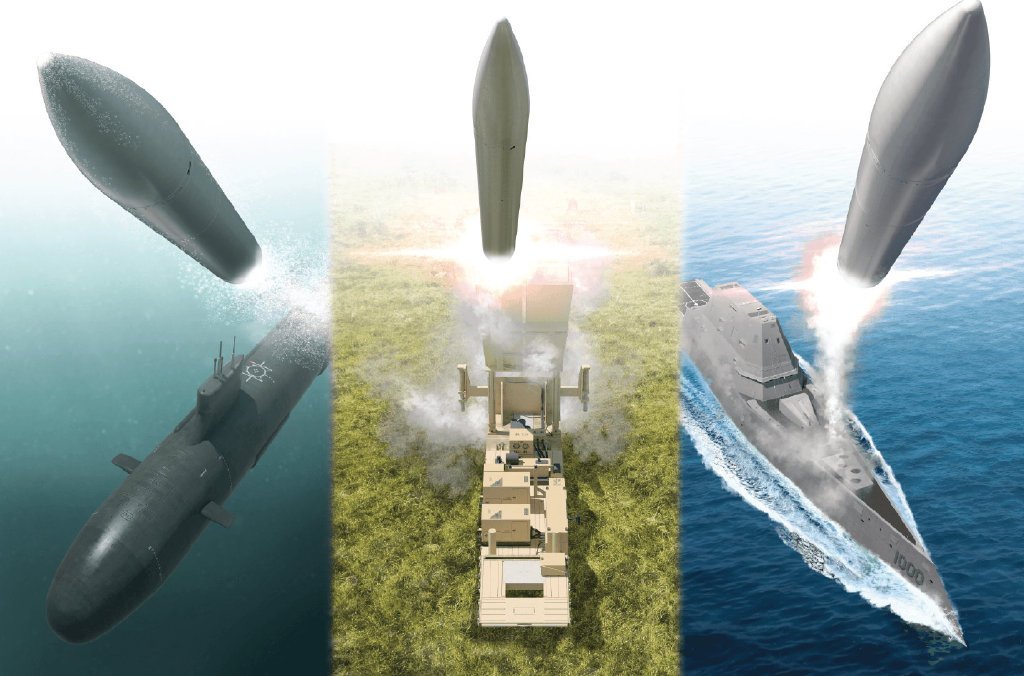
The Zumwalt destroyers will be the first Navy platform to field the missiles. The Army is set to get its first operational, truck-launched weapons next year. In 2029, the weapons will be deployed on the first attack submarine with the Virginia Payload Module that is currently under construction at General Dynamics Electric Boat and HII’s Newport News Shipbuilding.
The Navy is currently building a test facility to launch the new weapon underwater from a similar tube as those installed on the Zumwalt ships and the Virginia boats, Wolfe said.
“Our first challenge was: Can we develop an air launch? Basically pressurized air to get that weapon out of a Zumwalt, right up in the air, so it lights off and we don’t have all those hot gases [to deal with]. We’ve actually proven that we’ve done that testing … That’s the next challenge is build the underwater launch,” he said.
“We’re starting to build a facility to do underwater launch testing, so that we understand what that weapon will do, even before we get to the first Virginia.”
In terms of fielding the weapons, Wolfe said progress has been on track to meet the tight deadlines on the Navy platforms, but margins were thin.
“I think we’re on a pretty good path right now, but time is not our friend,” he said.
A version of this post originally appeared on USNI News. It’s been republished here with permission.