The Senegalese Navy announced on November 10, 2025, that it had reached a significant milestone in its operational development by successfully carrying out its first-ever anti-ship missile launch from one of its newest missile-equipped offshore patrol vessels (OPVs).
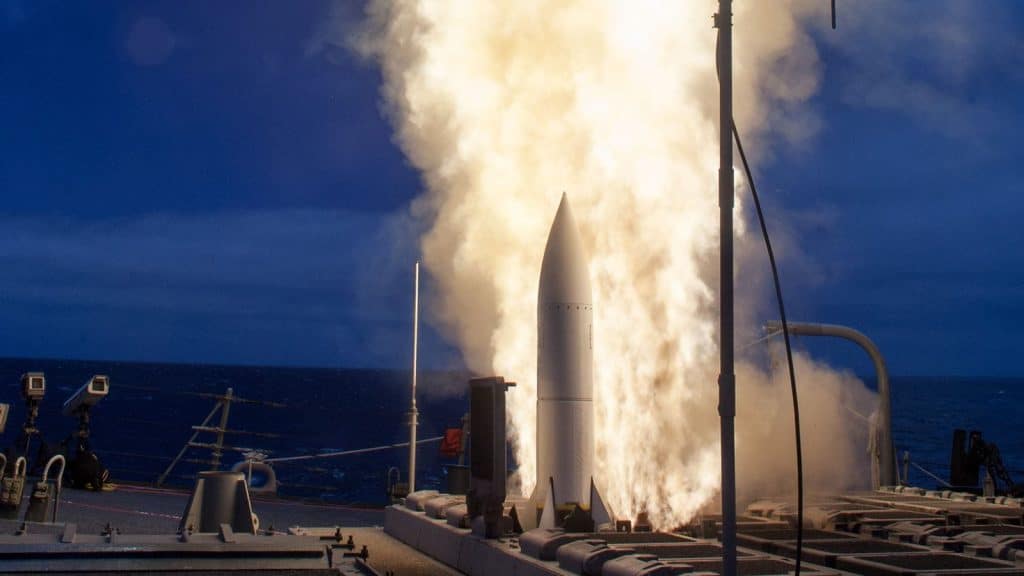
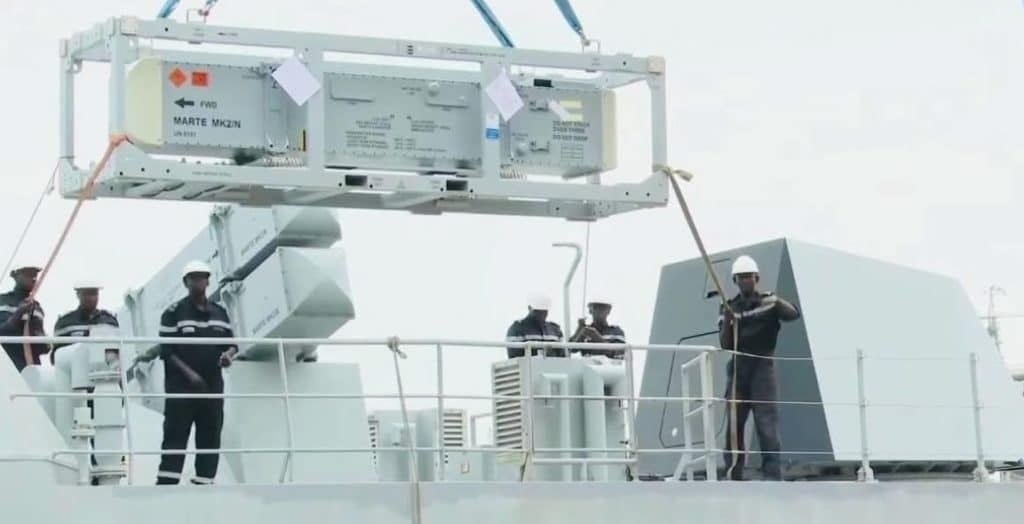
At around 10:00 a.m. on November 9, the Walo-class (OPV 58S) vessel Cayor fired an MBDA MARTE Mk2/N lightweight anti-ship missile at a decommissioned CTM-type landing craft located approximately 15km away. The target ship had been loaded with shipping containers to increase its radar cross-section and to mimic a high-value target. The missile’s live warhead struck the containers with precision, though the landing craft itself remained afloat after the impact. The test was revealed to the public the following day, during the Journée des Forces Armées (Armed Forces Day), by Radio Télévision Sénégalaise (RTS). The missile launch represents the first-ever anti-ship missile launch from a Senegalese naval unit.
Why the Missile Launch Matters
The Senegalese Navy has achieved a major milestone with the successful test launch of its first anti-ship missile, marking a significant boost to its maritime defense capabilities. The event underscores the Navy’s growing operational readiness and capabilities, and its commitment to safeguarding national sovereignty.The service highlighted the launch as an important step in its evolution, representing a major technological leap. This new capability notably strengthens Senegal’s ability to protect its extensive maritime territory and reinforces its role in regional security along the Atlantic coast.
“This achievement symbolizes the operational maturity of our Navy and its constant commitment to serving national sovereignty,” the Senegalese Navy wrote on X.
Rear Admiral Abdou Sène, Chief of Staff of the Senegalese Navy, stated in the RTS coverage that the event marks a historic moment, noting that the Navy has now joined the select group of navies capable of employing such complex and modern weapon systems in a fully sovereign manner. He further emphasized that every aspect of the process, from preparation and logistics to the security measures required to clear the area, was conducted independently. Moreover, he praised the professionalism of all personnel involved.
The missile launch test comes roughly two years after the commissioning of the first missile-armed naval vessel in the class, Walo, and one year after the third, and final, OPV 58S, Cayor, entered service. The test also aligns with Senegal’s broader naval modernization strategy, which aims to build a fully capable and modern maritime force. It may even represent an initial step toward the future acquisition of larger and more capable vessels with missiles of longer range, such as corvettes, in the years ahead.
Walo Class OPV of Senegalese Navy
The Walo-class OPVs, also known as the OPV 58S (marketed as OPV 60 by Kership), are a new-generation class of three patrol vessels, Walo, Niani, and Cayor, designed and built by Kership in Concarneau and Lorient, a joint venture between the French shipyards Piriou and Naval Group. The class is intended for a wide range of missions, including surveillance, identification, intervention, maritime rescue, anti-pollution operations, and the broader spectrum of law-enforcement duties. The three OPVs are the most heavily armed and technologically advanced ships in Senegal’s increasingly modern OPV fleet.
In addition to its deployment capability, including intervention RHIBs, it provides significant deterrence thanks to its anti-surface and anti-air weapon systems. Key innovations include a versatile mission-adaptive design, a large elevated panoramic bridge offering 360° visibility, a rapid launch and recovery system for two RHIBs via twin stern ramps, a C-Sharp hull optimized for endurance and seakeeping, and an advanced monitoring and combat management system.
Measuring 62.2m in length, 9.5m in beam and draught of 3m, the vessel features a steel hull with an aluminum superstructure. It can exceed 21 knots and has a maximum range of 4,500 nautical miles (21 days endurance) at 12 knots. Full-load displacement is approximately 650 tons. The ship carries a core crew of 24, with accommodation for an additional 24 personnel. Amidships, an open deck provides space for two 20-foot containers, allowing the vessel to carry a wide range of mission-tailored equipment.

The armament suite includes a Leonardo OTO 76/62 SR main gun; two twin MBDA MARTE Mk2/N SSM launchers located behind the main gun and forward of the bridge; two KNDS France NARWHAL 20mm RWS at the back of the bridge; a MBDA SIMBARD-RC twin MISTRAL 3 SAM launcher with anti-ship also capability; and several 12.7 mm heavy machine guns. The class represents Senegal’s first modern naval units equipped with a 76mm gun, as older vessels are armed only with 30mm or smaller caliber guns, and the first to carry both anti-ship and anti-air missiles.
The electronic suite includes a Terma SCANTER surveillance radar with integrated IFF, a Sperry Marine navigation radar, a Safran PASEO XLR electro-optical sensor and fire-control system, an additional EO sensor positioned aft of the mast, a CCTV system, a comprehensive communications suite, and the POLARIS combat management system provided by Naval Group