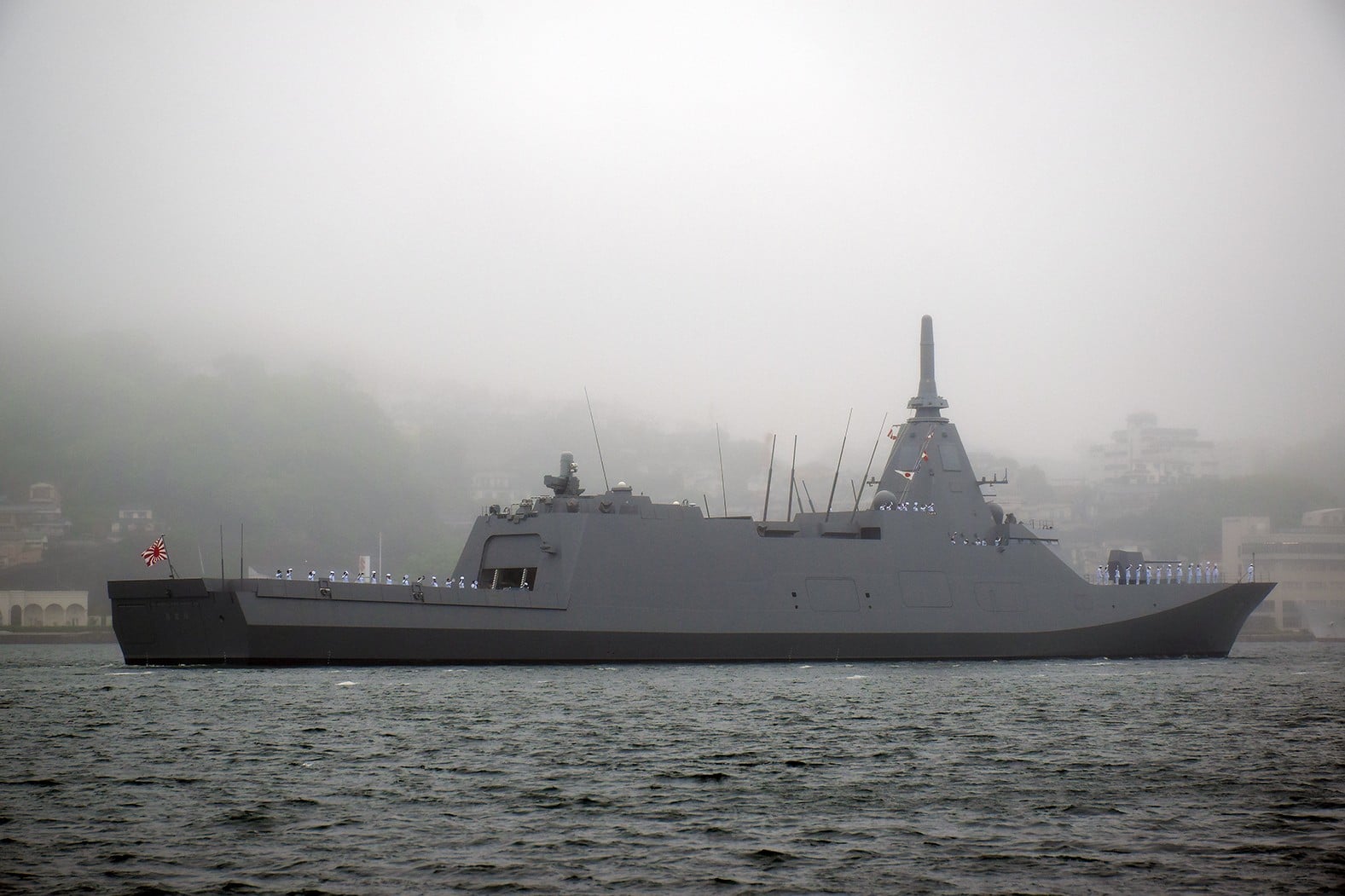
Japanese shipbuilder Mitsubishi Heavy Industries (MHI) held a delivery ceremony and a “self-defense ship flag raising ceremony” this week for the Natori (なとり). The event means the ship, the ninth Mogami-class FFM, was officially commissioned with the Japan Maritime Self-Defense Force (JMSDF).
The event comes amid growing international interest in Mogami-derived designs, following Australia’s selection of the upgraded Mogami-class design for its future naval program and amid ongoing interest from New Zealand and Indonesia.
JS Natori was inducted into Patrol and Defense Squadron 5 of the newly established Patrol and Defense Group at Ominato Naval Base in Aomori Prefecture.
Natori is the third Mogami-class frigate to enter service with the Mk 41 vertical launching system (VLS) installed from the outset, following JS Niyodo (seventh) and JS Yubetsu (eighth). The first six ships of the class are expected to receive the VLS at a later date.
The vessel is named after the Natori River (名取川, Natori-gawa), which flows through Miyagi Prefecture in northeastern Japan.
The vessel was laid down on 6 July 2023 and launched on 24 June 2024 under Japan’s fiscal year 2022 procurement plan. The Natori was built at a cost of about 51.4 billion yen ($323 million).

Automation-Centered Warship Design
The Mogami-class has attracted international attention for its heavy emphasis on automation and reduced manpower requirements.
While conventional JMSDF destroyers typically require crews of around 200 personnel, the Mogami-class operates with about 90 sailors. The reduction is enabled by an advanced Combat Information Center (CIC), which integrates radar, sonar, electronic warfare, and tactical data into a centralized real-time operational picture.
The CIC directs the engagement process against detected threats, from issuing attack orders to weapon launch. Compared with previous JMSDF destroyers, the Mogami-class features a significantly redesigned CIC architecture integrating not only combat management functions, but also anti-submarine warfare sonar operations and engineering control systems.
To enhance shared situational awareness, the CIC is surrounded by large-screen displays that allow operators to switch between sensor and tactical data in real time. A centralized command area at the center of the circular layout accommodates senior officers, including the commanding officer and officer of the watch.
The architecture reflects Japan’s broader shift toward Network-Centric Warfare — positioning each frigate as a command and data-sharing node within an integrated maritime combat network, and laying the groundwork for real-time coordination with UAVs, UUVs, and USVs as the class’s unmanned systems capabilities mature.
The bridge is also operated with a significantly reduced crew. According to JMSDF officers, only four personnel are normally assigned to bridge operations, compared with seven or eight aboard conventional destroyers.
Taken together, these design choices underscore Japan’s determination to sustain naval combat capability despite long-term demographic and recruitment challenges facing the Self-Defense Forces.
Specifications and Systems
As with other ships of the class, Natori features a stealth-oriented hull design intended to reduce radar cross-section.
Powered by a combined diesel and gas (CODAG) propulsion system consisting of two MAN 12V28/33D STC diesel engines and one Rolls-Royce MT30 gas turbine, the Mogami-class can achieve speeds exceeding 30 knots. It is the first JMSDF surface combatant class to adopt a CODAG configuration.
The ship is equipped with:
BAE Systems 5-inch (127 mm) Mk 45 Mod 4 naval gun ×1
Japan Steel Works 12.7 mm Remote Weapon System ×2
Mk.41 VLS (16 cells)
Raytheon SeaRAM ×1
Type 17 surface-to-ship missile launchers ×2
Mitsubishi Electric OPY-2 multifunction radar
Mitsubishi Electric OAX-3 EO/IR sensor
Hitachi OQQ-11 anti-mine sonar
NEC OQQ-25 anti-submarine sonar (VDS/TASS)
UUVs and USVs for mine countermeasures are planned to be installed at a later stage.

New FFM Program Moving Forward
Japan’s Ministry of Defense has already begun procurement of the larger and more capable upgraded Mogami-class frigate, known in Japan as 06FFM or New FFM, intended to succeed the current Mogami-class.
Compared with the existing frigates, the New FFM will feature a larger hull and significantly expanded missile capacity. The design is expected to carry 32 Mk.41 VLS cells — double the number installed aboard the current Mogami-class — alongside enhanced anti-air and anti-submarine warfare capabilities.
The new ships are also expected to field the Type 23 ship-to-air guided missile (A-SAM) and the upgraded ship-launched Type 12 surface-to-ship missile, a long-range stand-off weapon currently under development.
The first two New FFMs are scheduled to enter service in fiscal year 2028, with all 12 vessels expected to be commissioned by fiscal year 2032 if construction proceeds as planned.